
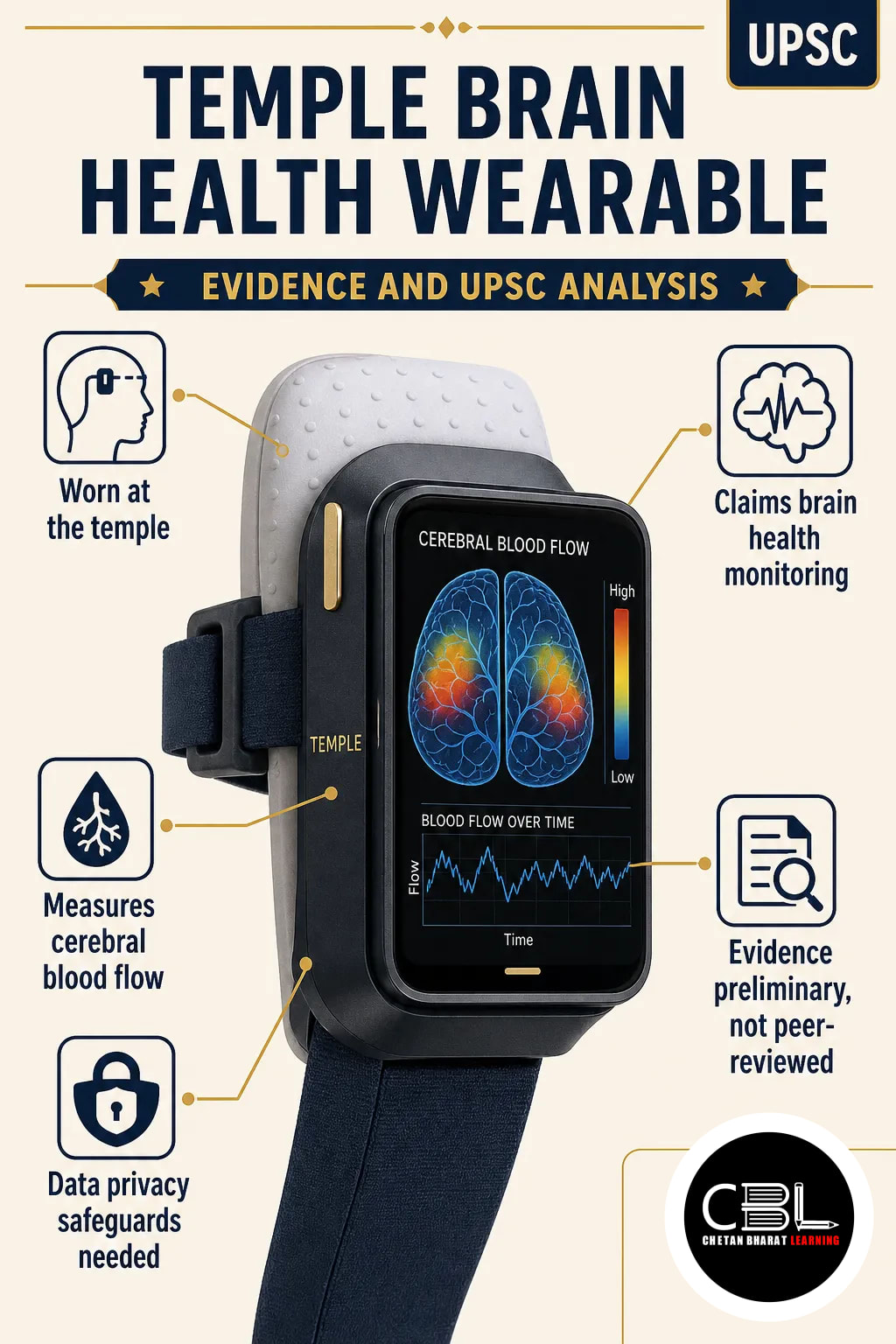

Temple brain health wearable has entered the market amid questions about its scientific claims. The debate connects health technology with evidence, consumer protection and data privacy.
Quick answer: Temple brain health wearable is a device worn at the temple and sold by entrepreneur Deepinder Goyal. It claims to monitor brain health and ageing by measuring cerebral blood flow outside a laboratory. However, doctors and critics question the core claims: the evidence is preliminary and has not undergone peer review.
What is the Temple brain health wearable?
Temple is a wearable attached at the side of the head that claims to track brain health and ageing. Its proposed measurement is cerebral blood flow, or blood flow to the brain, outside a laboratory.
Goyal, co-founder of Zomato and Blinkit, announced its commercial availability. However, availability for purchase does not establish that its measurements or health interpretations are clinically reliable.
Why is the device in the news?
The device has drawn scrutiny because its brain-health claims are being questioned by doctors and critics. The source describes the evidence as preliminary and not peer-reviewed.
Physician Cyriac Abby Philips, also known as LiverDoc, has publicly criticised the product. Goyal studied computer science and mathematics at the Indian Institute of Technology Delhi; however, the claims themselves must be assessed through evidence, rather than solely through the promoter’s qualifications.
What must the evidence establish?
Evidence must establish both whether the device measures its target accurately and whether its interpretation helps health decisions. These are related but distinct questions.
| Evidence question | What to examine |
|---|---|
| Measurement accuracy | How readings compare with an appropriate established reference method. |
| Repeatability | Whether repeated readings are consistent under comparable conditions. |
| Clinical validity | Whether a reading meaningfully relates to the health condition or ageing claim. |
| Clinical utility | Whether using the information improves decisions or outcomes. |
For example, even an accurate physiological measurement does not automatically establish a reliable measure of overall brain ageing. Researchers must test that interpretation separately.
Similarly, peer review allows independent experts to scrutinise methods and conclusions before publication. It does not guarantee correctness; nevertheless, transparent data and independent replication strengthen confidence.
Why do health wearable claims matter?
Health wearables can make monitoring more accessible, but their benefits depend on trustworthy measurements and interpretation.
- Convenience: Measurements outside a laboratory could make repeated observation easier. However, convenience alone cannot establish medical usefulness.
- Clinical decisions: A misleading reading may cause unnecessary anxiety or false reassurance. Therefore, users need to understand the limits of a device’s output.
- Consumer choice: Commercial claims influence purchasing decisions. Clear disclosure of supporting evidence and uncertainty helps consumers evaluate them.
- Health data: Personal readings can reveal sensitive information. Consequently, collection, storage and sharing require safeguards and meaningful user control.
The distinction between a promising finding and a validated health claim also matters in neurological research. For related context, see CBL’s coverage of the Parkinson’s gut bacteria study.
What are the concerns and the way forward?
The central concern is the gap between a commercial brain-health claim and independently assessed evidence. The available source does not establish that Temple can diagnose a condition or reliably measure brain ageing.
First, researchers should compare readings with suitable reference methods and publish detailed methods and results. Independent studies should then test reproducibility across relevant user groups and conditions.
Second, each specific claim should be tested against a meaningful clinical outcome. In addition, communications should distinguish exploratory wellness information from validated diagnostic or treatment guidance.
Finally, policymakers and producers should support proportionate oversight, transparent advertising and privacy safeguards. Users should seek qualified medical advice for health concerns rather than treating an unvalidated reading as a diagnosis.
Source: The Hindu, 10 November 2026
State PCS General Studies can examine health technology, evidence-based public health and consumer protection through this example. In addition, candidates can discuss privacy safeguards when state health services consider digital tools.
Prelims Practice Corner
Mains Practice Questions
Frequently Asked Questions
What does the Temple wearable claim to measure?
Cerebral blood flow, according to its brain-health monitoring claim. It is worn at the temple and is intended for use outside a laboratory.
Is Temple’s brain-health claim peer-reviewed?
No; the source describes the evidence as preliminary and not peer-reviewed. Therefore, the core claims require further independent scrutiny.
Can a cerebral blood flow reading alone establish brain age?
No; a measurement alone does not establish a reliable measure of overall brain ageing. Researchers must separately validate any interpretation linking a reading to ageing.
Related Current Affairs
Preparing for UPSC, PCS or HCS?
Talk to a mentor at Chetan Bharat Learning, Chandigarh. Free guidance on choosing the right exam and building a study plan.
Chat on WhatsAppCall 97793 53345UPSC / IAS / PCS coaching in Chandigarh · Trusted by aspirants across Punjab & Haryana

 Ananya RanaIAS · AIR 60
 Aditya SharmaIAS · AIR 70
 Ria Kaur SethiIPS · AIR 89
 Aman AloonIRS · AIR 295
 Sumer Singh VirkIRS · AIR 335
 Shivani PanchalIAS

Leave a Reply
You must be logged in to post a comment.