
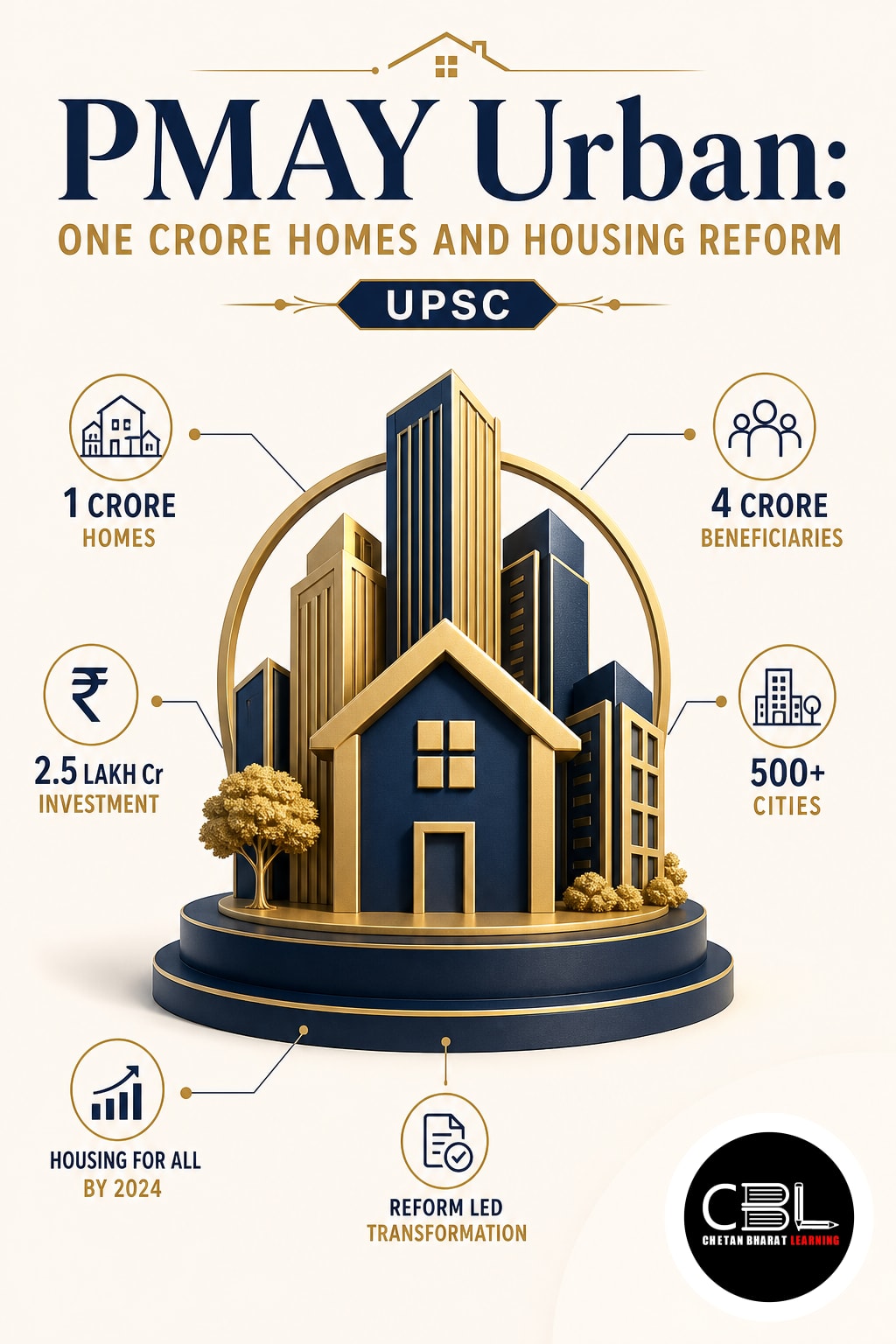
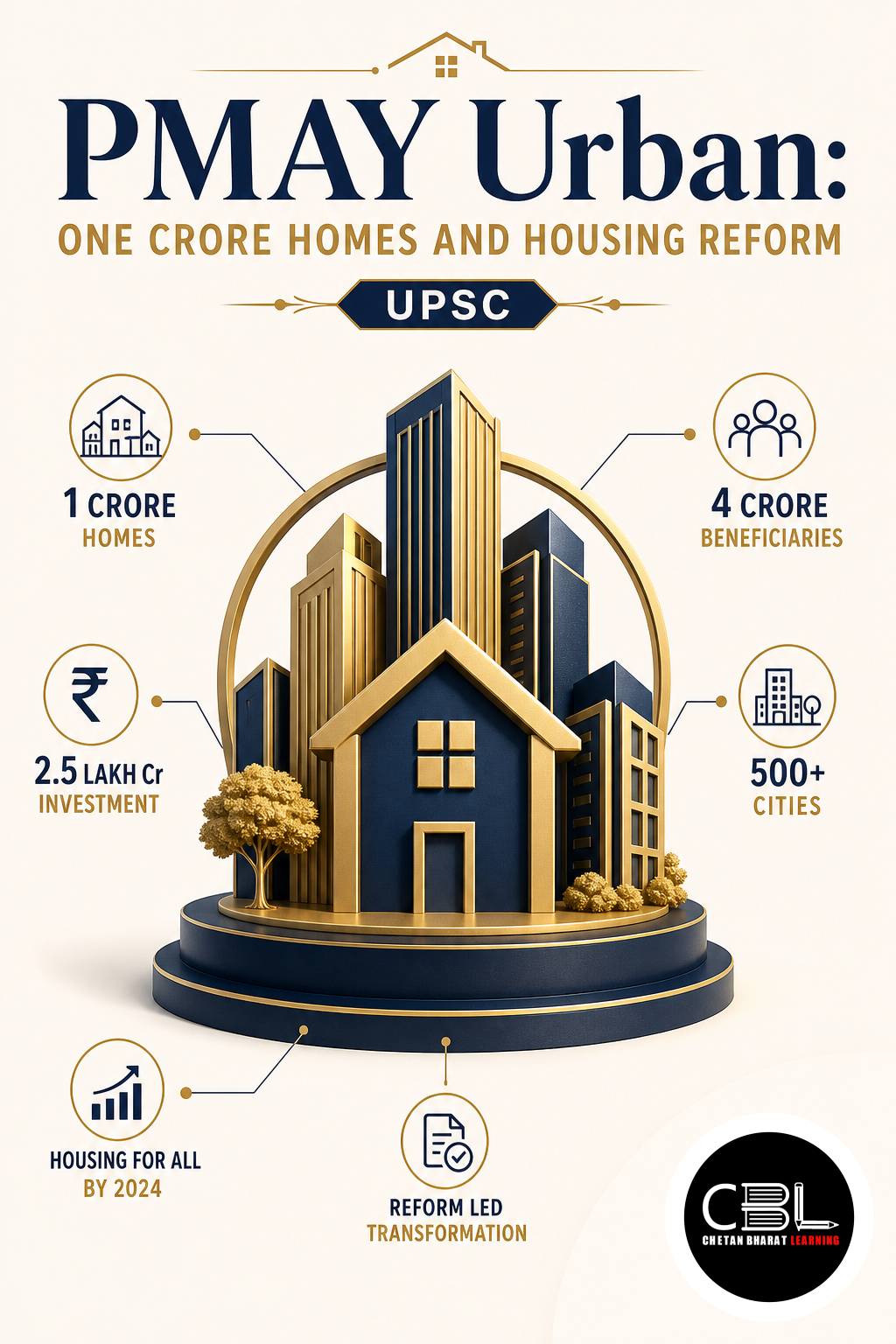
PMAY Urban has delivered more than one crore pucca houses to beneficiaries across Indian cities. Its second phase expands support for eligible urban poor and middle-class households between 2024 and 2029. The programme connects affordable housing, women’s empowerment and inclusive urbanisation, making it important for aspirants following the daily current affairs archive.
UPSC Mapping
| Prelims | Ministry, Beneficiaries, Funding and Implementation Verticals |
|---|---|
| Mains | GS Paper II — Welfare Schemes and Urban Governance |
Quick Facts
| Launch | 25 June 2015 |
|---|---|
| Ministry | Ministry of Housing and Urban Affairs |
| Second Phase | 2024–2029 |
| Phase-II Target | One crore additional families |
| Maximum Assistance | Up to ₹2.50 lakh per eligible unit |
| Phase-II Verticals | BLC, AHP, ARH and ISS |
What is PMAY Urban?
PMAY Urban is the Union government’s flagship mission for addressing housing shortages among eligible urban households. The Ministry of Housing and Urban Affairs launched it in 2015 to support all-weather pucca houses with essential civic amenities. Its beneficiaries include economically weaker sections, lower-income groups and eligible middle-income families without a pucca house.
The mission provides central assistance through states, Union Territories, urban local bodies, lending institutions and approved housing agencies. It promotes cooperative federalism because states assess demand, approve projects and supervise implementation within national guidelines. Houses generally require ownership by an adult female member or joint ownership by spouses, strengthening women’s economic security.
Why is PMAY Urban in News?
PMAY Urban entered the news after the government reported that PMAY-U and its second phase had delivered over one crore completed houses. Around 1.25 crore houses had received sanction across the programme, representing a major expansion of formal housing assistance. A large share of sanctioned homes carries female or joint ownership.
The progress also highlights the programme’s transition from the original mission to PMAY-U 2.0. The new phase aims to assist another one crore families during 2024–2029 through ownership and rental options. Applicants can access guidelines, application facilities and implementation updates through the official urban housing mission portal.
Key Features
The second phase offers four implementation pathways reflecting differences in land ownership, income and housing requirements.
- Beneficiary-Led Construction: Eligible EWS households possessing land receive financial support to construct a new house or improve an existing dwelling according to approved standards.
- Affordable Housing in Partnership: States, public agencies and private developers create housing projects for beneficiaries who lack suitable land or independent construction capacity.
- Affordable Rental Housing: Public and private entities develop or manage rental homes for migrants, workers, students, working women and other groups needing flexible accommodation.
- Interest Subsidy Scheme: Eligible EWS, LIG and MIG households can receive a four-per-cent subsidy on the specified portion of qualifying home loans, subject to loan and property-value limits.
- Technology and digital monitoring: Geo-tagging, online application systems, direct transfers and green construction technologies improve tracking, transparency and disaster resilience across housing projects.
Challenges
Housing delivery requires more than construction because beneficiaries also need secure tenure, services, transport and livelihood access.
- Land availability: High land prices, unclear titles and limited public land make affordable projects difficult in expanding cities where housing demand remains concentrated.
- Beneficiary contribution: Low-income families may struggle to provide their required contribution or obtain formal credit despite receiving government assistance and interest support.
- Project delays: Approval gaps, contractor capacity, material costs and coordination failures can postpone construction and leave sanctioned units incomplete for extended periods.
- Peripheral locations: Houses built far from employment, schools, healthcare and public transport may remain vacant or impose high commuting expenses on beneficiary families.
- Service convergence: Urban local bodies must connect completed houses with water, sanitation, electricity and social protection schemes discussed in wider governance and welfare coverage.
Way Forward
Future PMAY Urban implementation should prioritise habitable neighbourhoods instead of treating completed structures as the only measure of success. Cities need serviced land, reliable transport and infrastructure planning before approving large housing projects. Authorities should publish timely information on completion, occupation, service delivery and beneficiary satisfaction.
Rental housing should expand for migrant workers and households unable to purchase homes. Municipalities also need professional planning capacity, transparent beneficiary verification and faster grievance redressal. Coordination with the Ministry of Housing and Urban Affairs can support green construction, climate resilience and convergence with sanitation, livelihood and health programmes.
Prelims Practice Corner
Q1. Which Union ministry administers the Pradhan Mantri Awas Yojana–Urban?
- (a) Ministry of Rural Development (b) Ministry of Housing and Urban Affairs (c) Ministry of Social Justice and Empowerment (d) Ministry of Panchayati Raj
Answer: (b) The Ministry of Housing and Urban Affairs implements the urban housing mission.
Q2. Which vertical primarily assists eligible EWS families who possess land for constructing their own houses?
- (a) Beneficiary-Led Construction (b) Affordable Rental Housing (c) Interest Subsidy Scheme (d) Smart Cities Mission
Answer: (a) Beneficiary-Led Construction supports eligible families undertaking independent house construction or enhancement.
Q3. Affordable Rental Housing under PMAY-U 2.0 is particularly relevant for:
- (a) Urban migrants and workers (b) Owners of luxury hotels (c) Export-oriented mining companies (d) Foreign diplomatic missions
Answer: (a) The vertical provides flexible and affordable accommodation for migrants and other eligible urban groups.
Q4. Consider the following statements regarding the scheme: 1. Female or joint ownership is promoted for supported houses. 2. Geo-tagging helps monitor construction progress. Which statements are correct?
- (a) 1 only (b) 2 only (c) Both 1 and 2 (d) Neither 1 nor 2
Answer: (c) Women’s ownership and technology-based construction monitoring are important programme features.
Q5. PMAY-U 2.0 is scheduled for which implementation period?
- (a) 2015–2020 (b) 2019–2024 (c) 2024–2029 (d) 2026–2036
Answer: (c) The second phase covers five years from 2024 to 2029.
Mains Practice Questions
Q1. Affordable urban housing policy must focus on liveable neighbourhoods rather than merely constructing dwelling units. Discuss. (15 marks)
Answer Structure
- Intro: Connect secure housing with dignity, health and inclusive urban development.
- Body: Discuss land, finance, transport, livelihood access, water, sanitation, occupancy and municipal planning capacity.
- Conclusion: Recommend integrated housing and infrastructure planning with measurable quality outcomes.
Q2. Examine the contribution of PMAY-U 2.0 to women’s empowerment and cooperative federalism in India. (15 marks)
Answer Structure
- Intro: Introduce the mission’s housing objective and women-focused ownership provision.
- Body: Cover asset ownership, household security, Centre-state funding, project approval, local implementation and digital monitoring.
- Conclusion: Link effective federal coordination with dignified and gender-responsive urbanisation.
FAQs on PMAY Urban
- Who can receive assistance under PMAY Urban?
- Eligible EWS, LIG and MIG families without a pucca house can seek support under the applicable vertical. Income, property and previous housing-benefit conditions also apply.
- What are the four verticals of PMAY-U 2.0?
- They are Beneficiary-Led Construction, Affordable Housing in Partnership, Affordable Rental Housing and the Interest Subsidy Scheme. Each addresses a different housing or financing need.
- Why does the scheme promote women’s ownership?
- Ownership gives women a valuable household asset and can improve their economic security and decision-making position. The house is generally registered to an adult female member or jointly by spouses.
Related Current Affairs
Preparing for UPSC, PCS or HCS?
Talk to a mentor at Chetan Bharat Learning, Chandigarh. Free guidance on choosing the right exam and building a study plan.
Chat on WhatsAppCall 97793 53345UPSC / IAS / PCS coaching in Chandigarh · Trusted by aspirants across Punjab & Haryana
Leave a Reply
You must be logged in to post a comment.