
The barrier-less tolling system will reshape fee plazas on new national highways, under guidelines issued by the National Highways Authority of India (NHAI). The reform links road design with digital collection, a key topic in infrastructure and the economy.
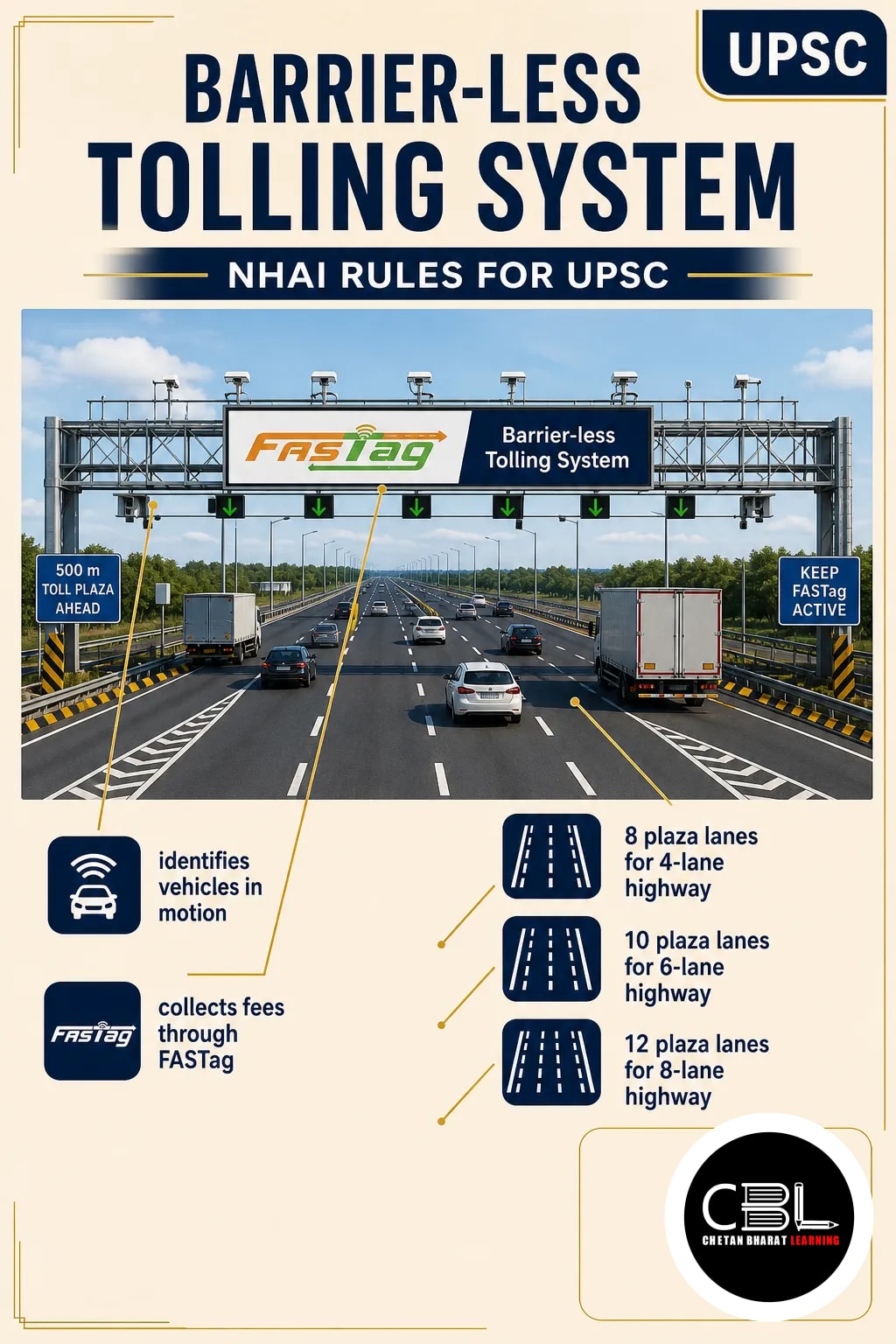
Quick answer: NHAI has standardised the barrier-less tolling system for newly built or under-construction national highways. The multi-lane free flow system identifies moving vehicles and collects applicable fees through FASTag. Its layouts prescribe 8, 10 and 12 plaza lanes for 4, 6 and 8-lane highways respectively, including emergency spares.
What is the barrier-less tolling system?
It is a multi-lane free flow (MLFF) arrangement that identifies vehicles and collects applicable user fees without requiring a stop at the plaza. NHAI expects this approach to reduce congestion and the number of fee plaza lanes needed on new highways.
Unlike a conventional boom-barrier layout, MLFF uses equipment mounted on overhead structures called gantries. However, barrier-less collection does not eliminate the need for a designed plaza area, spare lanes or road-user guidance.
For the broader operation of electronic collection, see CBL’s guide to the MLFF toll system and highway operations.
Why are the new NHAI guidelines significant?
NHAI has standardised MLFF layouts for the first time, fixing plaza lanes for three highway configurations. The prescribed totals include spare lanes for emergencies.
| Highway width | Fee plaza lanes under new layout |
|---|---|
| 4 lanes | 8 lanes |
| 6 lanes | 10 lanes |
| 8 lanes | 12 lanes |
In contrast, the 2021 guidelines prescribed minimums of six, eight and 12 toll lanes for two, four and six-lane highways respectively. The new layout fixes numbers rather than specifying minimums for the configurations covered.
Existing plazas illustrate the older design approach. For example, Delhi’s four-lane Urban Extension Road-II has more than 20 plaza lanes, while the eight-lane Dwarka Expressway has 32. These examples show why officials expect smaller layouts; they do not establish a measured saving.
How will vehicles be identified and charged?
Gantry-mounted equipment will identify moving vehicles and deduct the applicable fee through FASTag. The system combines radio-frequency identification (RFID) readers with an automatic number plate recognition (ANPR) camera system.
- Pay-axis gantry: Each toll lane at this gantry is to be 3.5 metres wide, providing lateral clearance and supporting equipment readings.
- Backup gantry: An MLFF gantry will operate as a backup after the pay-axis gantry, on either side of the carriageway.
- Invalid FASTag: For vehicles without a valid and functional tag, the system will generate an e-notice under Rule 14 of the National Highways Fee (Determination of Rates and Collection) Rules, 2008.
- Road-user guidance: Advance signs will indicate the plaza ahead. In addition, high-mast lighting will support night-time safety and equipment performance.
The source does not specify a new toll for two-wheelers or their treatment under these guidelines. Therefore, the layout change alone should not be read as a decision to charge them.
What are the benefits and governance concerns?
The main expected benefit is smoother movement, because vehicles need not stop for fee payment. Consequently, a standardised layout can reduce dependence on large plaza footprints designed for peak-hour queues.
There are also implementation trade-offs. For example, reliable collection depends on equipment capturing vehicles correctly while they move. Inadequate lighting, damaged plates or reader failures could undermine identification; the guidelines accordingly provide for lighting and a backup gantry.
Accuracy and accountability matter when an automated system generates notices. A mistaken identification or deduction can burden a road user, so operators need accessible correction and grievance processes. These are policy considerations, not additional measures confirmed in the source.
Data protection and safety are further concerns. Plate recognition and transaction records require appropriate safeguards against misuse. Meanwhile, advance signs, illumination and emergency capacity remain important because uninterrupted payment does not remove other road hazards.
What should implementation prioritise?
Implementation should combine reliable detection with clear remedies for errors and safe plaza operation. First, operators should test readers, cameras and backup equipment under different traffic and lighting conditions.
Second, accessible notice and dispute channels can help users correct incorrect identification or deductions. In addition, transparent handling of vehicle data can strengthen accountability. Finally, monitoring congestion and equipment performance can help authorities assess whether the new layouts deliver their intended benefits.
Source: Indian Express Business, 31 October 2026
- MLFF Toll System: Highway Tolling for UPSC (31 Oct 2026)
Asked in UPSC: Previous Year Questions
- UPSC CSE Mains 2024 (GS Paper III): What technology supports electronic highway tolling? Discuss its advantages, limitations, proposed seamless changes and potential hazards of the transition.
UPSC links tolling technology with its benefits and risks, so prepare both design details and governance safeguards.
Punjab PCS and Haryana HCS may test the technology and layout of national highway toll plazas in General Studies. In addition, candidates can connect automated collection with road safety, public grievances and infrastructure governance.
Prelims Practice Corner
Mains Practice Questions
Frequently Asked Questions
How many toll lanes are prescribed for an eight-lane highway?
Twelve plaza lanes are prescribed, including spare lanes for emergencies. In addition, the guidelines fix totals for four and six-lane highways.
Does MLFF require vehicles to stop at a toll plaza?
No, because the system identifies vehicles in motion and collects applicable fees through FASTag. It also uses gantry-mounted readers and number plate cameras.
Do the reported guidelines introduce a toll on two-wheelers?
The source does not specify any new two-wheeler toll. Therefore, the revised plaza layout should not be treated as evidence of one.
What happens if a FASTag is not valid or functional?
The system will generate an e-notice under Rule 14 of the 2008 national highway fee rules. The guidelines apply this provision to vehicles without a valid and functional FASTag.
Related Current Affairs
Preparing for UPSC, PCS or HCS?
Talk to a mentor at Chetan Bharat Learning, Chandigarh. Free guidance on choosing the right exam and building a study plan.
Chat on WhatsAppCall 97793 53345UPSC / IAS / PCS coaching in Chandigarh · Trusted by aspirants across Punjab & Haryana

 Ananya RanaIAS · AIR 60
 Aditya SharmaIAS · AIR 70
 Ria Kaur SethiIPS · AIR 89
 Aman AloonIRS · AIR 295
 Sumer Singh VirkIRS · AIR 335
 Shivani PanchalIAS

Leave a Reply
You must be logged in to post a comment.