
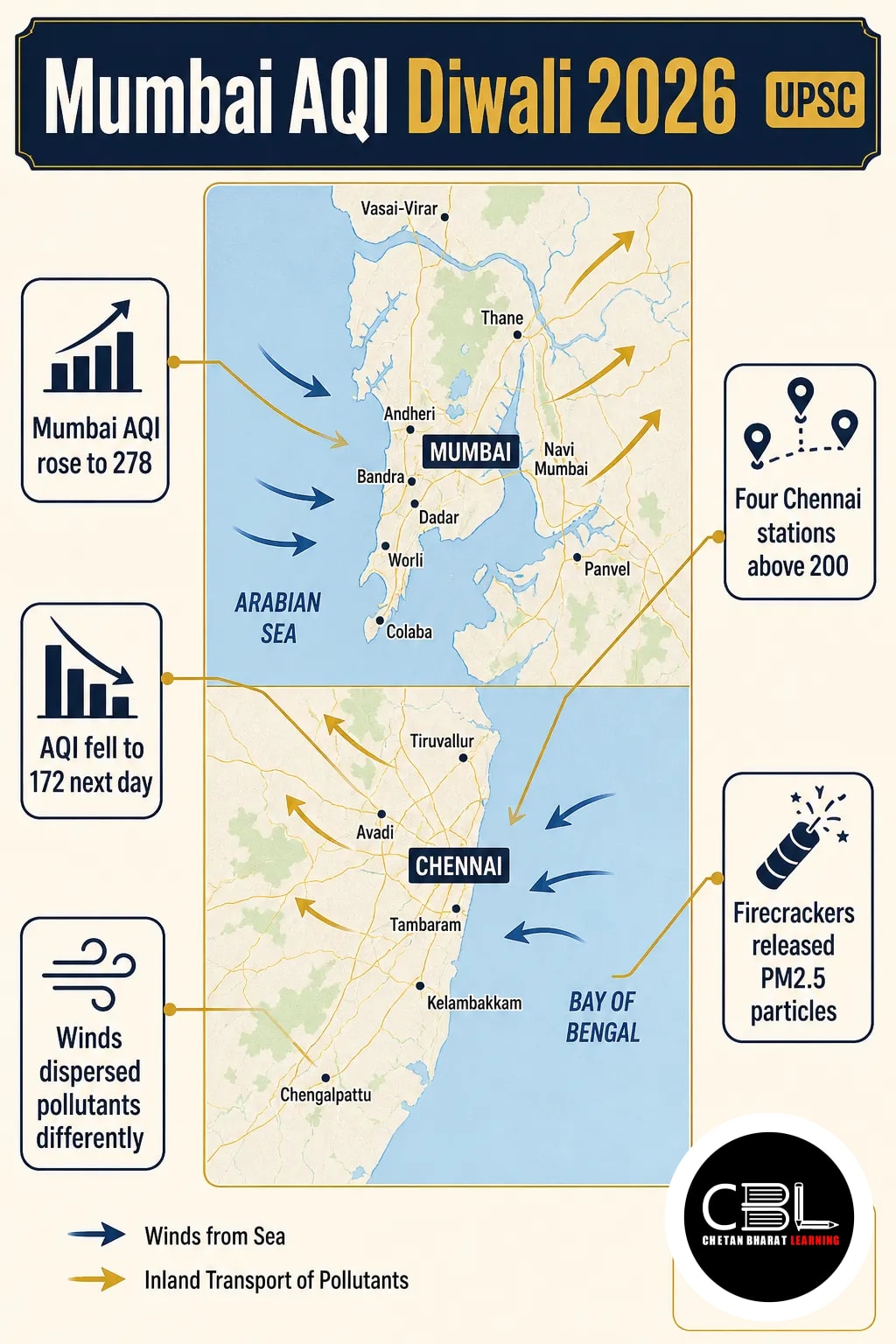

Mumbai AQI Diwali 2026 highlights how weather can shape the effects of festival emissions. The contrast with Chennai also offers a case study for environment and geography preparation.
Quick answer: Mumbai AQI Diwali 2026 rose from 131 to 278 on Diwali, then stood at 172 the following day. Chennai had poor air on Monday morning, with four of seven operational stations above 200. Different wind patterns helped disperse Mumbai’s pollutants while adding to Chennai’s pollution load.
Where are the cities and what did their readings show?
Mumbai faces the Arabian Sea, while Chennai faces the Bay of Bengal. Their different coastlines affect whether a given wind arrives from land or sea.
| Location or indicator | Key fact |
|---|---|
| Mumbai | Arabian Sea to the west; surrounded by sea on three sides |
| Chennai | South-eastern coast; Bay of Bengal to the east |
| Mumbai after Diwali | Air Quality Index (AQI) of 172, in the moderate category |
| Chennai on Monday morning | Poor air; four of seven operational stations recorded readings above 200 |
The Mumbai AQI Diwali 2026 readings cover different points in time: 278 on the festival day and 172 the next day. Also, Chennai’s four readings are station-level observations, not a citywide average.
Why did winds affect Mumbai and Chennai differently?
Wind direction and speed changed how each city’s air dispersed or accumulated pollutants. Firecrackers released PM2.5 in both cities: particles measuring 2.5 micrometres or less.
Mumbai: dispersal across the coast
Mumbai’s land and sea breezes can reverse direction and disperse pollutants near the surface. In addition, easterly winds from the mainland towards the sea helped disperse suspended pollutants and reduce temperatures.
The source links these easterlies to an anticyclonic circulation over the Himalayas. Professor Gufran Baig of the National Institute of Advanced Studies said sea winds gained speed and changed direction over 48 hours, helping control airborne pollutants. For the city comparison, see CBL’s Diwali air quality explainer.
Chennai: pollution carried from inland
Chennai was receiving strong northerly winds from inland Andhra Pradesh and northern Tamil Nadu. Consequently, pollutants from industrial and urban centres added to suspended firecracker emissions.
By contrast, easterlies would reach Chennai from the Bay of Bengal. Experts expected these winds to bring cleaner air and aid dispersal, but the source described this as an expectation, not an observed outcome.
Why did inland Maharashtra face poorer air?
Inland cities lacked the same coastal ventilation and also faced industrial and festival emissions. The source recorded 13 Maharashtra cities in the poor or very poor categories a day after Diwali.
These included Pune, Pimpri Chinchwad, Nagpur, Jalna, Nashik and Chandrapur. Moreover, the source associates deficient rainfall and sustained heat since October with disrupted wind reversal and longer pollutant retention.
Emission sources differ across the region. For example, Pune and Pimpri Chinchwad have automobile, pharmaceutical and heavy engineering industries; Chandrapur has thermal power plants and mining. Therefore, a single city-specific measure cannot address every source.
What does the episode reveal about urban air pollution?
The episode shows that pollution exposure depends on emissions as well as atmospheric conditions. A favourable wind can lower concentrations without eliminating the sources that produce pollution.
- Health exposure: Fine particles can enter the respiratory system; therefore, short pollution peaks matter alongside longer-term exposure.
- Regional transport: Winds can carry pollution across administrative boundaries. Thus, municipal action alone may not address an upwind source.
- Uneven exposure: Station readings can differ within a city; consequently, a citywide figure may not reflect every neighbourhood.
- Governance challenge: Festivals create short-lived emission peaks, while industry and other urban activities add continuing pressures. Hence, responses need both immediate and sustained measures.
The Delhi air pollution case offers another urban context for comparing air-quality challenges. However, local meteorology and sources must be assessed separately.
How should cities respond to pollution peaks?
Cities need to cut emissions at source while using weather forecasts to prepare for pollution episodes. Cleaner winds can provide temporary relief, but they are not a substitute for prevention.
- Monitor and communicate: Publish station-level readings and explain their timing. Also, issue clear health advisories when pollution rises.
- Control festival emissions: Enforce applicable firecracker restrictions and encourage lower-emission celebrations. For legal context, review the Supreme Court green firecrackers discussion.
- Address continuing sources: Strengthen industrial emission checks and reduce pollution from transport and dust. In addition, tailor enforcement to each city’s source profile.
- Coordinate regionally: State agencies and local bodies should share monitoring and forecast information. Thus, they can plan for pollution transported across jurisdictions.
Ultimately, the Mumbai AQI Diwali 2026 episode supports an airshed approach: manage pollution across the area where emissions and winds interact. Alongside emergency action, consistent source control can reduce dependence on favourable weather.
Source: The Indian Express, 10 November 2026
- Diwali Air Quality: Mumbai vs Chennai for UPSC (10 Nov 2026)
Asked in UPSC: Previous Year Questions
- UPSC CSE Prelims 2018 (GS Paper I): How is the National Green Tribunal different from the Central Pollution Control Board in their establishment and functions?
UPSC also tests pollution governance through the mandates and legal origins of environmental institutions.
Punjab PCS and Haryana HCS may test how winds transport pollutants across state boundaries. Candidates should also examine the roles of state pollution control boards and local bodies in monitoring and enforcement.
Prelims Practice Corner
Mains Practice Questions
Frequently Asked Questions
What was Mumbai’s AQI after Diwali in 2026?
Mumbai recorded an AQI of 172 the day after Diwali. Earlier, its reading had risen from 131 to 278 on the festival day.
Why was Chennai’s air poorer than Mumbai’s?
Different wind patterns played a major role. In Chennai, northerly winds carried inland pollutants that added to firecracker emissions.
What is PM2.5?
PM2.5 refers to particles measuring 2.5 micrometres or less. For example, firecrackers released these fine particles in both cities.
Related Current Affairs
Preparing for UPSC, PCS or HCS?
Talk to a mentor at Chetan Bharat Learning, Chandigarh. Free guidance on choosing the right exam and building a study plan.
Chat on WhatsAppCall 97793 53345UPSC / IAS / PCS coaching in Chandigarh · Trusted by aspirants across Punjab & Haryana

 Ananya RanaIAS · AIR 60
 Aditya SharmaIAS · AIR 70
 Ria Kaur SethiIPS · AIR 89
 Aman AloonIRS · AIR 295
 Sumer Singh VirkIRS · AIR 335
 Shivani PanchalIAS

Leave a Reply
You must be logged in to post a comment.