
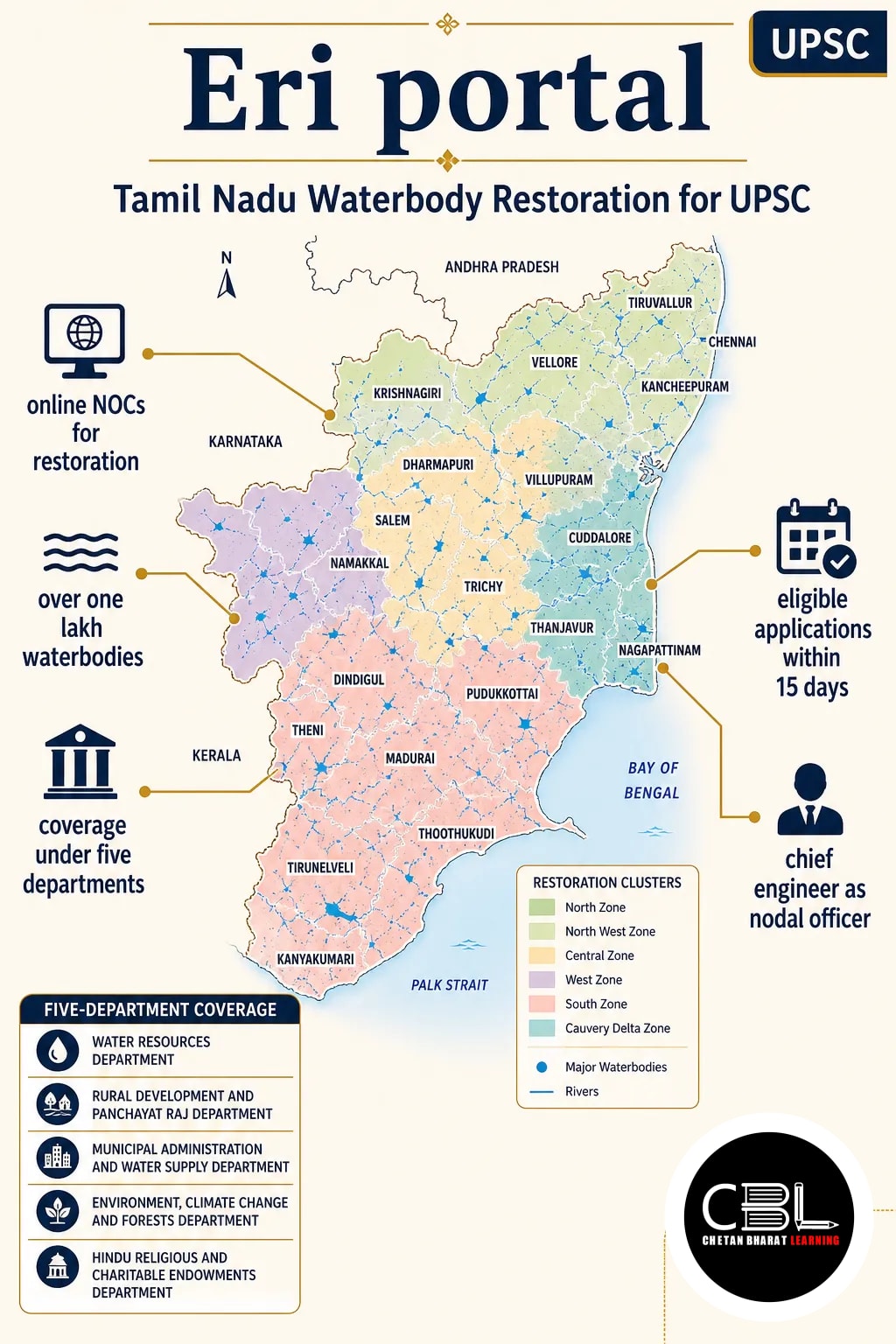
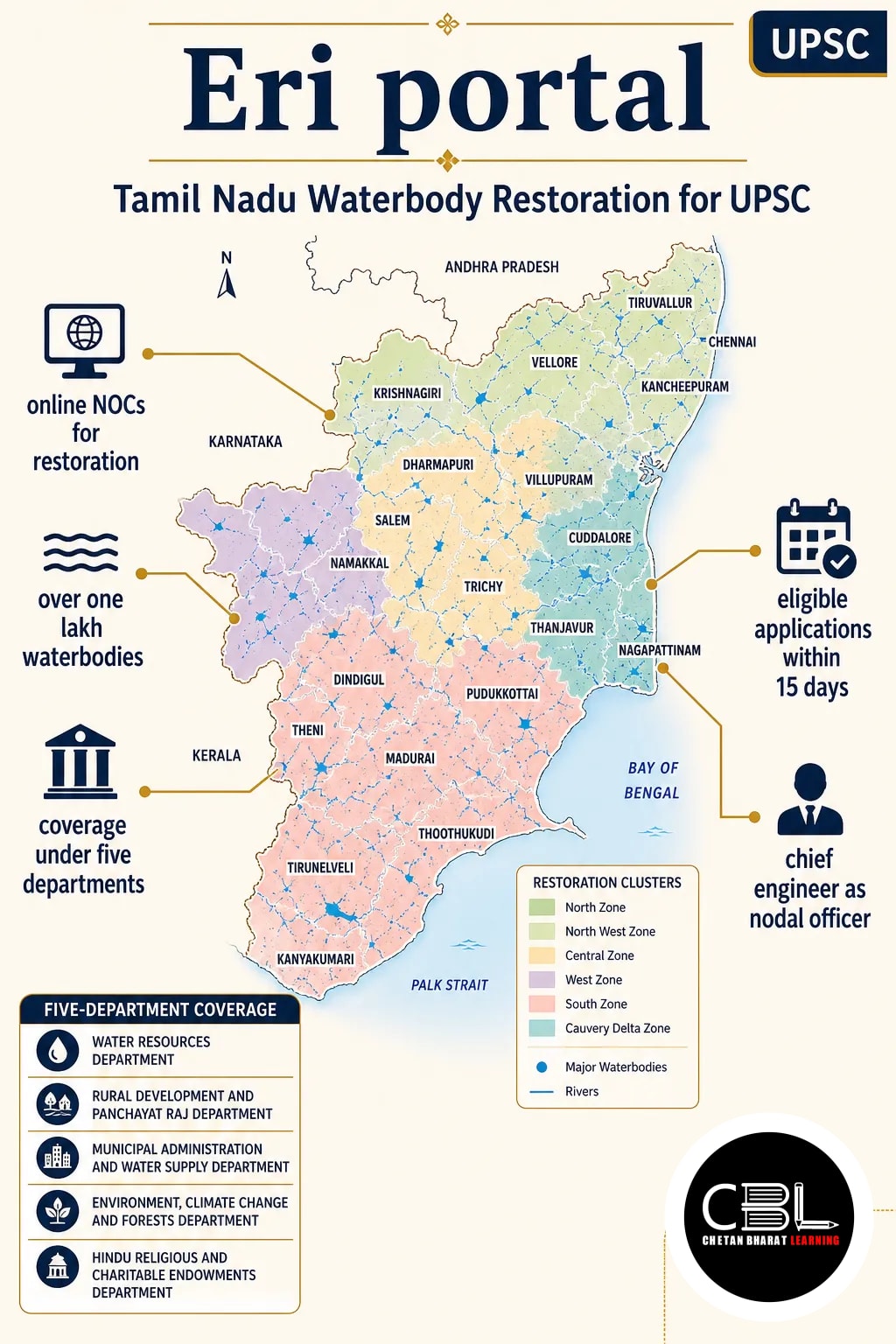
The Eri portal gives organisations an online route to seek permission for restoring Tamil Nadu’s waterbodies. Its launch connects water conservation with digital governance and community participation.
Quick answer: Tamil Nadu Chief Minister C. Joseph Vijay launched the Eri portal in Chennai on 10 November 2026. Developed by the Water Resources Department, it enables online applications for no-objection certificates for waterbody restoration. It covers over one lakh waterbodies under five departments and targets decisions on eligible applications within 15 days.
What is the Eri portal?
The Eri portal is Tamil Nadu’s online platform for seeking no-objection certificates (NOCs) for waterbody restoration. The Water Resources Department developed it for non-governmental organisations (NGOs) and volunteers.
It brings information on waterbodies controlled by five government departments onto one platform. Therefore, applicants can use an online process instead of submitting applications in person. The portal concerns permission for works; an application does not by itself authorise restoration.
| Feature | Details |
|---|---|
| Developing department | Tamil Nadu Water Resources Department |
| Potential applicants | NGOs and volunteers seeking restoration permissions |
| Works | Desilting, bund strengthening and other permitted minor improvements |
| Nodal officer | Chief Engineer and Director of the State Water Resources Management Agency |
Why was the portal launched?
The portal responds to difficulties in obtaining NOCs from multiple departments for restoration projects. NGOs and volunteers raised these procedural problems, particularly for projects using corporate social responsibility (CSR) funding.
At the Secretariat in Chennai, the Chief Minister also distributed NOCs to organisations including Siruthuli, Environmental Foundation of India, Exnora International Foundation, Mega Foundation and Dhan Foundation. Thus, the launch combined a new application channel with permissions for identified organisations.
The government aims to issue NOCs for eligible applications within 15 days. However, this is a stated target, not evidence that every application will receive approval or meet the deadline.
How will scrutiny and coordination work?
The designated nodal officer will oversee scrutiny, monitor approvals and coordinate with departments. This officer is the Chief Engineer and Director of the State Water Resources Management Agency (SWaRMA).
In principle, a single platform can reduce the burden of navigating separate offices. Nevertheless, technical scrutiny and coordination remain necessary because different departments control the listed waterbodies. The source does not specify separate departmental workflows or an appeal mechanism.
Why does waterbody restoration matter?
Well-designed restoration can help waterbodies perform their water-storage and ecological functions. For example, removing accumulated silt may improve storage where sedimentation has reduced capacity; the outcome depends on local conditions and the work undertaken.
Bund strengthening can also support the structural stability of a tank. However, restoration should consider catchments, inlets, outlets and habitat rather than treating excavation alone as the solution. The wider theme also connects with CBL’s coverage of Krishnakanth Park lake restoration and Thammidikunta lake restoration.
Constitutionally, Article 48A directs the State to protect and improve the environment. Similarly, Article 51A(g) places a fundamental duty on citizens to protect and improve the natural environment. These provisions provide context; they do not establish the portal’s application procedure.
What are the governance challenges?
The main challenge is to combine faster permissions with ecological safeguards and accountable execution. The following are implementation considerations, not failures established by the launch announcement.
- Coordination: The nodal officer must secure timely inputs across departments; otherwise, a single application channel may not shorten the full decision process.
- Technical quality: Desilting depth, bund design and silt disposal need site-specific scrutiny because unsuitable works can damage waterbody functions.
- Community participation: Local users should have opportunities to identify needs and raise concerns; otherwise, projects may overlook competing uses.
- Digital access: Applicants with limited digital capacity may need assistance, even though online submission reduces travel to offices.
- Long-term upkeep: An NOC permits a proposed intervention; consequently, maintenance and monitoring after the work require separate attention.
What should the way forward include?
The Eri portal’s effectiveness should be assessed by both decision times and restoration outcomes. Therefore, authorities could publish aggregate application, approval and disposal-time data while protecting relevant personal information.
Clear eligibility criteria, reasons for rejection and an accessible grievance channel would improve accountability. In addition, assisted applications could help organisations that face digital barriers.
Before approval, departments could use site-specific checks for hydrology, habitats and safe silt disposal. Finally, post-work inspections and locally agreed maintenance responsibilities would help link permissions to durable conservation. CSR-funded participation can supplement public action, but it should not replace regulatory oversight.
Source: The Hindu, 10 November 2026
Punjab PCS and Haryana HCS may test this initiative through state-level water governance and digital public services. In addition, compare the role of local communities and departments in maintaining waterbodies without assuming that the same portal operates in either state.
Prelims Practice Corner
Mains Practice Questions
Frequently Asked Questions
What is the Eri portal used for?
It is used to apply online for NOCs for waterbody restoration in Tamil Nadu. For example, applicants can seek permission for desilting and bund strengthening.
How many waterbodies does the portal cover?
It provides details of more than one lakh waterbodies. These waterbodies are under five government departments.
Is an NOC guaranteed within 15 days?
No, the government has set a 15-day target for eligible applications. Therefore, the target should not be treated as automatic approval for every application.
Who oversees applications on the portal?
The Chief Engineer and Director of SWaRMA is the designated nodal officer. In addition to overseeing scrutiny, the officer monitors approvals and coordinates with departments.
Related Current Affairs
Preparing for UPSC, PCS or HCS?
Talk to a mentor at Chetan Bharat Learning, Chandigarh. Free guidance on choosing the right exam and building a study plan.
Chat on WhatsAppCall 97793 53345UPSC / IAS / PCS coaching in Chandigarh · Trusted by aspirants across Punjab & Haryana

 Ananya RanaIAS · AIR 60
 Aditya SharmaIAS · AIR 70
 Ria Kaur SethiIPS · AIR 89
 Aman AloonIRS · AIR 295
 Sumer Singh VirkIRS · AIR 335
 Shivani PanchalIAS

Leave a Reply
You must be logged in to post a comment.