
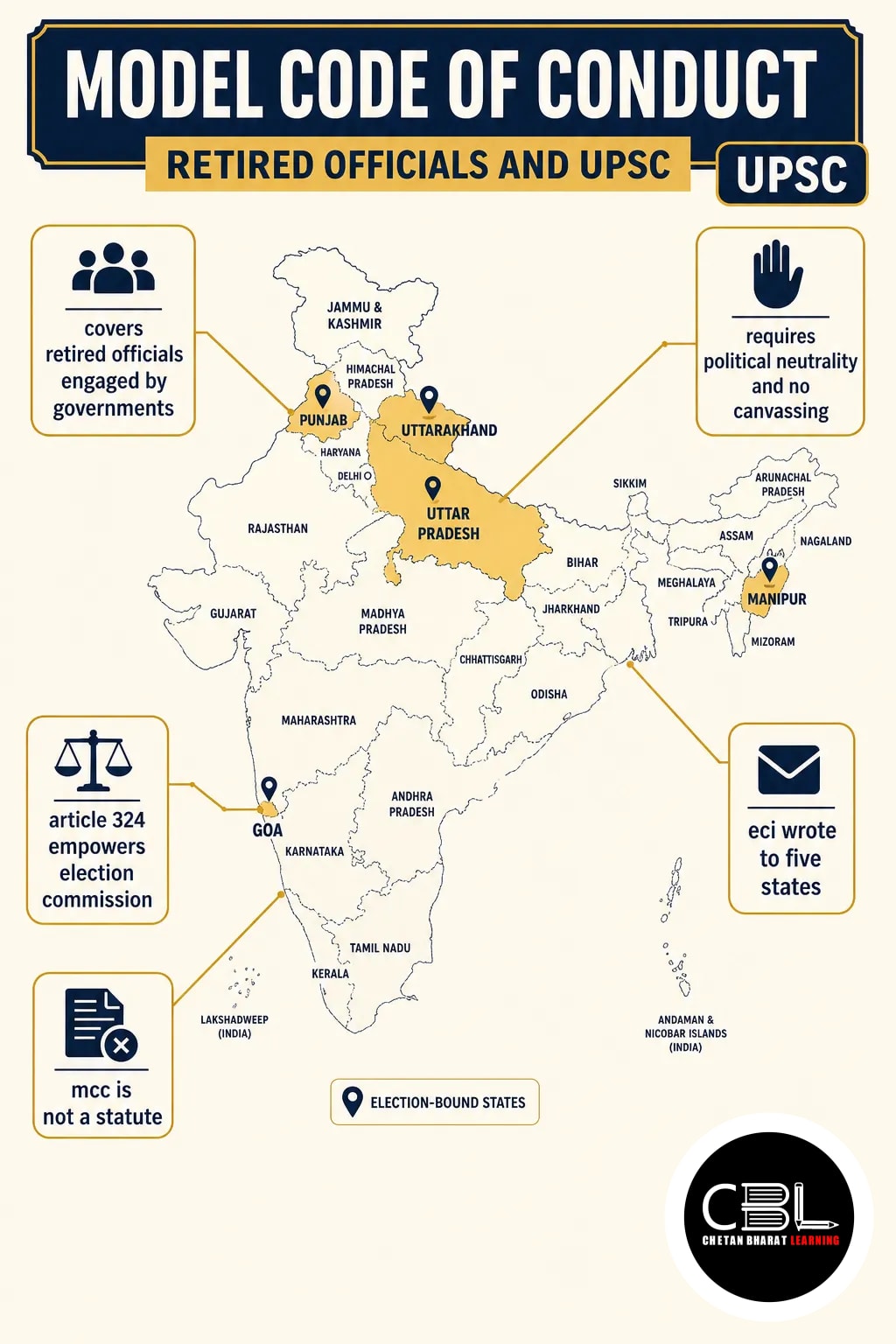
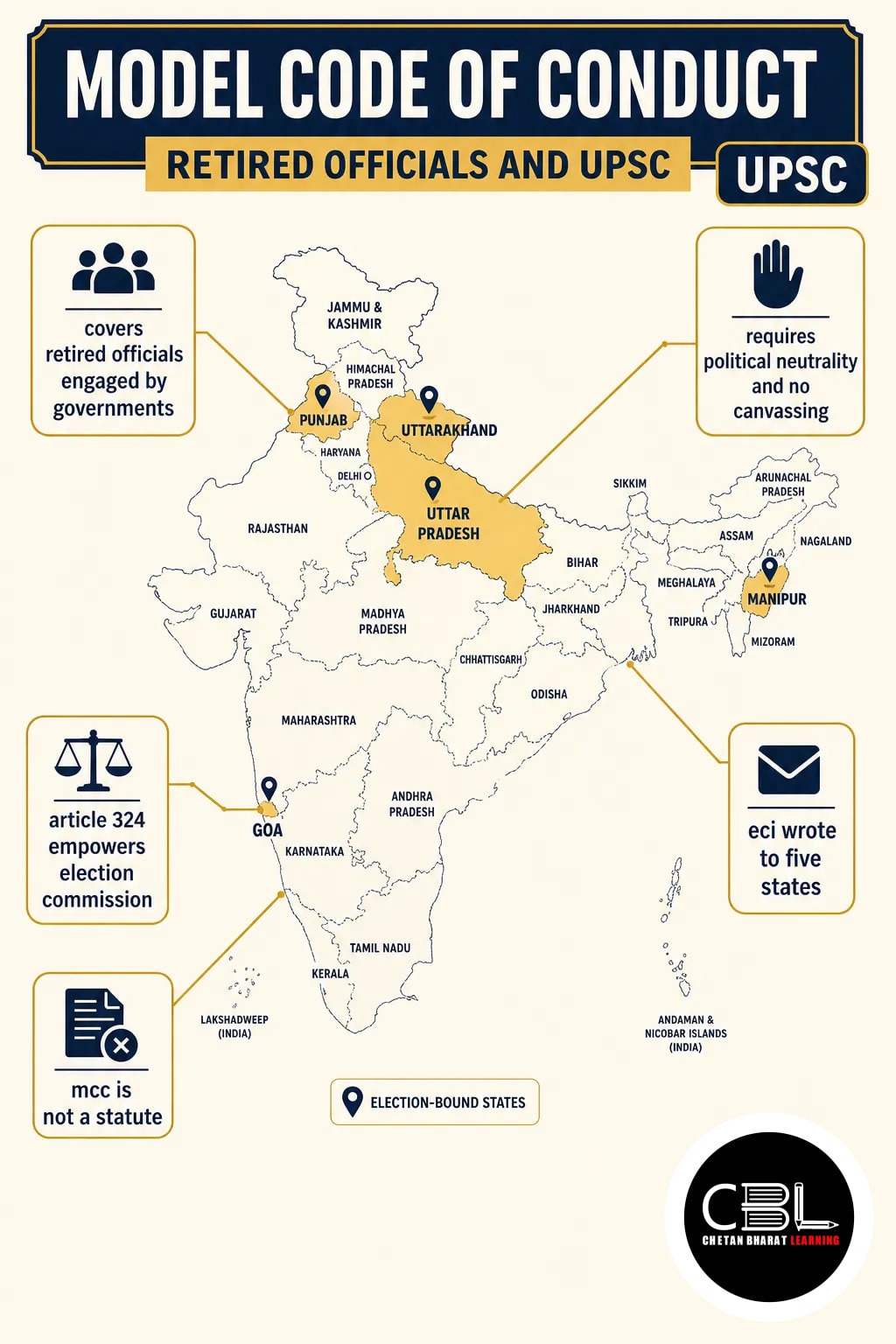
The Model Code of Conduct will cover retired officials engaged by state and Union Territory governments, the Election Commission of India announced. Explore the constitutional context in our polity current affairs coverage.
Quick answer: On 10 November 2026, the Election Commission of India extended Model Code of Conduct restrictions applicable to serving employees to retired officials and others engaged by state and Union Territory governments. They must remain politically neutral and avoid campaigning or canvassing. The Commission wrote to authorities in five poll-bound states.
What does the Model Code of Conduct extension cover?
The extension applies serving employees’ election-code restrictions to retired officials and other individuals engaged by state and Union Territory governments. The Election Commission of India (ECI) said these individuals must maintain political neutrality and refrain from election campaigns or canvassing.
Thus, the relevant distinction is not retirement alone, but engagement by a government. The source does not say that the direction covers every retired government official, including those without such an engagement.
For context on another election-governance debate, see CBL’s analysis of simultaneous elections and poll costs.
Why is the decision in the news?
The ECI communicated its decision on 10 November 2026 to senior election and administrative authorities in five states. Those states were due to vote early in 2027, according to the source.
| Fact | Detail |
|---|---|
| States addressed | Goa, Manipur, Punjab, Uttar Pradesh and Uttarakhand |
| Recipients | Chief Secretaries and Chief Electoral Officers |
| People covered | Retired officials and other individuals engaged by state and Union Territory governments |
| Conduct specified | Political neutrality; no election campaigning or canvassing |
The five states identify the letter’s recipients; however, the reported scope also refers to Union Territory government engagements. The source does not specify an enforcement procedure or a penalty for breaches.
What is the constitutional and legal context?
Article 324 gives the ECI responsibility for supervising, directing and controlling specified elections. The Model Code of Conduct (MCC), meanwhile, is a set of election conduct guidelines rather than a statute in itself.
| Provision or instrument | Relevance |
|---|---|
| Article 324 | Entrusts the ECI with electoral rolls and elections to Parliament, state legislatures, and the offices of President and Vice-President. |
| Model Code of Conduct | Sets election conduct standards; its guidelines are not themselves a statute. |
| Article 19(1)(a) | Protects freedom of speech and expression, subject to restrictions permitted by Article 19(2). |
| Article 243K | Vests supervision of panchayat elections in the State Election Commission. |
The MCC ordinarily operates from the announcement of an election schedule until completion of the election process. Some conduct addressed by it may separately attract statutory provisions; however, a code breach should not automatically be described as a criminal offence.
For examination purposes, distinguish the ECI from State Election Commissions. The latter supervise local-body elections under the constitutional framework; the present report concerns the ECI’s direction.
Why does the extension matter?
The decision addresses political neutrality when governments engage people outside regular service. Its significance lies in applying election-related conduct standards to that wider group.
- Institutional impartiality: Government engagement can place individuals close to public administration; therefore, neutrality helps protect the appearance of fair treatment.
- Consistent expectations: The direction extends restrictions applicable to serving employees; thus, retirement does not by itself remove the requirement for those engaged by governments.
- Electoral confidence: Clear separation between official engagement and campaigning can support trust in the administration of elections.
- Administrative accountability: Chief Secretaries and Chief Electoral Officers received the letter; consequently, communication across government offices becomes important.
The measure does not mean that all government-engaged individuals perform election duties. Rather, its reported standard concerns political conduct and neutrality.
What are the implementation concerns?
Implementation requires clarity about who is engaged, what conduct is prohibited and how concerns will be examined. The source does not provide those operational details.
- Identifying coverage: Governments may need reliable records of eligible engagements; otherwise, instructions may not reach everyone concerned.
- Defining conduct: Campaigning and canvassing require clear practical guidance; for example, authorities could explain how the rules apply to public political activity.
- Fair procedure: Any response to an alleged breach should distinguish evidence from accusation and give the individual an opportunity to respond.
- Rights and neutrality: Political expression raises constitutional questions; therefore, restrictions and any consequences should be assessed against their applicable legal basis.
These are governance considerations, not findings that a breach has occurred. Moreover, neither the source nor the announcement summary specifies a new penalty.
What should implementation focus on?
Implementation should prioritise clear communication, consistent identification and fair handling of complaints. First, departments could communicate the direction to covered individuals and explain prohibited election activity.
Second, election authorities could coordinate with departments to clarify uncertain cases. Finally, documented decisions and a chance to respond would help balance electoral neutrality with procedural fairness, subject to applicable law.
Source: The Hindu, 10 November 2026
- Simultaneous Elections India: Poll Costs for UPSC (31 Oct 2026)
Asked in UPSC: Previous Year Questions
- UPSC CSE Mains 2022 (GS Paper II): Discuss the role of the Election Commission of India in the light of the evolution of the Model Code of Conduct.
UPSC links the Commission’s institutional role to the evolution of election conduct standards.
Punjab was among the five states whose senior authorities received the ECI letter. State PCS aspirants should also distinguish ECI-supervised assembly elections from local-body elections supervised by State Election Commissions.
Prelims Practice Corner
Mains Practice Questions
Frequently Asked Questions
Does the election code now cover all retired government officials?
No. The reported direction covers retired officials and other individuals engaged by state and Union Territory governments; it does not say that every retired official is covered.
What conduct must covered individuals avoid?
They must avoid election campaigning and canvassing. In addition, the ECI requires them to maintain political neutrality.
Which states received the ECI letter?
Goa, Manipur, Punjab, Uttar Pradesh and Uttarakhand received it. The ECI addressed their Chief Secretaries and Chief Electoral Officers.
Is the election code itself a law?
No, the code is not itself a statute. However, separate statutory provisions may apply to particular conduct covered by its guidelines.
Related Current Affairs
Preparing for UPSC, PCS or HCS?
Talk to a mentor at Chetan Bharat Learning, Chandigarh. Free guidance on choosing the right exam and building a study plan.
Chat on WhatsAppCall 97793 53345UPSC / IAS / PCS coaching in Chandigarh · Trusted by aspirants across Punjab & Haryana

 Ananya RanaIAS · AIR 60
 Aditya SharmaIAS · AIR 70
 Ria Kaur SethiIPS · AIR 89
 Aman AloonIRS · AIR 295
 Sumer Singh VirkIRS · AIR 335
 Shivani PanchalIAS

Leave a Reply
You must be logged in to post a comment.