
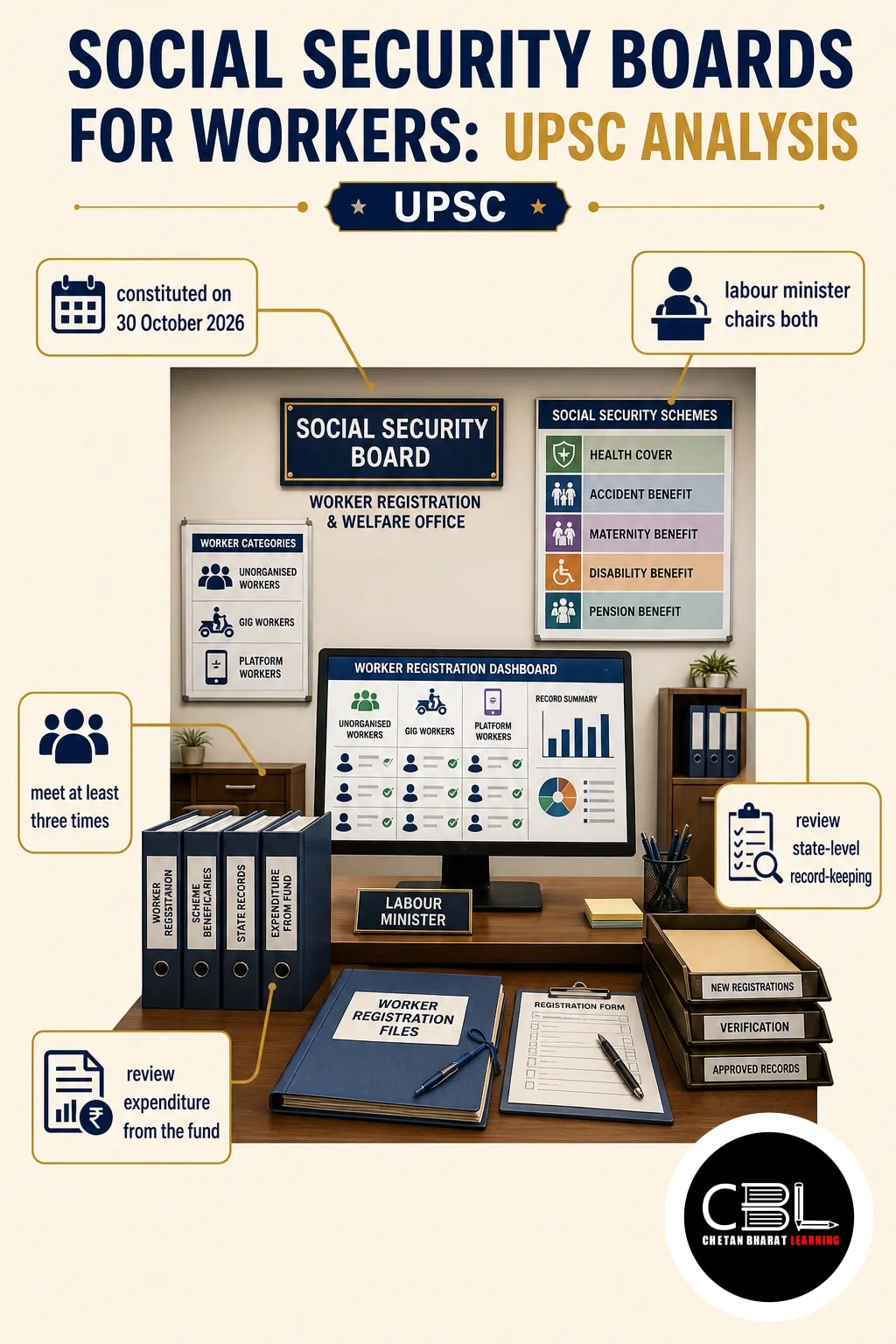

Social security boards for unorganised, gig and platform workers were constituted by the Union Labour Ministry on 30 October 2026. The decision adds a national-level forum to India’s social welfare governance.
Quick answer: On 30 October 2026, the Union Labour Ministry constituted national social security boards for unorganised workers and for gig and platform workers. Labour Minister Mansukh Mandaviya will chair both. They will design, recommend and monitor targeted welfare schemes, review state-level record-keeping and examine expenditure from the fund and account.
What are the social security boards?
The boards are national forums tasked with designing, recommending and monitoring welfare schemes for different categories of workers. One concerns unorganised workers; the other concerns gig and platform workers.
Unorganised work broadly includes work outside the protections associated with organised employment. Gig work involves earning from work arrangements outside a traditional employer-employee relationship; platform work uses an online platform to connect workers with specific services or activities. These categories can overlap, so welfare design must account for different working arrangements.
The announcement establishes a governance mechanism rather than specifying a new benefit for every worker. Therefore, aspirants should distinguish the boards’ responsibilities from the eligibility, funding and benefits of any individual scheme.
Why are the boards in the news?
The Union Labour Ministry constituted the boards on 30 October 2026 to address welfare needs across traditional and newer forms of work. Union Minister for Labour and Employment Mansukh Mandaviya will chair both.
Their membership will include representatives of the Central and State Governments, prominent aggregator companies, employers, civil society organisations, workers’ unions, and gig and platform associations. Thus, the structure brings policy actors and stakeholders into the same forum. The boards must meet at least three times a year; the Union Government will prescribe their procedural rules.
What functions will the boards perform?
The boards will combine scheme recommendations with oversight of implementation and expenditure. Their principal responsibilities are summarised below.
| Function | Scope |
|---|---|
| Scheme design and advice | Design and recommend suitable schemes for different worker groups. |
| Policy administration | Advise the Union Government on administration of the Social Security Code. |
| Scheme monitoring | Monitor social welfare schemes for the worker categories concerned. |
| Records and expenditure | Review state-level record-keeping and expenditure from the fund and account. |
| Other functions | Undertake additional functions assigned by the Union Government. |
These functions connect national policy advice with state-level information. However, the source does not specify scheme-wise benefits, funding allocations or the boards’ procedural rules.
Why do these boards matter for labour welfare?
The social security boards create a forum for considering welfare across diverse and changing work arrangements. Their significance lies in linking worker needs to scheme design and subsequent review.
- Representation: Worker associations and unions can place occupational concerns alongside government and employer perspectives.
- Targeting: Different categories may face different risks; therefore, scheme recommendations can reflect the nature of their work.
- Federal coordination: Reviewing state-level records can help the Union assess whether implementation information is consistent and useful.
- Accountability: Monitoring schemes and reviewing expenditure can connect policy recommendations with evidence about delivery.
Local employment information can also help administrators identify gaps in coverage. For related context, see CBL’s discussion of district-level labour indicators.
What implementation challenges need attention?
Effective welfare depends on identifying eligible workers, coordinating records and translating advice into accessible benefits. These are policy challenges for implementation, not findings established by the announcement.
- Identification and mobility: Workers may change occupations, locations or platforms; therefore, records need timely updates.
- Representation: The interests of aggregators and workers may differ, so procedures should permit meaningful worker participation.
- Centre–state coordination: State-level records must support national review; however, inconsistent information could make comparison difficult.
- Financial scrutiny: Expenditure review matters, but it must also assess whether intended beneficiaries can access support.
- Digital access: Online processes can simplify administration; nevertheless, workers with limited digital access may need alternative channels.
What should be the way forward?
The boards should prioritise transparent procedures, reliable records and accessible scheme delivery. Their recommendations can be assessed against whether workers can identify and obtain the support intended for them.
First, clear consultation procedures should enable unions and associations to present evidence. Second, common reporting standards and coordination with states can improve the review of records. In addition, accessible grievance channels and non-digital assistance can reduce barriers for workers.
Finally, regular public reporting on recommendations, expenditure review and follow-up would strengthen accountability. The key test is not merely the creation of social security boards, but how effectively their advice informs welfare delivery.
Source: The Hindu, 30 October 2026
- District Labour Indicators: India’s Local Jobs Map (23 Sep 2026)
Punjab PCS and Haryana HCS candidates can connect this topic to state-level worker records and welfare delivery. In addition, questions may test how state governments coordinate with national institutions on labour welfare.
Prelims Practice Corner
Mains Practice Questions
Frequently Asked Questions
Who chairs the new national boards?
Mansukh Mandaviya, the Union Minister for Labour and Employment, chairs both boards. They also include government, worker, employer and other stakeholder representatives.
How often will the boards meet?
At least three times a year. In addition, the Union Government will prescribe their procedural rules.
Do the boards cover only platform workers?
No, because their remit also covers gig workers and traditional unorganised workers. The boards will recommend and monitor welfare schemes for the relevant groups.
Will the boards review state-level worker records?
Yes, because reviewing state-level record-keeping is part of their mandate. They will also review expenditure from the fund and account.
Related Current Affairs
Preparing for UPSC, PCS or HCS?
Talk to a mentor at Chetan Bharat Learning, Chandigarh. Free guidance on choosing the right exam and building a study plan.
Chat on WhatsAppCall 97793 53345UPSC / IAS / PCS coaching in Chandigarh · Trusted by aspirants across Punjab & Haryana
Leave a Reply
You must be logged in to post a comment.