
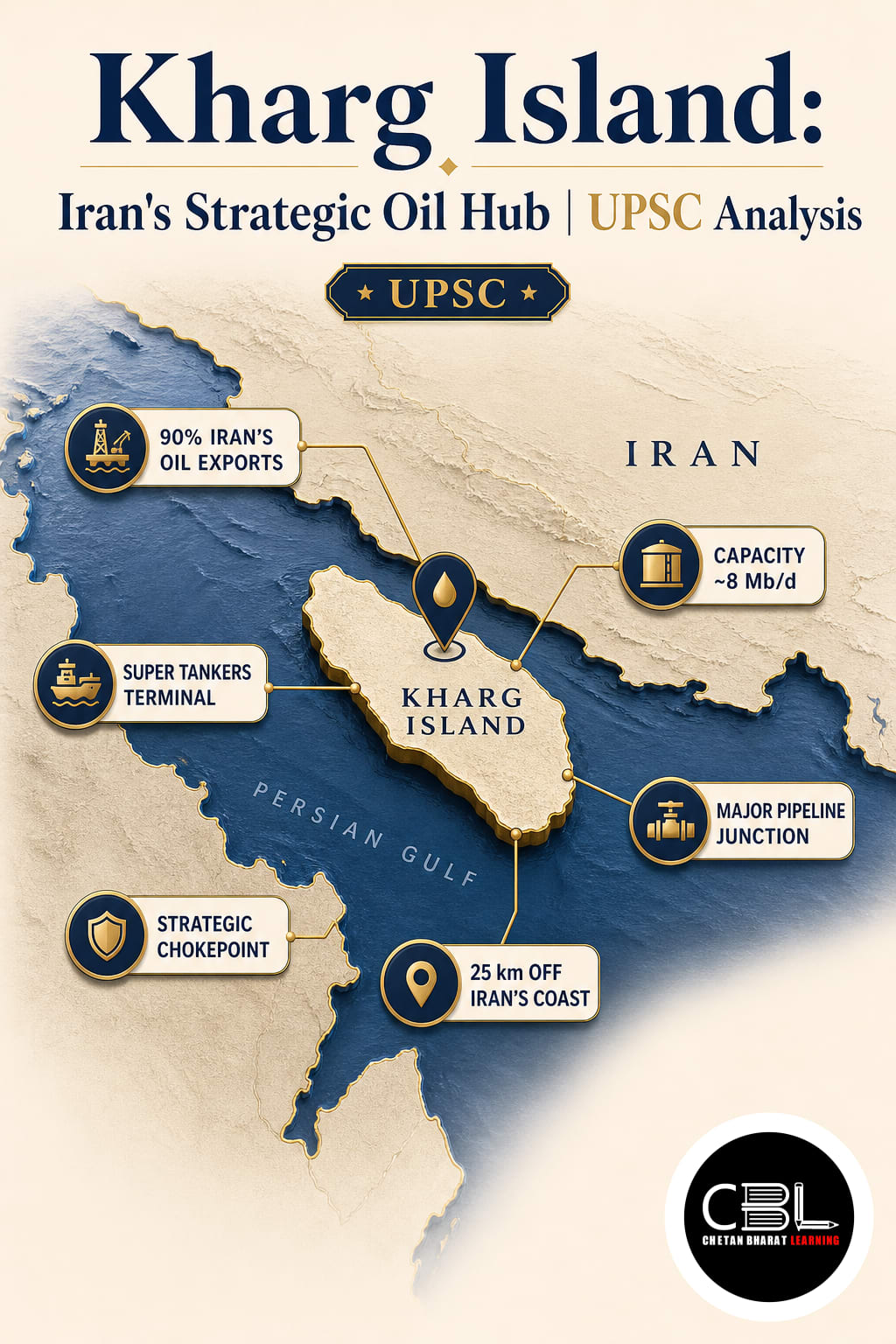

UPSC Mapping
| Country | Iran |
|---|---|
| Location | Northern Persian Gulf |
| Administrative Region | Bushehr Province |
| Primary Function | Crude Oil Export Terminal |
Article
Kharg Island, Iran’s strategically important oil export hub in the Persian Gulf, has attracted international attention amid concerns about regional security and energy supplies. US President Donald Trump reportedly stated that Iran’s oil infrastructure on the island could face destruction if freedom of navigation through the Strait of Hormuz were threatened. The development highlights the relationship between energy infrastructure, maritime security and geopolitical tensions. It is significant for UPSC current affairs preparation under international relations, geography and energy security.
The island serves as a major terminal for Iranian crude oil exports. Its location and extensive petroleum facilities make it strategically important for Iran’s economy and the wider global energy market.
Location and Key Features
Kharg Island is a small coral island situated in the northern Persian Gulf, approximately 30 kilometres from the Iranian mainland. It lies within Iran’s Bushehr Province.
The island measures approximately 8 kilometres in length and 4.5 kilometres in width. Its geographical position and surrounding deep waters have made it suitable for large-scale petroleum shipping operations.
It is relatively distant from the shallow coastal conditions found along several parts of the Persian Gulf. This geographical advantage supports the movement of large oil tankers.
- Geographical location: The island lies in the northern Persian Gulf, off Iran’s southwestern coast.
- Administrative control: It belongs to Bushehr Province in Iran.
- Physical characteristics: It is a relatively low-lying coral island surrounded by waters suitable for major shipping activities.
- Economic importance: It houses one of Iran’s most significant crude oil export facilities.
- Oil infrastructure: The island contains petroleum storage installations, loading terminals and connecting pipelines.
- Port facilities: Its terminals accommodate large crude oil tankers, including Very Large Crude Carriers.
- Strategic importance: The island links Iranian oil production facilities with international maritime energy markets.
Why in News?
The island recently came into focus following reported warnings concerning possible attacks on Iran’s oil infrastructure. President Donald Trump reportedly linked the issue to maintaining open navigation through the strategically important Strait of Hormuz.
According to the supplied news extract, the warning concerned the potential destruction of Iranian oil facilities if maritime passage through the strait were threatened.
The reported remarks reflect concerns over the security of energy infrastructure during regional geopolitical tensions. Such developments can influence international oil markets even before any physical disruption occurs.
The possibility of conflict involving a major oil export terminal raises questions about shipping security, energy prices and the economic consequences of military escalation.
History and Development of Kharg Island
The island emerged as a major petroleum export centre during the twentieth century. Its deepwater access and proximity to oil-producing regions encouraged investment in storage and loading facilities.
In the early 1960s, offshore oil discoveries in the waters surrounding Kharg contributed to the development of its petroleum infrastructure. The island subsequently became an important link between Iranian oilfields and global markets.
During the Iran-Iraq War of 1980-1988, the island’s oil facilities faced repeated attacks because of their economic importance. Oil terminals and associated infrastructure were damaged during the conflict.
After the war, Iran undertook reconstruction and restoration of affected petroleum facilities. The island continued to play a central role in the country’s crude oil export system.
Ecological and Strategic Significance
1. Iran’s Major Oil Export Hub
The island serves as one of the most important centres for Iranian crude oil exports. Pipelines transport oil from producing regions to storage and loading facilities on the island.
Its terminals can accommodate large petroleum tankers, allowing crude oil to enter international markets. This infrastructure contributes significantly to Iran’s ability to generate revenue from petroleum exports.
2. Petroleum Storage and Shipping Infrastructure
The island contains extensive storage facilities designed to support continuous oil export operations. The supplied report refers to approximately 28 million barrels of storage capacity.
Large oil tankers use its loading terminals because of the surrounding deepwater conditions. This makes the island particularly valuable compared with shallower sections of the Iranian coast.
3. Strategic Importance of the Strait of Hormuz
The Strait of Hormuz connects the Persian Gulf with the Gulf of Oman and the wider Arabian Sea. It is one of the world’s most important maritime passages for petroleum transportation.
Kharg Island lies northwest of the strait within the Persian Gulf. Oil exported from the island must generally pass through this maritime route to reach markets beyond the Gulf.
Any serious disruption to tanker movements could therefore affect Iran’s petroleum exports and international energy supply chains.
4. Global Energy Security
Energy markets depend on reliable transportation routes and functioning export infrastructure. Damage to major oil terminals may reduce supply availability and increase market uncertainty.
Even the possibility of conflict can influence insurance costs, tanker operations and crude oil prices. These effects may extend far beyond the countries directly involved.
5. Importance for India
India imports a substantial share of its crude oil requirements. Developments affecting Persian Gulf energy infrastructure and shipping routes are therefore relevant to India’s economic security.
Higher global petroleum prices can influence India’s import expenditure, transport costs and inflationary pressures. Maritime instability may also affect shipping schedules and commercial activity.
Threats and Challenges
- Geopolitical tensions: Regional conflicts and military threats can endanger petroleum installations and maritime trade.
- Infrastructure concentration: Dependence on major export terminals creates vulnerabilities when essential facilities face disruption.
- Maritime security risks: Restrictions on tanker movements could interrupt the transportation of crude oil.
- Environmental damage: Oil spills and damage to petroleum facilities may threaten marine ecosystems and coastal environments.
- Economic uncertainty: Disruptions can affect oil prices, shipping expenses and the stability of energy-importing economies.
- Operational vulnerabilities: Pipelines, storage tanks and loading terminals require extensive maintenance and effective security arrangements.
Conservation and Policy Measures
Protecting strategically important oil infrastructure requires coordinated action on maritime security, environmental management and energy resilience.
- Maritime security cooperation: Regional and international stakeholders should support safe navigation through important shipping routes.
- Diplomatic engagement: Dialogue and de-escalation can reduce the risk of military conflict affecting civilian energy infrastructure.
- Oil spill preparedness: Authorities should maintain appropriate emergency response systems for potential petroleum-related environmental incidents.
- Infrastructure resilience: Regular inspection and maintenance can improve the reliability of petroleum storage and export facilities.
- Energy diversification: Importing countries can strengthen resilience by diversifying energy suppliers and transportation arrangements.
- Strategic petroleum reserves: Adequate emergency oil stocks can help countries manage temporary supply disruptions.
The strategic importance of the island illustrates the close relationship between geography, energy production and international security. Stable maritime routes and resilient energy infrastructure remain essential for the global economy.
Prelims Package
| Q1 | Kharg Island is located in which waterbody? |
|---|---|
| a | Red Sea |
| b | Persian Gulf |
| c | Caspian Sea |
| d | Mediterranean Sea |
| Answer | (b). The island lies in the northern Persian Gulf, off Iran’s coast. |
| Q2 | Kharg Island is administratively associated with which Iranian province? |
| a | Tehran |
| b | Isfahan |
| c | Bushehr |
| d | Kerman |
| Answer | (c). The island belongs to Iran’s Bushehr Province. |
| Q3 | The Strait of Hormuz connects which two waterbodies? |
| a | Red Sea and Mediterranean Sea |
| b | Persian Gulf and Gulf of Oman |
| c | Black Sea and Caspian Sea |
| d | Arabian Sea and Bay of Bengal |
| Answer | (b). The strait connects the Persian Gulf with the Gulf of Oman. |
| Q4 | Consider the following statements: 1. Kharg Island is a major crude oil export centre of Iran. 2. Its surrounding deep waters facilitate the movement of large oil tankers. 3. It is located in the Mediterranean Sea. Which statements are correct? |
| a | 1 and 2 only |
| b | 2 and 3 only |
| c | 1 and 3 only |
| d | 1, 2 and 3 |
| Answer | (a). Statements 1 and 2 are correct. The island lies in the Persian Gulf, not the Mediterranean Sea. |
| Q5 | Why is Kharg Island strategically important to global energy markets? |
| a | It is the world’s largest coal mine |
| b | It is a major Iranian oil export hub near a critical maritime energy route |
| c | It controls the Suez Canal |
| d | It produces most of the world’s natural gas |
| Answer | (b). The island’s petroleum infrastructure and location in the Persian Gulf make it important for international energy supplies. |
Mains Package
Q1. Examine the geographical and strategic significance of Kharg Island in Iran’s petroleum export system. (150 words, 10 marks)
Answer Structure
- Intro: Identify the island’s location in the northern Persian Gulf.
- Body: Discuss deepwater access, export terminals, storage facilities, historical development and dependence on maritime routes.
- Conclusion: Highlight the island’s importance for Iran’s economy and regional energy security.
Q2. Geopolitical instability in the Persian Gulf can have significant consequences for India’s energy security and economic stability. Critically examine. (250 words, 15 marks)
Answer Structure
- Intro: Explain the Persian Gulf’s importance for international petroleum trade.
- Body: Discuss Strait of Hormuz disruptions, global oil prices, shipping risks, India’s import dependence and inflation. Examine supply diversification, strategic petroleum reserves and diplomatic engagement.
- Conclusion: Recommend resilient energy infrastructure, diversified imports and sustained regional diplomacy.
FAQs
Where is Kharg Island located?
Kharg Island is located in the northern Persian Gulf, approximately 30 kilometres off Iran’s southwestern coast. It belongs to Bushehr Province.
Why is Kharg Island important for Iran?
It houses major crude oil storage and export facilities connected to Iran’s petroleum-producing regions. Its deepwater terminals support large oil tankers serving international markets.
Why is Kharg Island strategically important for India?
India depends heavily on imported petroleum, making stability in the Persian Gulf economically important. Disruptions involving Iranian oil terminals or the Strait of Hormuz could influence international crude prices and India’s energy import costs.
Related Current Affairs
Preparing for UPSC, PCS or HCS?
Talk to a mentor at Chetan Bharat Learning, Chandigarh. Free guidance on choosing the right exam and building a study plan.
Chat on WhatsAppCall 97793 53345UPSC / IAS / PCS coaching in Chandigarh · Trusted by aspirants across Punjab & Haryana
Leave a Reply
You must be logged in to post a comment.