
Simultaneous elections are under parliamentary scrutiny after economists advised a House panel on the costs of holding polls separately. The discussion brings investment and administrative costs into the electoral reform debate.
Quick answer: Members of the Economic Advisory Council to the Prime Minister (EAC-PM) met the Joint Parliamentary Committee examining simultaneous elections Bills. According to The Indian Express, they flagged investment uncertainty, Centre–State coordination and administrative deployment as costs of staggered polls beyond election expenditure. The panel is chaired by P P Chaudhary.
What are simultaneous elections?
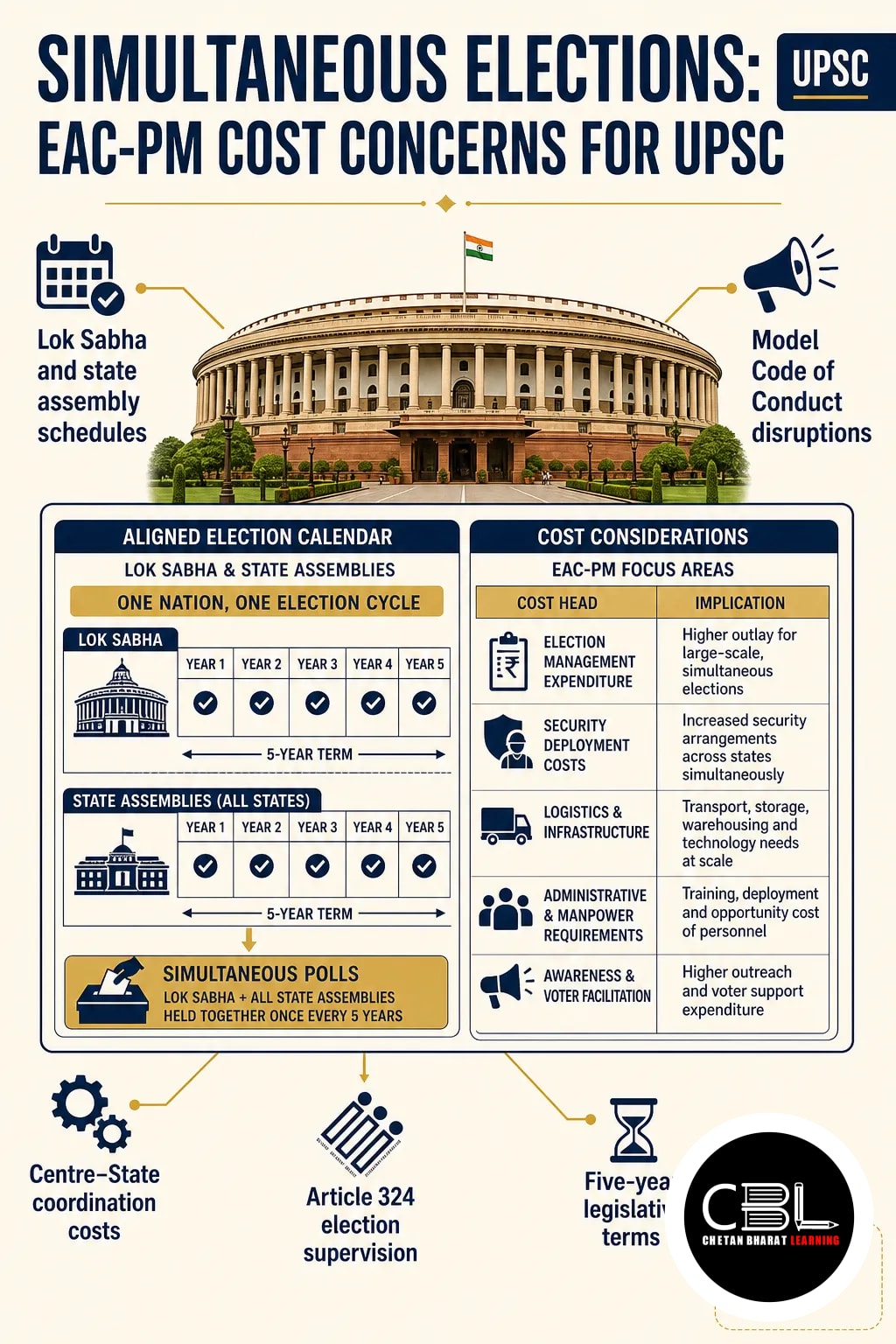
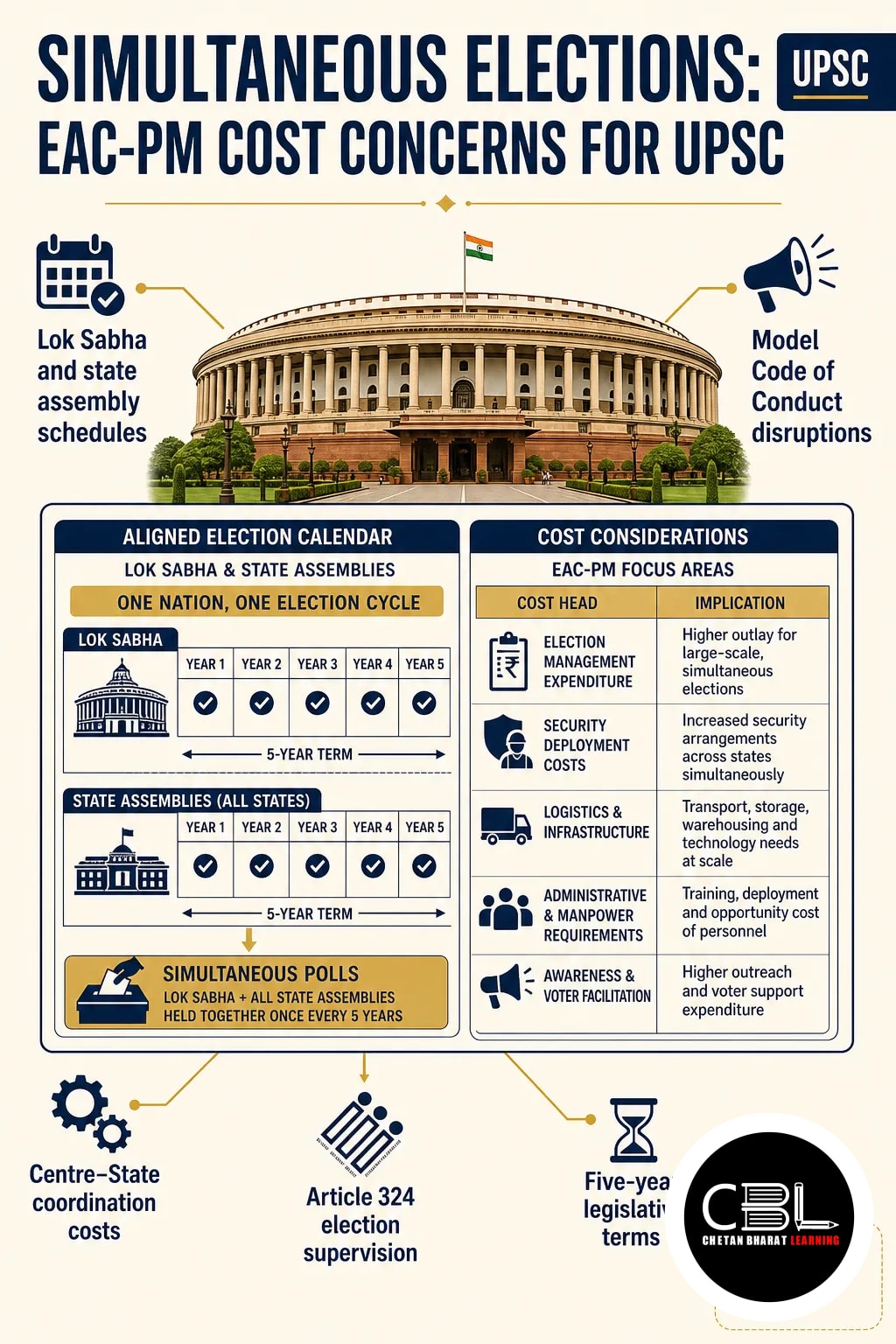
Simultaneous elections involve aligning election schedules for the Lok Sabha and State Legislative Assemblies. Staggered elections, by contrast, take place at different times as the terms of elected bodies end.
Alignment does not remove the need for separate elected governments or their accountability to legislatures. For the wider constitutional debate, see CBL’s analysis of One Nation One Election.
Why is the issue in the news?
The Joint Parliamentary Committee met EAC-PM members while examining Bills on aligning elections. The Indian Express said the economists raised costs that extend beyond conducting the polls.
Panel chair and Bharatiya Janata Party Member of Parliament P P Chaudhary met council chair Professor S Mahendra Dev, member Dr Shamika Ravi and part-time member Professor Pami Dua. The panel also met S Gurumurthy, chair of the Vivekananda International Foundation.
| Participant | Concern raised, according to the report |
|---|---|
| S Mahendra Dev | General election uncertainty and contraction in corporate capital expenditure |
| Shamika Ravi | Effects on low-income families, Centre–State coordination and long-term capital formation |
| Pami Dua | Model Code of Conduct disruptions, revenue expenditure and personnel deployment |
These are concerns attributed to the participants, not quantified conclusions published by the committee. The source gives neither an estimated economic loss nor details of the evidence presented.
How can staggered polls affect the economy?
Staggered polls can entail indirect costs as well as the direct expense of administering elections. The panel discussion identified several possible channels:
- Private investment: Election-related policy uncertainty may lead firms to postpone capital expenditure. However, the report does not quantify this effect.
- Coordination: Ravi flagged disruption to Centre–State coordination; consequently, long-term capital formation could be affected.
- Household impact: Ravi also raised effects on low-income families, although the report does not specify the mechanism.
- Public resources: Dua flagged personnel deployment and higher government revenue expenditure. In addition, administrative attention may shift towards election duties.
Capital expenditure generally creates or improves productive assets; revenue expenditure covers recurring costs. Therefore, an assessment should distinguish short-term spending from possible effects on investment over time.
What constitutional and administrative rules matter?
Legislative terms, electoral supervision and government accountability all matter when election schedules are aligned.
| Provision or instrument | Relevance |
|---|---|
| Article 83(2) | The Lok Sabha ordinarily continues for five years unless dissolved sooner. |
| Article 172(1) | A State Legislative Assembly ordinarily continues for five years unless dissolved sooner. |
| Article 324 | The Election Commission supervises, directs and controls elections to Parliament and State Legislatures, and to the offices of President and Vice-President. |
| Model Code of Conduct | The election-time code guides the conduct of political parties and governments. |
Both five-year term provisions also permit specified extensions during a national emergency. Meanwhile, the Model Code of Conduct is not a blanket prohibition on all government activity.
Election administration also depends on institutional independence. For related context, read the constitutional rules on removal of the Chief Election Commissioner.
What are the main trade-offs?
The central trade-off is between potential administrative efficiency and the requirements of federal democracy.
- Federal choice: State elections allow voters to judge State governments on their own records. Therefore, reform must consider whether aligned campaigns leave sufficient space for State issues.
- Early dissolution: A government can lose legislative support before its term ends. Consequently, any alignment framework needs a clear response to an early dissolution.
- Accountability: The prospect of elections gives voters opportunities to evaluate governments. On the other hand, frequent campaigns can also demand administrative resources.
- Evidence: Investment decisions have multiple determinants. Therefore, an election-related effect needs careful comparison rather than an assumption that every delay results from polling.
What should a way forward examine?
A sound assessment should compare the full costs and benefits of alternative election schedules, not just polling expenditure.
First, the committee could examine evidence on investment, household effects and administrative deployment, including the methods used to estimate them. Second, it could assess transition costs and arrangements for early dissolution alongside any projected savings.
Finally, consultation with States, political parties and election authorities can test operational choices against federalism and democratic accountability. The objective should be a workable framework supported by evidence, rather than a presumption that either schedule is cost-free.
Source: The Indian Express, 31 October 2026
Punjab PCS and Haryana HCS questions can link election scheduling to State Assembly terms and federalism. In addition, revise the Model Code of Conduct and the deployment of State administrative personnel during elections.
Prelims Practice Corner
Mains Practice Questions
Frequently Asked Questions
What are simultaneous elections in India?
They involve aligning Lok Sabha and State Assembly election schedules. In contrast, staggered elections occur at different times.
What did EAC-PM members flag about staggered polls?
They flagged investment uncertainty, coordination and administrative costs beyond poll expenditure. The report also identifies concerns about low-income families and personnel deployment.
Does the Model Code of Conduct stop all government work?
No, the code is not a blanket ban on government activity. However, it guides the conduct of governments and political parties during elections.
Who chairs the committee examining the election Bills?
P P Chaudhary chairs the Joint Parliamentary Committee. The panel met EAC-PM members and S Gurumurthy during its examination.
Related Current Affairs
Preparing for UPSC, PCS or HCS?
Talk to a mentor at Chetan Bharat Learning, Chandigarh. Free guidance on choosing the right exam and building a study plan.
Chat on WhatsAppCall 97793 53345UPSC / IAS / PCS coaching in Chandigarh · Trusted by aspirants across Punjab & Haryana

 Ananya RanaIAS · AIR 60
 Aditya SharmaIAS · AIR 70
 Ria Kaur SethiIPS · AIR 89
 Aman AloonIRS · AIR 295
 Sumer Singh VirkIRS · AIR 335
 Shivani PanchalIAS

Leave a Reply
You must be logged in to post a comment.