
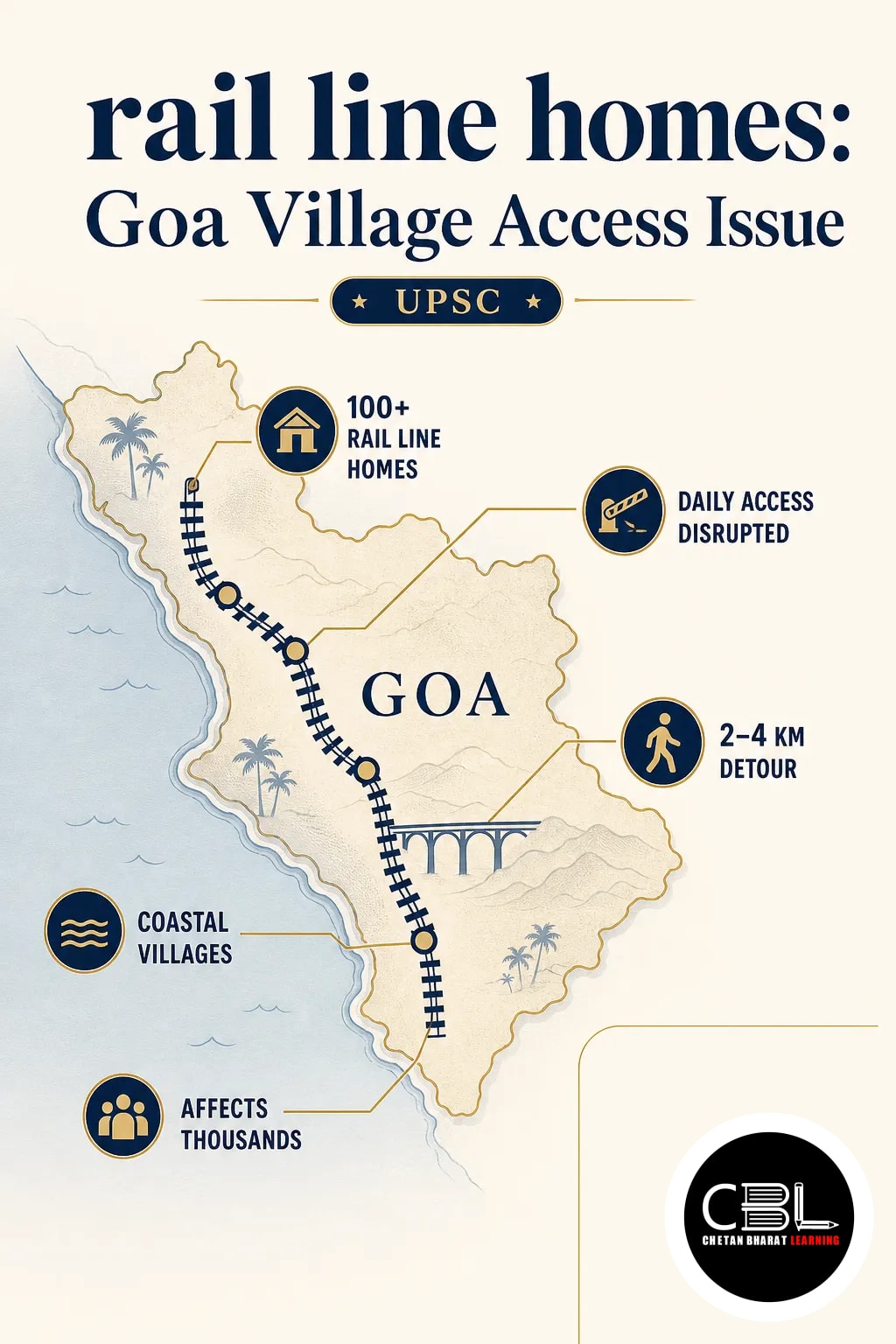
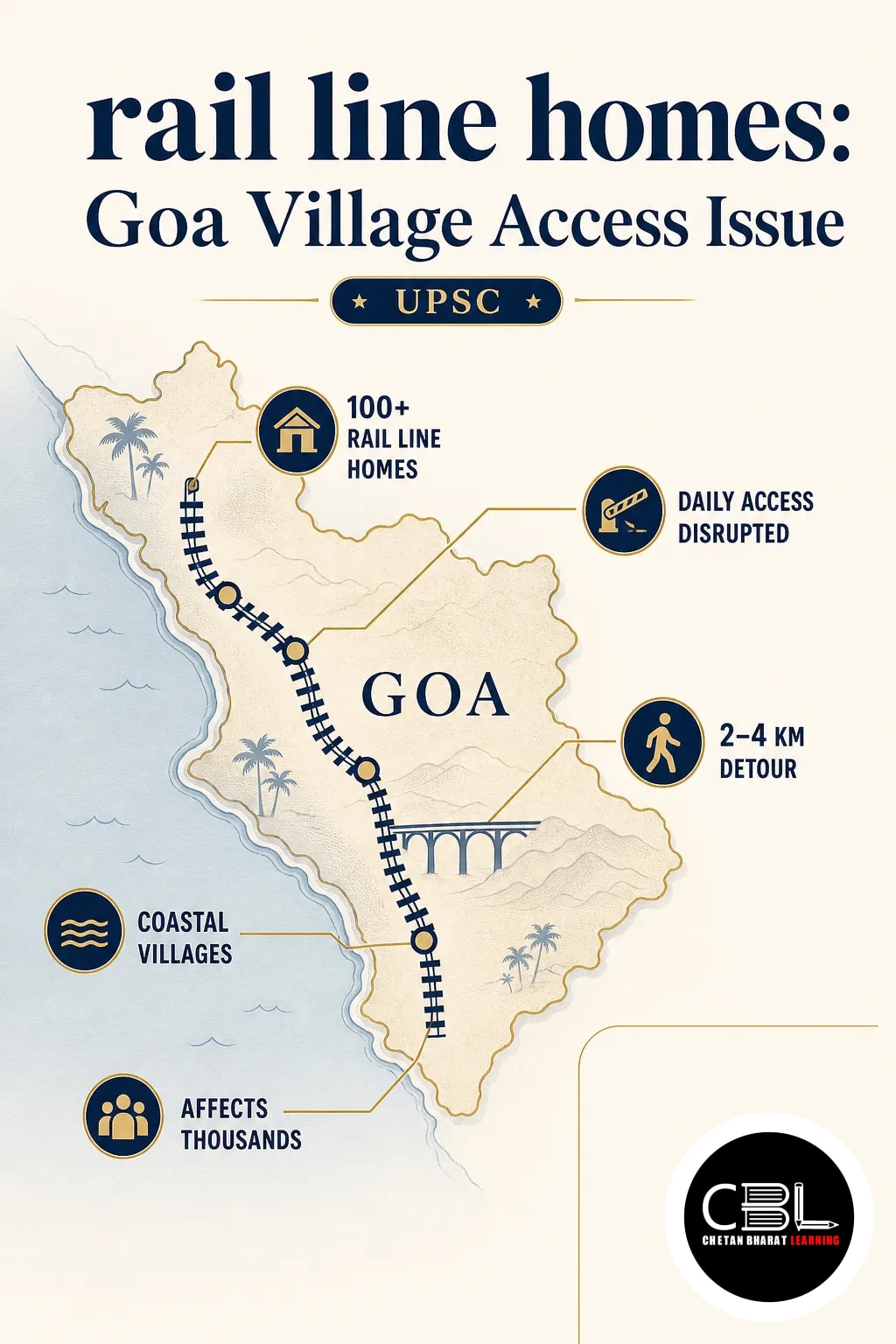
Rail line homes in a Goa village have become the centre of a difficult infrastructure question. The report on village access and development trade-offs shows how a transport corridor can change everyday life for nearby residents.
What is rail line homes?
The phrase rail line homes describes residences affected by a railway alignment, especially where the line splits a settlement or blocks movement. In such cases, the railway becomes not only a transport asset but also a daily access barrier.
This issue fits within India’s broader challenge of balancing infrastructure expansion with local connectivity. The Constitution protects property through legal procedure, while planning norms require public projects to consider access, safety, and livelihood effects.
Why in News?
The report describes a Goa village where a railway line has left homes cut off from normal access. It highlights the lived experience of residents facing restricted movement because of the project layout.
For UPSC, this is relevant because railway expansion often intersects with land acquisition, resettlement, and local governance. The case also raises questions on whether infrastructure design has adequately accounted for the village’s internal mobility.
Key Features
- Physical severance: The railway line has divided the village space, making movement between homes and nearby areas difficult.
- Access disruption: Residents face constraints in using vehicles and reaching adjoining parts of the settlement.
- Infrastructure-public life tension: The project shows how a national transport asset can create local inconvenience when alignment is not fully integrated with habitation patterns.
- Governance dimension: Such cases usually require coordination among railway authorities, district administration, and local bodies.
Challenges
- Restricted daily mobility: Households may need longer detours for routine travel, emergency access, and transport of goods.
- Safety concerns: Poorly planned crossings or informal movement near tracks can raise accident risks.
- Livelihood impact: Disrupted access can affect work, schooling, healthcare, and local commerce.
- Dispute resolution burden: Residents often depend on slow administrative responses for mitigation measures.
Way Forward
Authorities should assess whether the corridor needs safe crossings, access roads, fencing adjustments, or other engineering fixes. A project of this scale should also include local consultation before and after construction.
In the longer term, planners must integrate rail development with settlement geography, not treat them separately. That approach can reduce avoidable hardship while preserving the utility of the railway system.
Source: Indian Express India, 2026-10-24
This topic connects to state PCS questions on infrastructure planning, land acquisition, and urban-rural connectivity. It can also appear under governance and public works, where candidates must explain how development projects affect local communities and how administrations can reduce displacement and access barriers.
FAQ
Why do railway projects sometimes affect homes so severely?
Railway alignments can cut across existing habitations, especially where land is narrow or densely built. If access roads, underpasses, or crossings are not planned well, residents may lose easy movement to nearby places.
Which constitutional ideas are relevant in such cases?
The State must follow due process in land matters and ensure just procedure for public projects. The issue also touches the right to livelihood, safe access, and the duty to plan in a socially responsible manner.
How can UPSC link this issue to governance questions?
It can be used to discuss land acquisition, public consultation, grievance redressal, and infrastructure planning. The case also helps explain why development must be inclusive and locally workable.
Related Current Affairs
Preparing for UPSC, PCS or HCS?
Talk to a mentor at Chetan Bharat Learning, Chandigarh. Free guidance on choosing the right exam and building a study plan.
Chat on WhatsAppCall 97793 53345UPSC / IAS / PCS coaching in Chandigarh · Trusted by aspirants across Punjab & Haryana
Leave a Reply
You must be logged in to post a comment.