

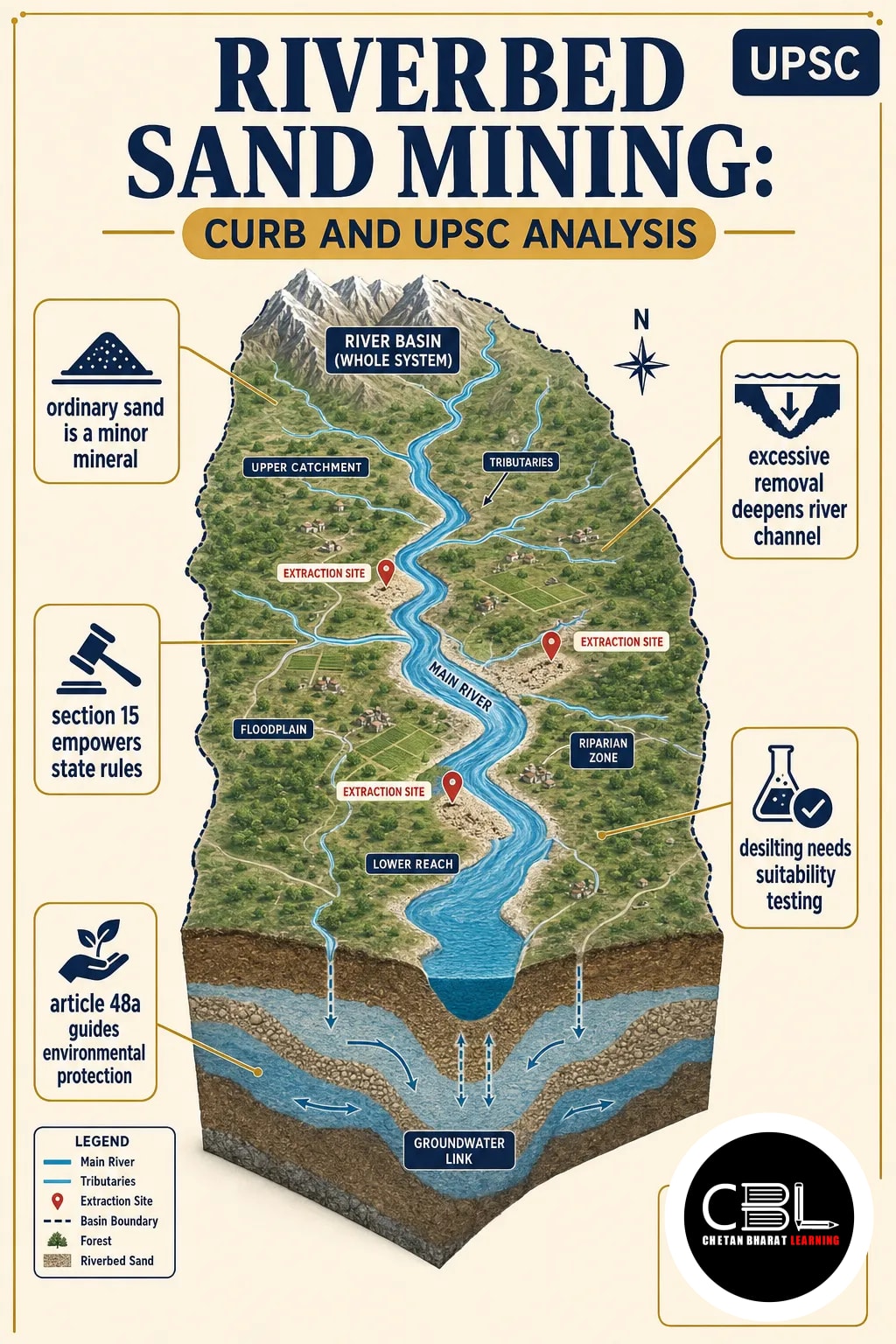
Riverbed sand mining is under scrutiny after the Supreme Court’s environmental watchdog called for a curb and suggested desilting-related alternatives. The issue links construction demand with river ecology and environmental governance.
Quick answer: The Supreme Court’s environmental watchdog wants to curb riverbed sand mining in India and has suggested alternatives involving desilting. The available source notes do not specify the proposal’s details, location or implementation timeline. For UPSC, the central question is how to meet sand demand while protecting rivers and regulating extraction.
Why is riverbed sand mining in the news?
A Supreme Court environmental watchdog has called for curbing extraction from riverbeds and suggested desilting-related alternatives. However, the available source notes do not identify the proposed mechanism or establish that the Court has ordered a ban.
Sand supplies construction, but river sediment also supports channel stability and aquatic habitats. Therefore, the policy challenge is not merely finding material; it is managing the environmental cost of its extraction.
Why does river sediment matter?
River sediment forms part of a dynamic system of erosion, transport and deposition. Excessive extraction can disturb that balance, although impacts depend on local conditions and extraction intensity.
- Channel stability: Removing too much sand can deepen a channel and destabilise its banks.
- Water and aquifers: A lowered riverbed can affect the connection between rivers and groundwater; as a result, nearby water levels may change.
- Habitats: Disturbance of the bed and banks can affect aquatic organisms and their breeding habitats.
- Infrastructure: Deepening near structures can expose foundations and increase risks to bridges and other works.
Moreover, impacts may extend downstream because rivers carry sediment across administrative boundaries. An assessment should therefore consider the river system, not just an individual extraction site.
Can desilting provide an alternative?
Desilting removes accumulated sediment from a water body or reservoir; suitable material may have potential uses, subject to testing and applicable approvals. The watchdog’s reported suggestion places desilting among the alternatives, but the supplied notes do not describe its precise proposal.
In a reservoir, sediment accumulation can reduce storage capacity. Desilting may address this problem in selected cases; however, cost, access, disposal and downstream effects require assessment.
Moreover, sediment is not necessarily suitable for construction: its grain size, composition and contamination need testing. Thus, desilting should not become a label for unregulated extraction, and it cannot automatically replace all river sand.
What laws and constitutional principles matter?
Indian law treats ordinary sand as a minor mineral, while constitutional principles guide environmental protection.
| Provision | Relevance |
|---|---|
| Mines and Minerals (Development and Regulation) Act, 1957 | Defines minor minerals to include ordinary sand, subject to specified exceptions. |
| Section 15 of the Act | Empowers state governments to make rules for grants and regulation of minor mineral concessions. |
| Environment (Protection) Act, 1986 | Provides a framework for environmental protection and measures by the central government. |
| Articles 48A and 51A(g) | Set out, respectively, a state directive and a citizen’s fundamental duty concerning environmental protection. |
The Mines and Minerals (Development and Regulation) Act is commonly called the MMDR Act. For another mineral-regulation context, see CBL’s coverage of the Madras High Court ruling on a Tamil Nadu mineral ban.
What are the governance challenges?
Effective regulation must reconcile construction needs with ecological limits and credible enforcement.
- Assessing supply: River sediment replenishment varies across locations; therefore, a uniform extraction limit may be inappropriate.
- Monitoring compliance: Authorities must check both permitted quantities and actual transport. Otherwise, unauthorised material can enter the supply chain.
- Economic trade-offs: Tighter controls can affect supply and livelihoods, so transition planning matters alongside environmental safeguards.
- Alternative materials: Manufactured sand and recycled construction material need quality assurance; moreover, their production has environmental costs.
What should a balanced response include?
A balanced response should set extraction decisions against river health, verified demand and the feasibility of alternatives.
First, agencies can assess sediment movement and identify sensitive stretches before permitting extraction. Second, transparent records and checks on transport can strengthen accountability. In addition, assessments should examine whether desilted material is safe and suitable for use.
Finally, states can encourage suitable alternatives while consulting affected communities. Any desilting project should also account for downstream sediment needs, rather than treating sediment solely as waste.
Source: Indian Express, 22 November 2026
- Tamil Nadu mineral ban: Madras HC ruling for UPSC (17 Nov 2026)
Asked in UPSC: Previous Year Questions
- UPSC CSE Mains 2019 (GS Paper III): Analyse the impact of sand mining along the Indian coasts, citing specific examples.
- UPSC CSE Prelims 2018 (GS Paper I): Which are possible consequences of heavy riverbed sand mining: decreased river salinity, groundwater pollution and lowering of the water table?
UPSC tests both the environmental consequences of sand mining and their application to different settings.
State PCS questions can connect minor mineral regulation with river ecology and state administration. Also, revise how Section 15 of the MMDR Act empowers states to frame rules for minor minerals.
Prelims Practice Corner
Mains Practice Questions
Frequently Asked Questions
What has the Supreme Court’s environmental watchdog proposed?
It wants a curb on riverbed sand mining and suggests desilting-related alternatives. However, the available source notes do not specify the proposed mechanism.
Is ordinary sand a minor mineral in India?
Yes, ordinary sand is a minor mineral under the MMDR Act, subject to specified exceptions. In addition, Section 15 empowers states to make rules concerning minor mineral concessions.
Can desilted sediment always replace river sand?
No, because sediment varies in composition and may not meet construction requirements. Its use therefore requires suitability testing and applicable approvals.
How can excessive sand mining affect groundwater?
It can alter river–groundwater connections and contribute to changes in nearby water levels. However, the effect depends on local geology and extraction conditions.
Related Current Affairs
Preparing for UPSC, PCS or HCS?
Talk to a mentor at Chetan Bharat Learning, Chandigarh. Free guidance on choosing the right exam and building a study plan.
Chat on WhatsAppCall 97793 53345UPSC / IAS / PCS coaching in Chandigarh · Trusted by aspirants across Punjab & Haryana






Leave a Reply
You must be logged in to post a comment.