
BepiColombo Mercury orbit entry brings a European-Japanese mission to the Solar System’s smallest planet. The milestone and a reported thruster glitch are relevant to science and technology current affairs.
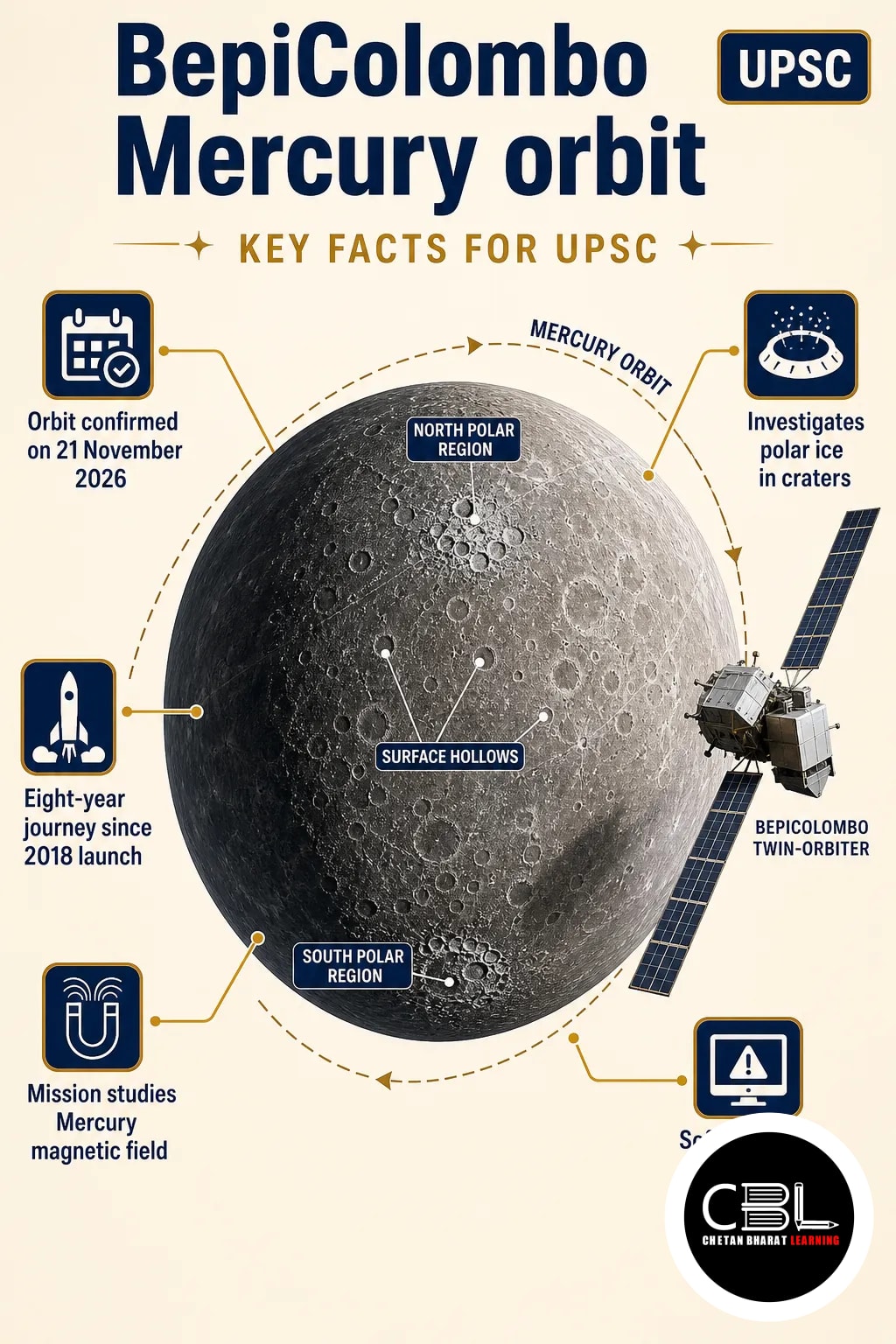
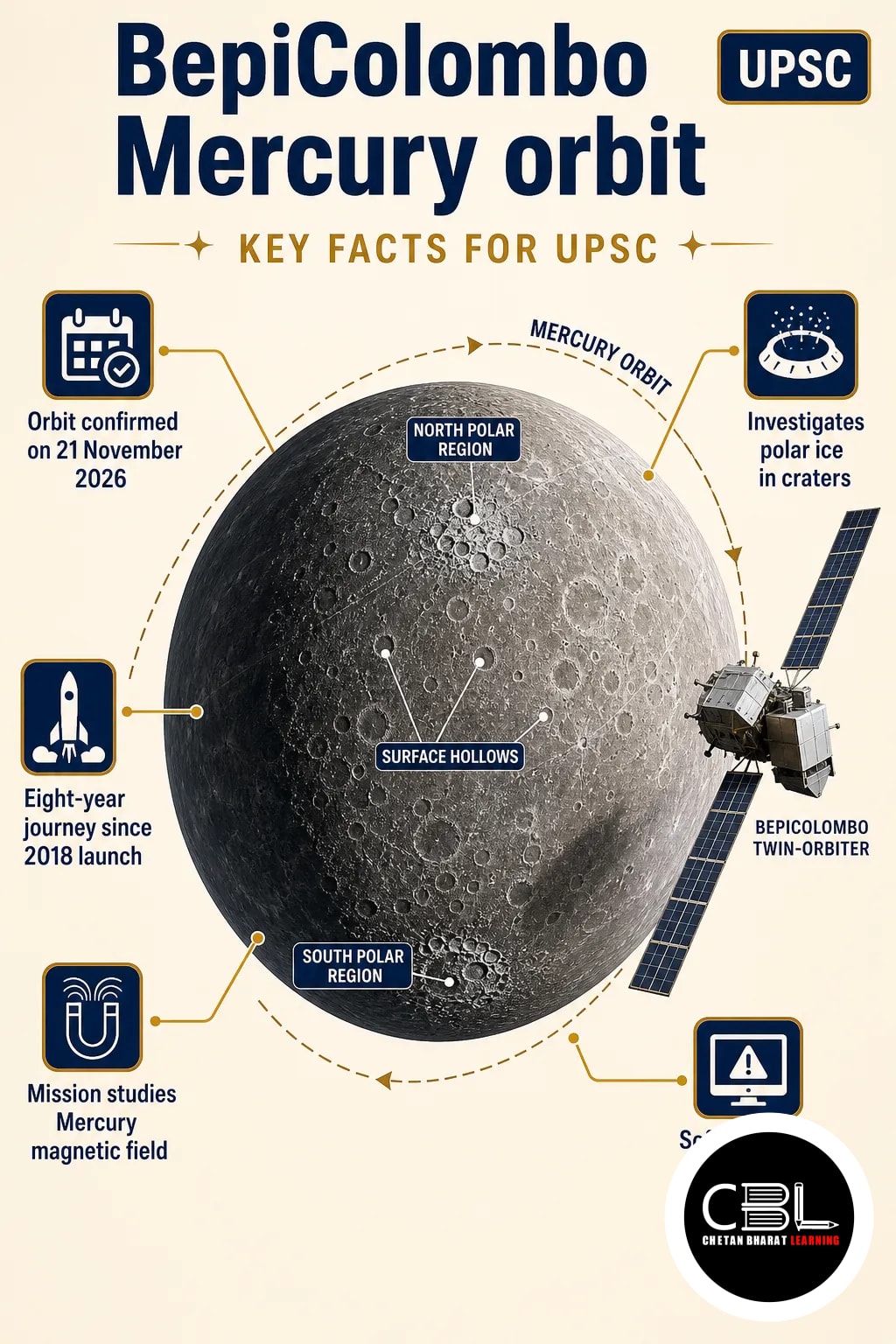
Quick answer: BepiColombo Mercury orbit entry was confirmed on 21 November 2026, after an eight-year journey. The European Space Agency and Japan Aerospace Exploration Agency mission will study Mercury’s magnetic field, polar ice and surface hollows. However, a software issue shortened a thruster burn during the manoeuvre; the spacecraft remains safe.
What is the BepiColombo Mercury orbit mission?
BepiColombo is a joint European-Japanese robotic mission to study Mercury. Launched in 2018, it is the third spacecraft to visit the planet and the second to orbit it.
The mission combines two orbiters with different scientific objectives. The European Space Agency (ESA) contributed the Mercury Planetary Orbiter, while the Japan Aerospace Exploration Agency (JAXA) contributed the Mercury Magnetospheric Orbiter.
| Feature | Key fact |
|---|---|
| Mission partners | ESA and JAXA |
| Orbiters | Mercury Planetary Orbiter and Mercury Magnetospheric Orbiter |
| Separation | Scheduled for 9 and 10 December 2026 |
| Routine science | Scheduled to begin in April |
What happened during orbit entry?
ESA confirmed the BepiColombo Mercury orbit entry on 21 November 2026. The next day, it said a software issue had made the thruster burn shorter than planned.
Nevertheless, ESA said the spacecraft was safe. Teams at the European Space Operations Centre were investigating the issue; ESA expected to provide updates on 23 November.
What will the mission study?
The mission will investigate Mercury’s magnetic field, polar ice and surface depressions known as hollows.
- Magnetic field: The orbiters will help investigate why Mercury has one. For related context, see auroras on Mercury.
- Polar ice: Researchers want to understand why ice exists in craters on a planet so close to the Sun.
- Hollows: The mission will examine the nature of these surface depressions.
What are Mercury’s key features?
Mercury is the smallest and innermost planet in the Solar System. It is also the least explored of the four inner planets.
Its diameter is about 4,880 km, less than 40% of Earth’s. Mercury is roughly 60% closer to the Sun than Earth, so the Sun appears over three times as large from its surface.
Its Moon-like surface has numerous impact craters, smooth expanses and cliffs. Some cliffs reach about 1.6 km in height.
Why does the mission matter?
The BepiColombo Mercury orbit gives scientists an opportunity to study a little-explored inner planet. In particular, its observations can help investigate how Mercury’s magnetic field and polar ice coexist with its proximity to the Sun.
Source: The Hindu Sci-Tech, 23 November 2026
- Auroras on Mercury (21 Jul 2023)
State PCS General Studies can test the mission’s partner agencies, target planet and scientific objectives. Also revise Mercury’s position and surface features.
Prelims Practice Corner
Mains Practice Questions
Frequently Asked Questions
Which agencies operate BepiColombo?
ESA and JAXA jointly undertake the mission. Each agency also contributed one of its two orbiters.
When did BepiColombo begin orbiting Mercury?
ESA confirmed orbit entry on 21 November 2026. The spacecraft had travelled for eight years after its 2018 launch.
What glitch affected BepiColombo’s orbit entry?
A software issue shortened the planned thruster burn. Nevertheless, ESA said the spacecraft was safe and its teams were investigating.
Related Current Affairs
Preparing for UPSC, PCS or HCS?
Talk to a mentor at Chetan Bharat Learning, Chandigarh. Free guidance on choosing the right exam and building a study plan.
Chat on WhatsAppCall 97793 53345UPSC / IAS / PCS coaching in Chandigarh · Trusted by aspirants across Punjab & Haryana






Leave a Reply
You must be logged in to post a comment.