
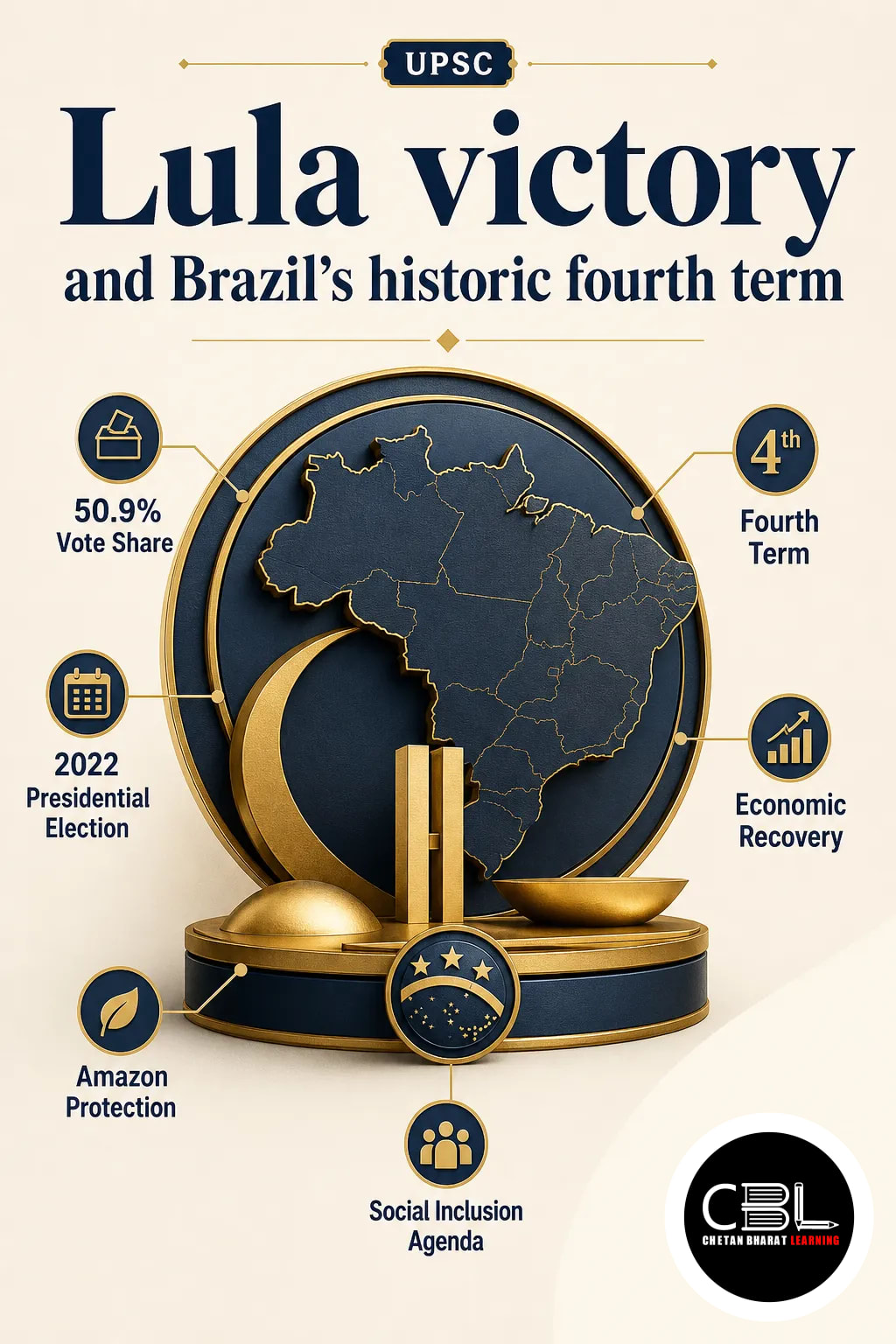
Lula victory in Brazil has drawn attention for overturning defeat forecasts and securing a historic fourth term. For a broader context on democratic contests, see current affairs updates that track elections and institutions.
What is Lula victory?
Brazil’s Lula victory refers to Luiz Inácio Lula da Silva returning to power after being projected by many observers to lose. The result matters because it shows how campaign momentum, social welfare appeal, and voter anxieties can reshape outcomes in large democracies.
In UPSC terms, this is a useful case study in electoral behaviour, coalition politics, and the durability of democratic competition in Latin America. It also shows how leaders can stage political comebacks after earlier setbacks.
Why in News?
The Indian Express explained two reasons why predictions of defeat did not hold and Lula won a historic fourth term. The news is important because it highlights how election forecasts can miss late shifts in public mood.
It is also relevant for understanding the changing political space in Brazil, where economic concerns and ideological divisions continue to shape voter choices. The Lula victory therefore has both domestic and international significance.
Key Features
- Historic return: Lula secured a fourth term, making the win politically notable in Brazil’s recent electoral history.
- Defied expectations: The result went against predictions that he would be defeated.
- Democratic resilience: The outcome reflects the competitive nature of Brazil’s electoral system.
- Issue-based politics: Economic and governance concerns appear to have influenced voter behaviour.
- Regional relevance: The result matters for Latin America, where left-right political swings often affect policy direction.
Challenges
- Polarised electorate: Deep ideological divisions can make governance difficult after a close contest.
- Expectation gap: When forecasts fail, public debate can become more uncertain and fragmented.
- Policy delivery pressure: A comeback win raises expectations on jobs, welfare, and economic stability.
- Institutional trust: Repeated polarisation can test confidence in democratic institutions and political compromise.
Way Forward
For Brazil, the next step is to convert electoral legitimacy into stable governance and broader social confidence. That requires attention to inflation, employment, welfare delivery, and constructive engagement across political camps.
For students, the larger lesson is that democracy is not only about counting votes but also about understanding voter behaviour. The Lula victory shows why election outcomes should be studied alongside institutions, social cleavages, and campaign strategy.
Source: Indian Express Explained, 2026-10-26
- New Development Bank: BRICS Finance and India’s Role (17 Sep 2026)
- UNSC Reform: Veto Restraint and India’s Claim (27 Sep 2026)
This topic helps in GS papers that cover international relations, comparative politics, and democratic processes. State PCS exams may also ask about how elections shape foreign policy, trade linkages, and South-South cooperation.
FAQ
Why is Lula’s win called historic?
It is described as historic because it marks a fourth term, which is politically significant in Brazil’s democratic journey. The result also defied expectations of defeat.
Why should UPSC aspirants study this election?
It helps in understanding electoral behaviour, political polarisation, and democratic resilience. Such themes are useful for both Polity and International Relations answers.
What is the broader relevance for India?
India engages with Brazil in multilateral and South-South platforms. Election outcomes there can matter for diplomacy, trade, and cooperation among emerging economies.
Related Current Affairs
Preparing for UPSC, PCS or HCS?
Talk to a mentor at Chetan Bharat Learning, Chandigarh. Free guidance on choosing the right exam and building a study plan.
Chat on WhatsAppCall 97793 53345UPSC / IAS / PCS coaching in Chandigarh · Trusted by aspirants across Punjab & Haryana

 Ananya RanaIAS · AIR 60
 Aditya SharmaIAS · AIR 70
 Ria Kaur SethiIPS · AIR 89
 Aman AloonIRS · AIR 295
 Sumer Singh VirkIRS · AIR 335
 Shivani PanchalIAS

Leave a Reply
You must be logged in to post a comment.