

UPSC Mapping
| Prelims | Mains |
|---|---|
| Defence Technology, Missile Systems | GS Paper II – International Relations; GS Paper III – Defence & Security |
| Country | Missile Type | Launch Platform | Range |
|---|---|---|---|
| Russia | Stealth Long-range Cruise Missile | Strategic Bombers | 2,500–3,000 km |
What is Kh-101 Missile?
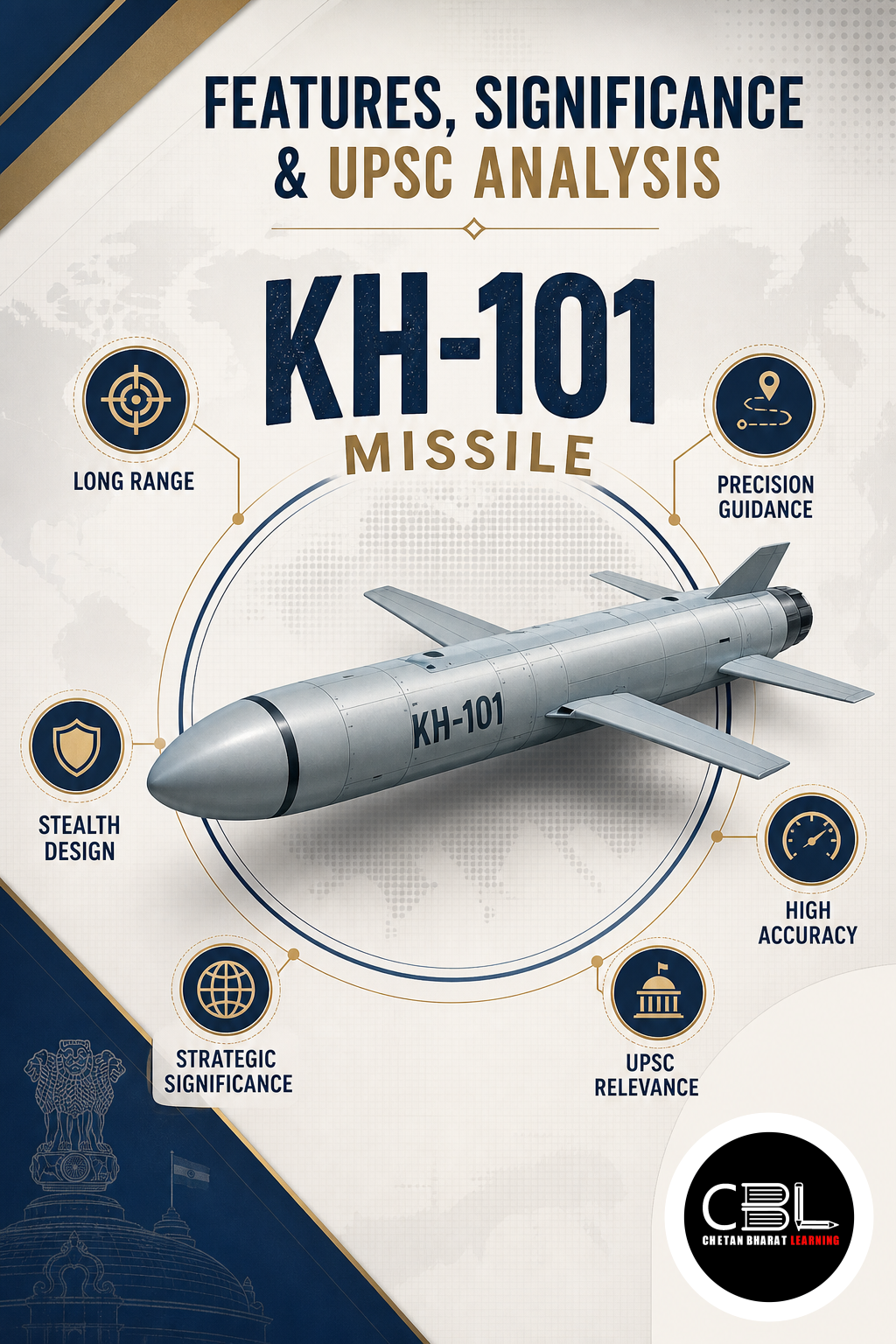
The Kh-101 Missile (NATO designation: AS-23A Kodiak) is an advanced Russian air-launched, long-range, subsonic cruise missile developed by the Tactical Missile Armament Corporation (KTRV) during the late 1990s. It is designed to strike high-value ground targets with exceptional precision while maintaining a low radar signature.
The missile primarily targets military infrastructure, bunkers, command centres and strategic facilities. Its stealth-oriented airframe and advanced navigation systems make it one of Russia’s most sophisticated conventional cruise missiles.
Why is Kh-101 Missile in News?
A suspected Kh-101 missile reportedly landed in eastern Poland, increasing tensions on NATO’s eastern border. The incident has renewed discussions on airspace security, escalation risks and the wider geopolitical impact of the Russia–Ukraine conflict.
The event also underlines the strategic importance of long-range precision-guided weapons in contemporary warfare. Official updates regarding NATO’s response can be accessed through the North Atlantic Treaty Organization (NATO).
Key Features of Kh-101 Missile
- Stealth design: Streamlined airframe reduces radar cross-section and improves survivability.
- Long operational range: Capable of striking targets between approximately 2,500 and 3,000 km.
- Precision guidance: Uses inertial navigation, satellite navigation and terrain contour matching for accurate targeting.
- Multiple warheads: Can carry high-explosive, penetrator and cluster munitions depending on mission requirements.
- Air-launched platform: Deployed from Tu-95MS, Tu-160, Tu-22M3 strategic bombers and the Tu-142 aircraft.
Variants of Kh-101 Missile
- Kh-101: Conventional precision-guided cruise missile.
- Kh-102: Nuclear-capable variant with reportedly longer range and improved guidance.
- Modernisation: Successive upgrades have enhanced electronic systems and navigation capabilities.
- Strategic role: Supports Russia’s long-range deterrence doctrine.
Strategic Significance
The Kh-101 Missile demonstrates the increasing importance of precision-guided stand-off weapons in modern military doctrine. Long-range cruise missiles allow strategic bombers to attack distant targets without entering heavily defended airspace.
The missile also influences regional security calculations involving NATO members and neighbouring countries.
Challenges
- Escalation risk: Cross-border incidents can rapidly increase geopolitical tensions.
- Air defence challenges: Low-altitude flight makes interception more difficult.
- Civilian impact: Precision weapons may still pose risks in densely populated conflict zones.
- Arms race: Continued missile modernisation encourages competing military investments.
- Strategic uncertainty: Conventional and nuclear variants complicate threat assessment.
Way Forward
Strengthening international communication channels, improving airspace monitoring and promoting confidence-building measures remain essential for reducing the risk of unintended escalation. Enhanced missile defence cooperation among allies also contributes to regional stability.
Diplomatic engagement, arms control initiatives and transparent military communication continue to play an important role in preventing misunderstandings during periods of heightened geopolitical tension.
Prelims Practice Corner
Q1. Kh-101 Missile is developed by which country?
- a) China
- b) Russia
- c) USA
- d) France
Answer: Russia.
Q2. Kh-101 belongs to which category?
- a) Ballistic missile
- b) Cruise missile
- c) Anti-tank missile
- d) Surface-to-air missile
Answer: Cruise missile.
Q3. Which aircraft commonly carries the Kh-101?
- a) MiG-21
- b) Tu-160
- c) Su-30
- d) Rafale
Answer: Tu-160 strategic bomber.
Q4. Kh-102 is known as:
- a) Anti-ship version
- b) Nuclear-capable variant
- c) Surface-to-air version
- d) Hypersonic version
Answer: Nuclear-capable variant.
Q5. The Kh-101 primarily targets:
- a) Satellites
- b) Ground installations
- c) Submarines
- d) Aircraft carriers
Answer: Ground installations.
Mains Practice Questions
Q1. Examine the role of long-range cruise missiles in contemporary warfare. (10 marks)
- Intro: Define cruise missiles.
- Body: Precision strikes, deterrence, strategic reach and security implications.
- Conclusion: Highlight the need for responsible military doctrines.
Q2. Discuss how modern missile technologies influence regional security and international relations. (15 marks)
- Intro: Explain technological advancements.
- Body: Strategic stability, deterrence, alliances, escalation risks and arms control.
- Conclusion: Stress diplomacy and confidence-building measures.
FAQs on Kh-101 Missile
What is the Kh-101 Missile?
The Kh-101 is a Russian long-range stealth cruise missile launched from strategic bombers to strike ground targets with high precision.
What is the difference between Kh-101 and Kh-102?
Kh-101 is the conventional version, whereas Kh-102 is the nuclear-capable variant with reported improvements in range and guidance.
Why is Kh-101 Missile important for UPSC?
It is relevant for defence technology, international security, Russia–Ukraine conflict, strategic deterrence and GS Paper II and III.
Related Current Affairs
Preparing for UPSC, PCS or HCS?
Talk to a mentor at Chetan Bharat Learning, Chandigarh. Free guidance on choosing the right exam and building a study plan.
Chat on WhatsAppCall 97793 53345UPSC / IAS / PCS coaching in Chandigarh · Trusted by aspirants across Punjab & Haryana
Leave a Reply
You must be logged in to post a comment.