
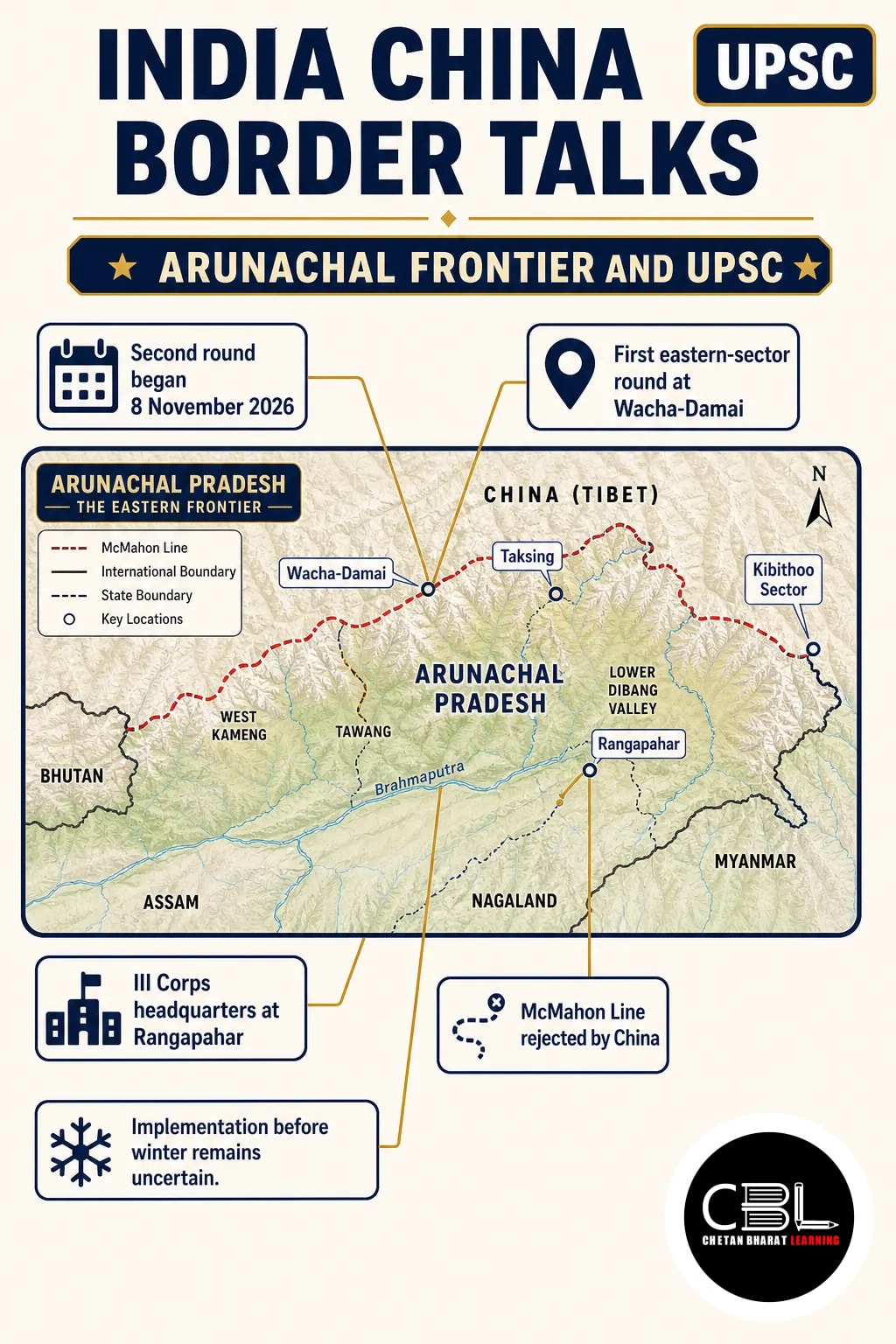
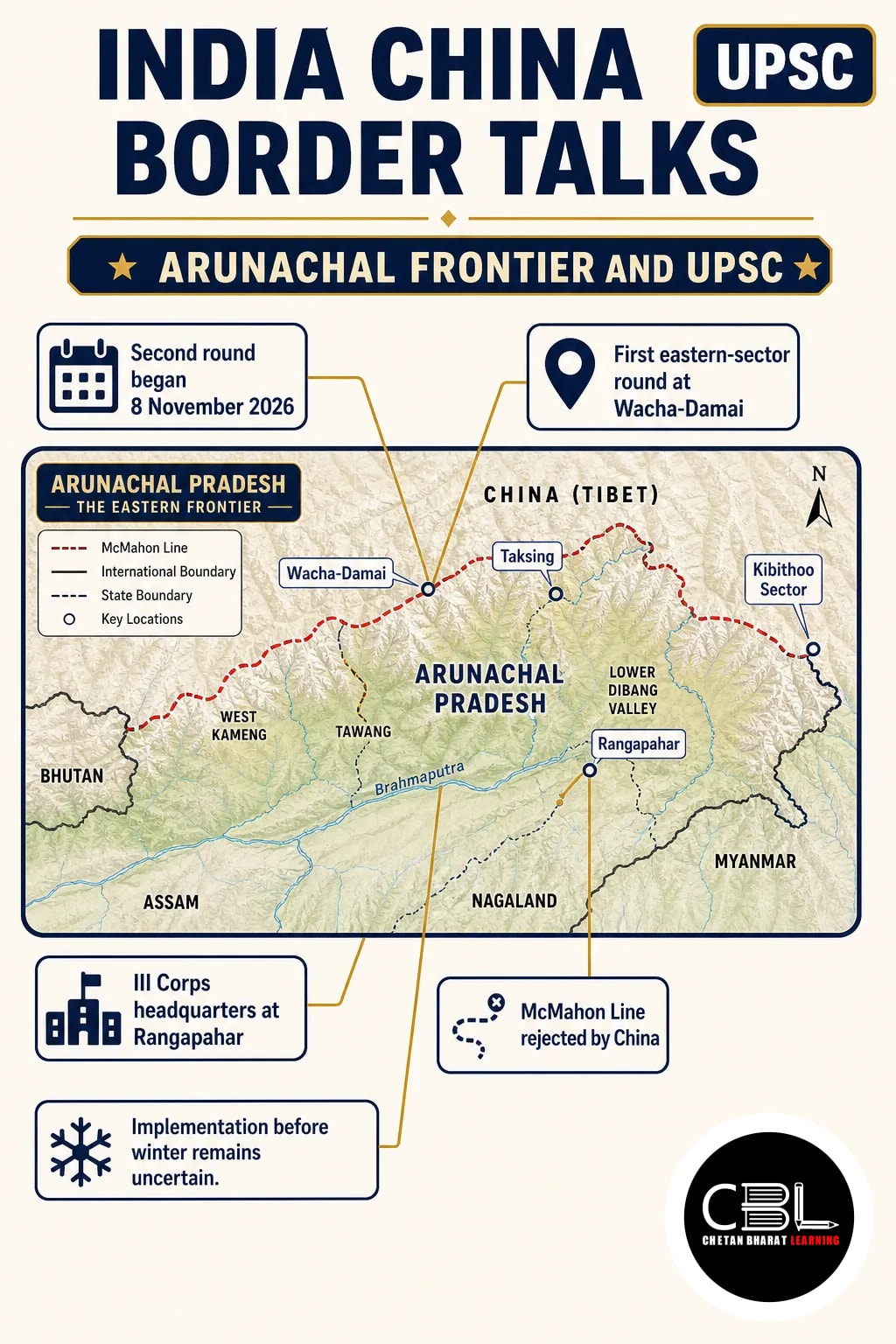
India China border talks have entered a second Corps Commander-level round to address tensions along the Arunachal Pradesh frontier. The discussions add a military dimension to the wider challenge of managing India’s external relations.
Quick answer: India China border talks brought senior military officers together for nearly 10 days after 8 November 2026. The second eastern-sector round sought clearer engagement rules and communication to reduce friction near Arunachal Pradesh before winter. However, it remains unclear whether the measures agreed upon will be implemented before winter fully sets in.
What happened at the India China border talks?
Indian and Chinese military officers concluded a second round aimed at reducing friction along the Arunachal frontier. The discussions began immediately after Diwali on 8 November and continued for nearly 10 days, with a short break.
Lieutenant General Girish Kalia, General Officer Commanding of the Indian Army’s III Corps, met his Chinese counterpart and other officers. An official from the Ministry of External Affairs also attended. III Corps, known as the Spear Corps, has its headquarters at Rangapahar near Dimapur in Nagaland.
The talks were described as cordial. However, the source does not specify the venue of this round or the details of the measures agreed upon. It also leaves their implementation before severe winter uncertain.
What are the objectives and outcomes?
The talks sought practical arrangements to prevent encounters from escalating, but their implementation remains uncertain.
- Engagement rules: Both sides sought rules for interactions between their forces; clear procedures can reduce misunderstandings.
- Communication: Open lines between the two sides could allow commanders to address incidents quickly.
- Winter pressures: Both sides have massed troops in the area; severe winter makes their sustenance and logistics harder.
- Implementation: The source mentions measures agreed upon, but provides neither their terms nor a confirmed implementation schedule.
Therefore, the discussions should not be equated with a confirmed disengagement or a boundary settlement. Their practical value depends on whether arrangements are carried out on the ground.
How did the talks develop?
The second round followed diplomatic contact and an earlier military meeting in the eastern sector.
| Date | Event |
|---|---|
| August 2026 | National Security Advisor Ajit Doval and Chinese Foreign Minister Wang Yi, the boundary-talks special representatives, met in Beijing. |
| 6–7 September 2026 | The first eastern-sector Corps Commander-level round took place at Wacha-Damai, following reports of tension near Taksing. |
| October 2026 | Indo-Tibetan Border Police Director General Shatrujeet Kapur said troops had faced off at multiple locations in Arunachal Pradesh. |
| From 8 November 2026 | The second military round continued for nearly 10 days, with a short break. |
Wacha is India’s easternmost border personnel meeting point, located in the Kibithoo sector. Taksing, meanwhile, lies in Arunachal Pradesh’s Upper Subansiri district. These locations show that the issue concerns the wider eastern frontier, not just one meeting point.
Why is the Arunachal frontier contested?
Different boundary perceptions and China’s rejection of the McMahon Line complicate management of the frontier. The Line of Actual Control (LAC) is the line separating areas under the two countries’ control; it is not a mutually settled international boundary.
The McMahon Line, agreed between British India and Tibet in 1914, serves as the de facto boundary in Arunachal Pradesh. However, Beijing rejects it, arguing that Tibet lacked the authority to conclude such an agreement.
After Kapur’s remarks, India’s Ministry of External Affairs said the situation is disturbed when Chinese forces diverge from established patrolling patterns. Arunachal Pradesh Chief Minister Pema Khandu also linked recurring transgressions to the undefined boundary and China’s position on the McMahon Line.
Why do the talks matter for India?
The discussions matter because local encounters can affect both border security and the wider bilateral relationship.
- Operational stability: Agreed procedures could help personnel manage close encounters without rapid escalation.
- Diplomatic coordination: Military talks address immediate friction, while special representatives engage with the broader boundary question.
- Logistics: Winter raises the difficulty of sustaining deployed forces; therefore, timely implementation matters.
- Bilateral relations: The Ministry of External Affairs has linked border peace with the overall development of India-China relations.
For a related security perspective, see CBL’s analysis of grey-zone tactics along the LAC. However, the present report does not establish that any specific incident in this round involved such tactics.
What are the concerns and the way forward?
The central concern is whether communication and agreed measures translate into predictable conduct by troops. Differing perceptions, infrastructure construction and force multipliers can create friction, as former Chief of Defence Staff Lieutenant General Anil Chauhan noted.
First, commanders need workable contact channels and clear procedures for handling encounters. Second, consistent adherence to any agreed measures is essential; otherwise, dialogue may not prevent renewed friction. Finally, military preparedness and diplomatic engagement must proceed together, without treating short-term stability as a substitute for settling the boundary question.
Source: The Indian Express, 22 November 2026
- Grey-Zone Warfare: China’s LAC Tactics Explained (28 Oct 2026)
Punjab PCS and Haryana HCS may test the McMahon Line, the LAC and locations in Arunachal Pradesh under General Studies. In addition, border management and India-China relations offer useful themes for descriptive answers.
Prelims Practice Corner
Mains Practice Questions
Frequently Asked Questions
Why were the India China border talks held?
The talks aimed to reduce friction along the Arunachal frontier before winter. They also sought engagement rules and open communication between the forces.
Where was the first eastern-sector Corps Commander meeting held?
It was held at Wacha-Damai on 6–7 September 2026. Wacha is India’s easternmost border personnel meeting point, in the Kibithoo sector.
Does China recognise the McMahon Line?
No, China rejects the McMahon Line. It argues that Tibet lacked the authority to conclude the 1914 agreement with British India.
Did the second round confirm disengagement?
No disengagement is confirmed in the source. Moreover, it remains unclear whether the measures agreed upon will be implemented before winter fully sets in.
Related Current Affairs
Preparing for UPSC, PCS or HCS?
Talk to a mentor at Chetan Bharat Learning, Chandigarh. Free guidance on choosing the right exam and building a study plan.
Chat on WhatsAppCall 97793 53345UPSC / IAS / PCS coaching in Chandigarh · Trusted by aspirants across Punjab & Haryana






Leave a Reply
You must be logged in to post a comment.