
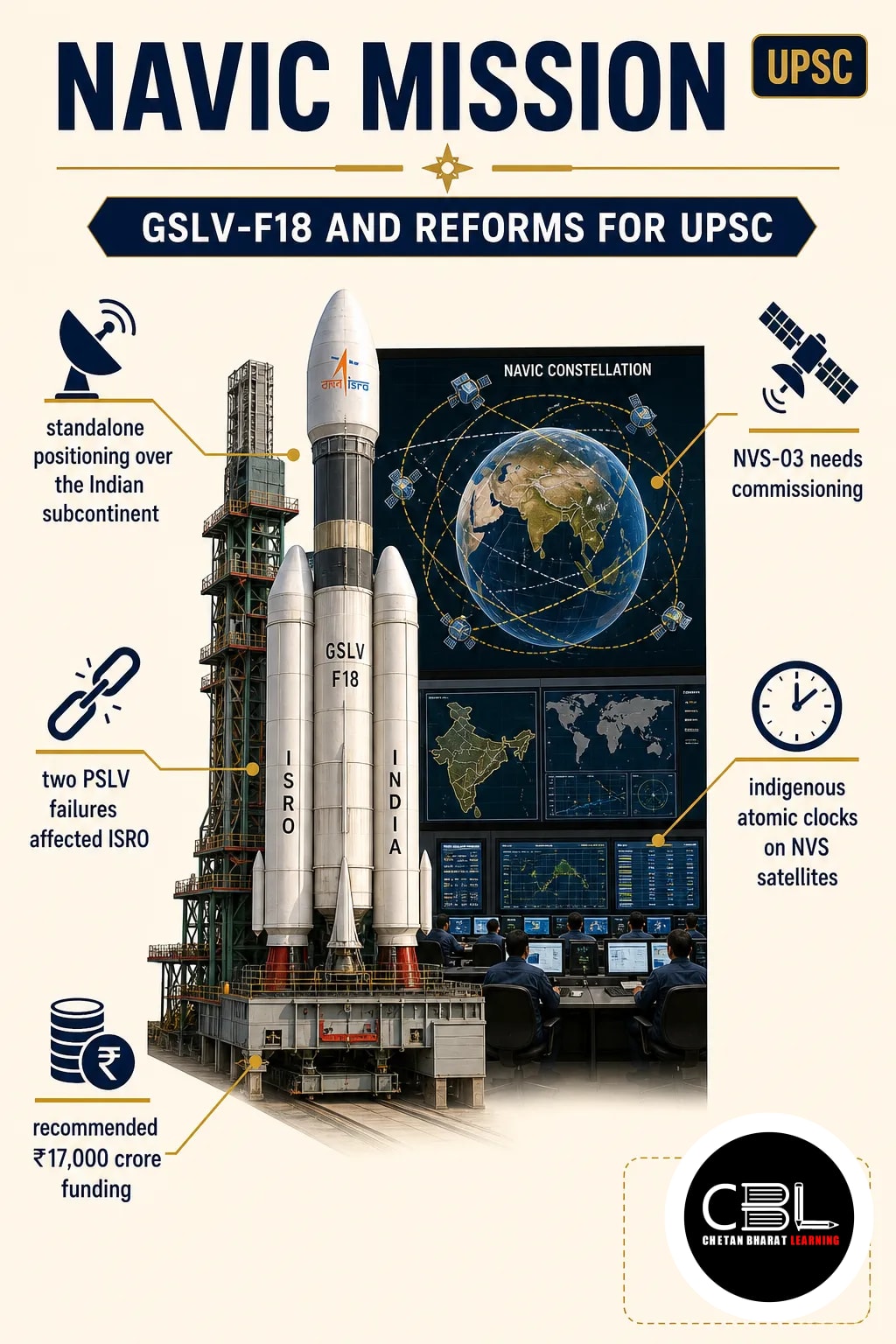

The NavIC mission has received a boost from the successful GSLV-F18 launch, but its recovery depends on the NVS-03 satellite reaching its intended orbital slot and entering service. The development highlights both India’s navigation needs and the production constraints facing its space programme.
Quick answer: The NavIC mission aims to provide independent positioning over the Indian subcontinent. The Indian Space Research Organisation (ISRO) successfully launched NVS-03 on GSLV-F18, and the satellite is healthy. However, restoration of standalone services depends on successful orbital manoeuvres and commissioning after a shortage lasting at least six months.
What is NavIC and why is it in the news?
Navigation with Indian Constellation (NavIC) is India’s regional satellite navigation system, designed to provide positioning services over the Indian subcontinent. The successful GSLV-F18 launch offers a route to restoring its standalone capability.
NVS-03 is healthy after launch, but ISRO must still manoeuvre it into its final intended orbital slot and commission it. Therefore, a successful launch is not the same as a fully restored navigation service. For launch-specific details, see CBL’s NVS-03 launch explainer.
The system has been at least one functional satellite short for the past six months. As a result, it has been unable to fulfil its primary purpose of providing standalone positioning across the subcontinent.
Key features of the NavIC mission
NavIC combines satellites and precise timekeeping to support regional positioning.
| Feature | What to remember |
|---|---|
| Service objective | Standalone positioning over the Indian subcontinent |
| Latest launch | GSLV-F18 carried NVS-03; final orbital placement and commissioning remain necessary |
| Second-generation satellites | Each of the three NVS satellites so far carries at least one indigenously made atomic clock |
| First-generation satellites | The Indian Regional Navigation Satellite System (IRNSS) satellites carried imported atomic clocks |
An atomic clock supplies precise time signals used to calculate distance from satellites. Therefore, clock reliability and satellite availability both matter for positioning. Indigenous clocks also reduce reliance on imported components, although they do not eliminate the need for testing and replacement capacity.
Why does independent navigation matter?
Independent navigation gives India greater control over a service used to determine location and time. Consequently, reliable availability matters as much as developing the underlying technology.
Positioning and timing can support transport, mapping and disaster response. In addition, dependable regional services can help users reduce reliance on signals controlled by other countries. However, this benefit requires enough functioning satellites and a system for replacing them on time.
The mission also illustrates a wider technology-policy issue: indigenous capability involves more than designing a satellite. It requires component suppliers, skilled personnel, testing facilities and sustained operational funding.
What challenges constrain recovery?
Launch setbacks, procurement delays and limited production capacity constrain the NavIC mission and the wider space programme.
- Launch reliability: Two failures involving the Polar Satellite Launch Vehicle (PSLV) constrained ISRO over the preceding 18 months. Moreover, PSLV and the Geosynchronous Satellite Launch Vehicle (GSLV) share some design aspects; GSLV-F18 was only the second successful launch of 2026.
- Satellite continuity: A constellation shortage can interrupt standalone service even when individual launches succeed. Therefore, replacement planning must account for both satellite readiness and launch availability.
- Procurement: The Parliamentary Standing Committee on Science and Technology flagged difficulties in sourcing specialised components and ensuring vendors were ready on time. Consequently, production schedules can slip before a satellite reaches the launch stage.
- Long lead times: A 2025 request for proposals from ISRO’s Space Applications Centre specified nearly two years between contract commencement and the first two flight models. Thus, urgent replacement cannot depend solely on last-minute orders.
- Capacity and workforce: Limited funding and personnel affect launch vehicle production, satellite replacement and recruitment. These pressures also compete with plans for human spaceflight, a space station and reusable launch vehicles.
What reforms could strengthen the programme?
A credible recovery requires predictable funding, stronger supply chains and clear operational responsibilities. The source editorial proposes the following measures rather than describing approved decisions.
Fund continuity, not just launches
The editorial recommends around ₹17,000 crore for the Department of Space in the 2027–28 Union Budget, compared with ₹13,705.6 crore in 2026–27. It proposes directing the increase towards launch vehicle manufacturing, satellite replacement and recruitment. Predictable allocations could support procurement before an operational shortage develops.
Build a space-grade supply chain
The editorial suggests adapting the Electronics Component Manufacturing Scheme and the Semiconductor Laboratory modernisation programme to space-sector needs. In addition, it recommends dedicated Electronics Ministry funding for specialised components and qualification tests over five to seven years. Qualification matters because components must meet demanding operational requirements before use in flight.
Clarify institutional roles
A dedicated NavIC operator could manage service continuity while ISRO concentrates on its core space mandate. However, such a separation would need clear responsibilities for performance, funding and coordination with satellite manufacturers.
Finally, the editorial calls for a national space law covering private participation and liability. Clear rules could support investment and allocate responsibility for damage; they must also preserve public oversight of a strategically important service.
Source: The Hindu Editorial, 2 November 2026
- NVS-03 NavIC Launch: Key Facts for UPSC (31 Oct 2026)
Asked in UPSC: Previous Year Questions
- UPSC CSE Prelims 2023 (GS Paper I): Which country has its own satellite navigation system: Australia, Canada, Israel or Japan?
UPSC tests navigation systems alongside their geographical and technological features.
State PCS General Studies may test NavIC’s purpose, satellite-based positioning and indigenous technology. In addition, candidates can connect reliable positioning to transport and disaster management without assuming state-specific deployment.
Prelims Practice Corner
Mains Practice Questions
Frequently Asked Questions
What is the purpose of NavIC?
NavIC aims to provide independent positioning over the Indian subcontinent. Therefore, its standalone operation depends on an adequate functional satellite constellation.
Has NVS-03 already restored standalone NavIC services?
No, because the satellite still needs final orbital manoeuvres and commissioning. Its healthy status after launch is a positive step, but it does not complete service restoration.
Why are atomic clocks important for satellite navigation?
Atomic clocks provide precise time signals for calculating distances from satellites. Moreover, each of the three second-generation NVS satellites so far carries at least one indigenous atomic clock.
Related Current Affairs
Preparing for UPSC, PCS or HCS?
Talk to a mentor at Chetan Bharat Learning, Chandigarh. Free guidance on choosing the right exam and building a study plan.
Chat on WhatsAppCall 97793 53345UPSC / IAS / PCS coaching in Chandigarh · Trusted by aspirants across Punjab & Haryana

 Ananya RanaIAS · AIR 60
 Aditya SharmaIAS · AIR 70
 Ria Kaur SethiIPS · AIR 89
 Aman AloonIRS · AIR 295
 Sumer Singh VirkIRS · AIR 335
 Shivani PanchalIAS

Leave a Reply
You must be logged in to post a comment.