
UPSC Mapping
| Exam | Topic |
|---|---|
| Prelims | Indian Polity |
| Mains | GS Paper 2 (Parliament & State Legislatures) |
Article
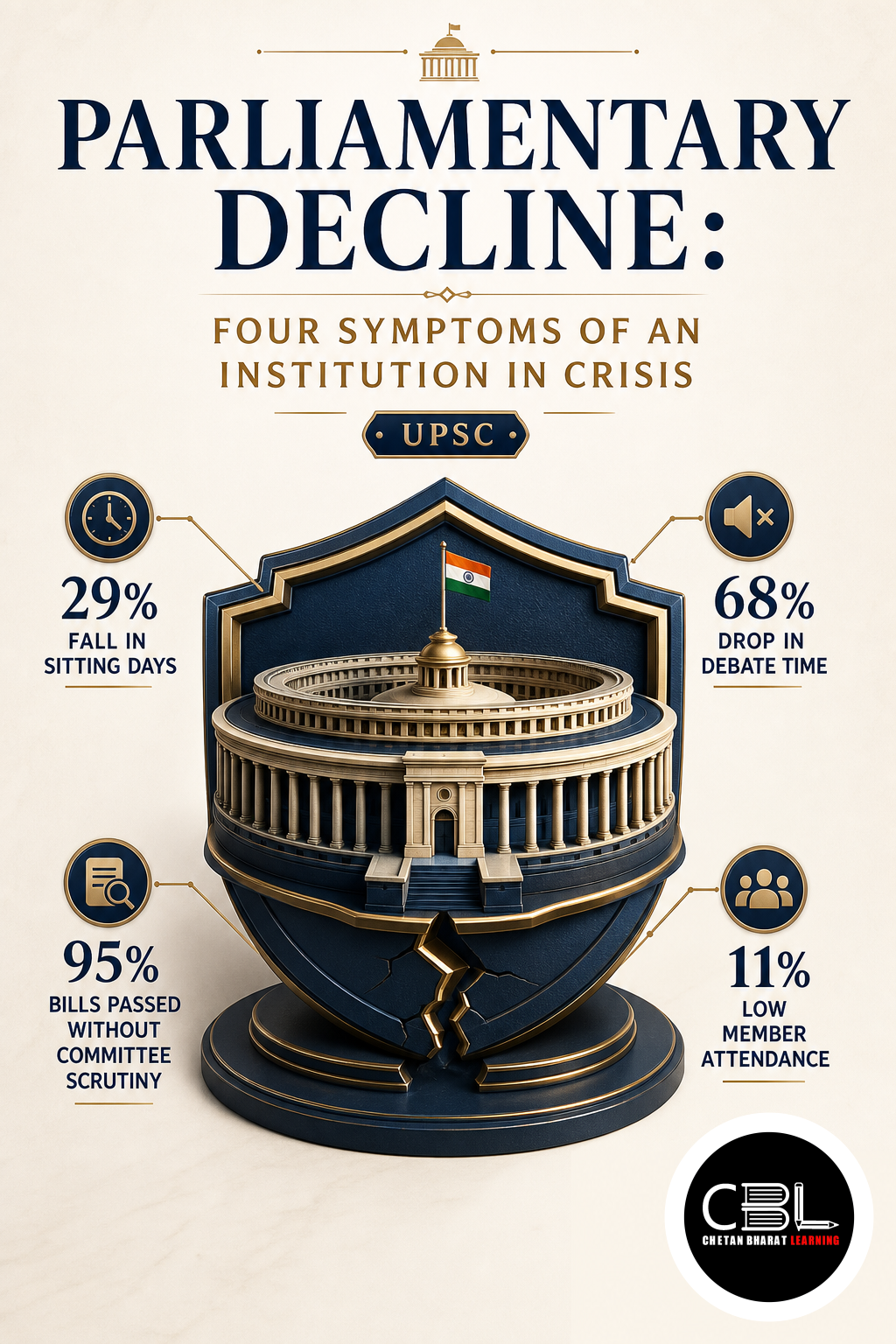
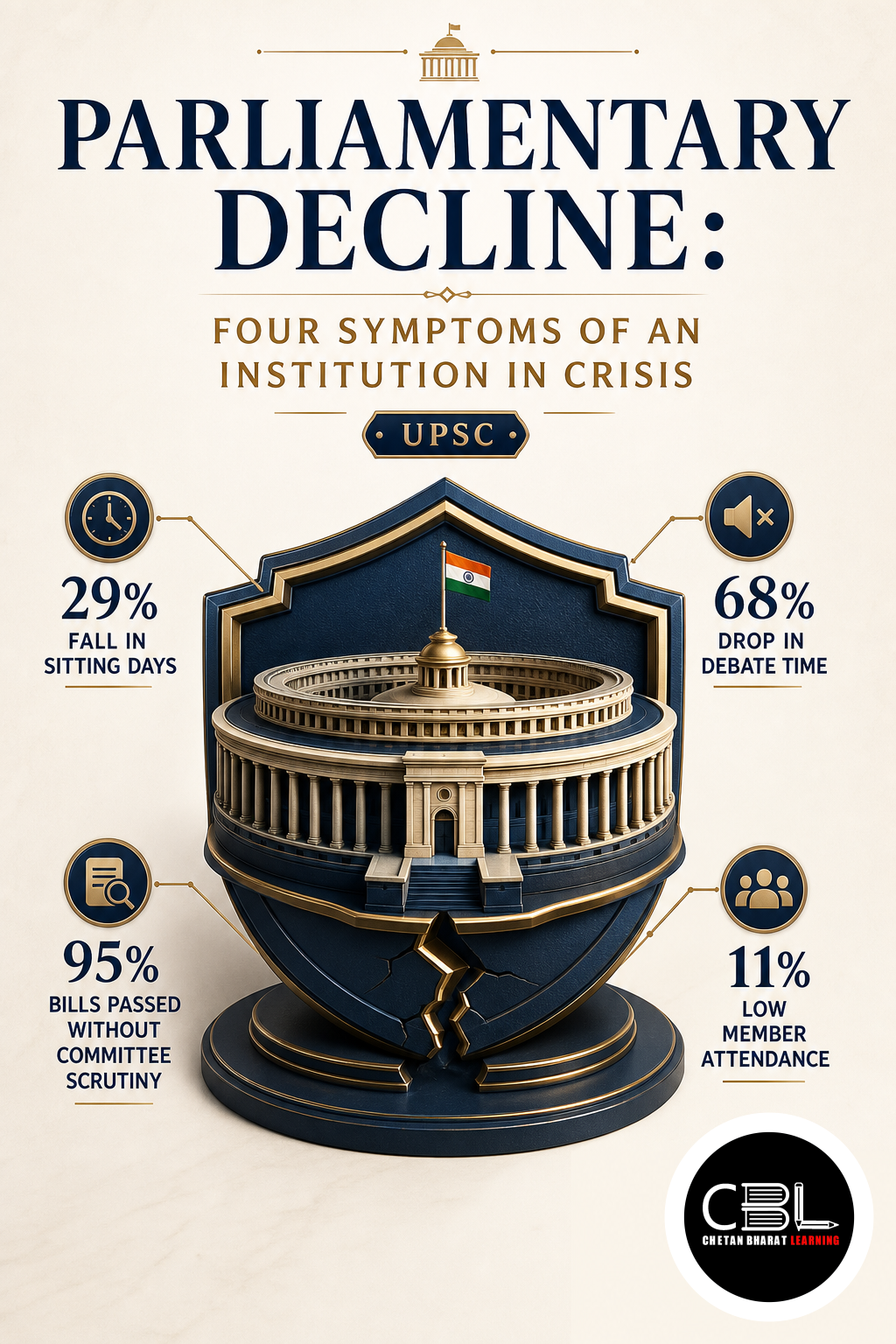
Concerns over parliamentary decline have been growing as India’s legislature appears to be losing its deliberative and oversight functions. A recent article drawing on Hiren Mukherjee’s classic ‘Portrait of Parliament’ highlights four symptoms of institutional decay: concentration of power in the executive, decline of debate, erosion of institutional memory, and weakening of parliamentary committees. These trends pose a serious threat to the health of India’s democracy and are a critical subject for polity governance current affairs.
| Core Issue | Key Symptom |
|---|---|
| Executive dominance | Decline of debate |
What is Parliamentary Decline?
Parliamentary decline refers to the gradual erosion of the legislature’s ability to effectively represent, deliberate, and hold the executive accountable. It manifests in reduced scrutiny of legislation, fewer meaningful debates, and a shift of power from the legislature to the executive. In India, this has been observed in the form of shorter sessions, frequent disruptions, and the bypassing of parliamentary committees for key decisions.
Hiren Mukherjee, a renowned parliamentarian, warned in his book that if Parliament fails to prize its own dignity, its powers would be imperilled. Today, many commentators argue that the institution has become a ratifying body for executive decisions rather than a sovereign deliberative forum. This decline has implications for the quality of democracy and governance.
Why is Parliamentary Decline in News?
The issue of parliamentary decline has been reignited by a recent opinion piece that outlined four symptoms of decay, drawing from Mukherjee’s work. The article pointed to the concentration of power in the executive, the decline of quality debate, the erosion of institutional memory, and the diminishing role of committees. These trends are particularly concerning because they weaken the checks and balances that are essential for a healthy democracy.
Parliament’s role in scrutinising the government has come under scrutiny, especially with the passage of key bills without adequate discussion. The opposition has often complained that their voices are ignored, and proceedings are frequently adjourned due to disruptions. The government, on the other hand, argues that it has a mandate to govern efficiently. For official records of parliamentary proceedings, refer to the official Parliament website.
Key Symptoms of Decline
- Executive Centralisation: The executive increasingly bypasses Parliament through ordinances and delegated legislation, reducing legislative oversight.
- Decline of Debate: Speeches are often designed for media consumption rather than genuine persuasion, and disruptions have replaced deliberation.
- Erosion of Institutional Memory: Conventions and unwritten rules that guide parliamentary behaviour are being ignored, weakening the democratic culture.
- Weakening of Committees: Parliamentary committees, which are meant for detailed scrutiny, are often underutilised, and their recommendations are ignored.
- Shortened Sessions: The number of sitting days has decreased, reducing the time available for examination of bills and policies. For more on governance issues, explore the governance archive.
Challenges to Parliamentary Effectiveness
- Partisanship: Increasingly polarized political environment makes consensus difficult.
- Lack of Expertise: Many MPs lack the time or resources to study complex legislation in depth.
- Disruptions: Frequent adjournments waste valuable time and prevent meaningful discussion.
- Executive Overreach: Use of money bills and ordinances to circumvent Parliament.
- Media Distortion: Parliamentary debates are often reduced to sound bites, undermining substantive discourse.
Way Forward for Revitalising Parliament
To address parliamentary decline, both the government and the opposition must recognise that a strong Parliament is in everyone’s interest. Reforms should include increasing the number of sitting days, strengthening committee systems, and ensuring that legislation is scrutinised thoroughly. There is also a need for capacity building of MPs through research support and training. Political parties should encourage constructive debate rather than disruptive tactics.
Ultimately, the revival of parliamentary dignity requires a collective commitment to democratic values. As Mukherjee argued, democracy requires institutions capable of slowing down power and compelling it to explain itself. The way forward lies in restoring the deliberative ethos and ensuring that Parliament remains the true voice of the nation. A PRS India analysis provides recommendations for parliamentary reforms.
Prelims Practice Corner
Q1. Who wrote ‘Portrait of Parliament’?
- (a) B.R. Ambedkar
- (b) Hiren Mukherjee
- (c) M.N. Roy
- (d) Jawaharlal Nehru
Answer: (b) Hiren Mukherjee. The book reflects on Parliament’s role and its decline.
Q2. Which of the following is NOT a symptom of parliamentary decline?
- (a) Strong committee scrutiny
- (b) Executive dominance
- (c) Decline of debate
- (d) Erosion of institutional memory
Answer: (a) Strong committee scrutiny is a sign of health, not decline.
Mains Practice Questions
Q1. “Parliament is not an appendage of the executive, but the sovereign arena for national deliberation.” In light of recent concerns, discuss the causes and consequences of parliamentary decline in India. (250 words, 15 marks)
Answer Structure:
Intro: Define parliamentary decline and its significance for democracy.
Body: Discuss symptoms (executive dominance, weak debate, committee erosion, institutional memory loss). Analyse causes: partisanship, short sessions, media influence. Consequences: reduced accountability, poor legislation, democratic deficit.
Conclusion: Suggest reforms—more sitting days, stronger committees, MP training, and a revived deliberative culture.
FAQs
What is the role of parliamentary committees?
Committees are meant for detailed scrutiny of bills, budgets, and policies away from the heat of partisan debate. They play a crucial role in improving legislation and ensuring executive accountability.
How does parliamentary decline affect governance?
It leads to weaker laws, less scrutiny of the executive, and a disconnect between the government and the people’s representatives, ultimately undermining democratic legitimacy.
What can be done to reverse parliamentary decline?
Measures include increasing sitting days, strengthening committees, providing better research support to MPs, and fostering a culture of constructive debate rather than disruption.
Related Current Affairs
Preparing for UPSC, PCS or HCS?
Talk to a mentor at Chetan Bharat Learning, Chandigarh. Free guidance on choosing the right exam and building a study plan.
Chat on WhatsAppCall 97793 53345UPSC / IAS / PCS coaching in Chandigarh · Trusted by aspirants across Punjab & Haryana
Leave a Reply
You must be logged in to post a comment.