

UPSC Mapping
| Prelims | Mains |
|---|---|
| Exomoon, Exoplanet, Brown Dwarf, Radial Velocity Method | GS Paper III – Science & Technology, Space Science and Astronomy |
What is Exomoon?
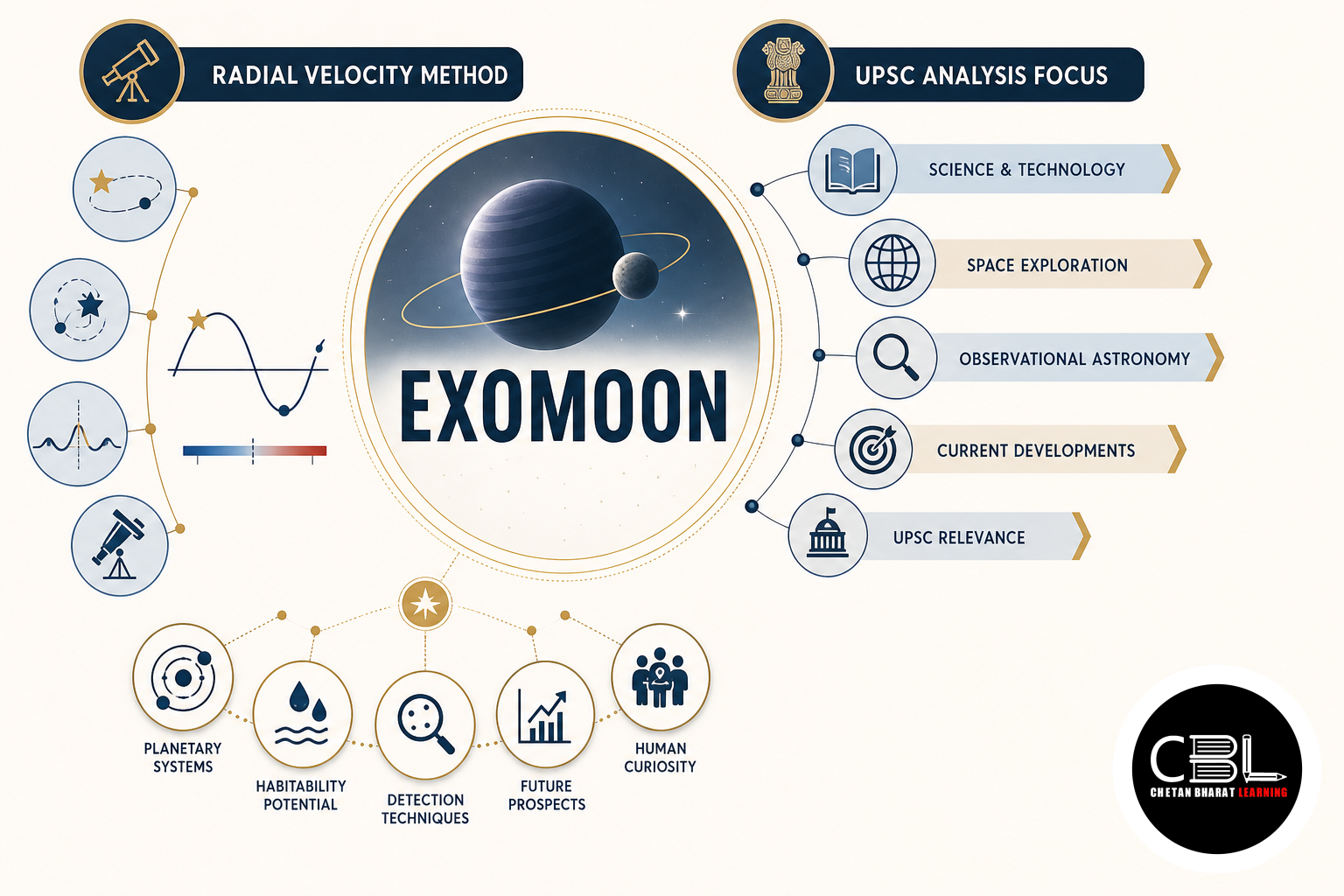
An exomoon is a natural satellite that orbits an exoplanet, a planet located outside our Solar System. Although astronomers have confirmed more than 6,000 exoplanets, no exomoon has yet been conclusively confirmed, making every strong candidate scientifically significant.
The recently reported object is located in the CD-35 2722 system about 73 light-years from Earth. It is estimated to have a mass nearly 90% that of Jupiter and is believed to orbit a brown dwarf every 170 days along an elliptical path.
Why is Exomoon in News?
Astronomers identified evidence of an exomoon candidate using the radial velocity method with the European Southern Observatory’s Very Large Telescope (VLT) in Chile. The discovery showcases modern telescopes’ and analytical techniques’ growing capability to detect distant celestial bodies.
Studying exomoons can improve our understanding of planetary formation, orbital evolution and the diversity of planetary systems beyond our Solar System.
Key Features
- Exomoon: A natural satellite orbiting an exoplanet beyond the Solar System.
- Brown Dwarf: An object heavier than planets but lighter than stars, around which the candidate orbits.
- Radial Velocity Method: Detects the wobble of a star by measuring Doppler shifts in its light caused by gravitational interactions.
- Doppler Effect: Periodic shifts in the wavelength of light reveal whether a star moves toward or away from Earth.
- Advanced Observations: Enabled by the ESO’s Very Large Telescope in Chile, one of the world’s leading optical observatories.
Challenges
- Extremely Weak Signals: Exomoons produce much smaller observational signatures than exoplanets.
- Confirmation Difficulties: Candidate detections require repeated observations using multiple techniques.
- Instrument Sensitivity: High-precision telescopes and spectrographs are essential.
- Complex Orbital Dynamics: Interactions among stars, planets and moons complicate data interpretation.
- Limited Observational Data: Long orbital periods demand extended monitoring campaigns.
Way Forward
Future observatories, improved spectroscopy and artificial intelligence–based data analysis will enhance the search for exomoons and other distant celestial bodies. Better detection methods will deepen scientific understanding of planetary systems and their evolution.
Continued international collaboration in astronomy and space science will improve the reliability of future discoveries and help answer fundamental questions about planetary system formation.
Prelims Practice Corner
Q1. An exomoon is:
(a) A moon orbiting Earth (b) A natural satellite orbiting an exoplanet (c) A comet around the Sun (d) A moon orbiting Mars
Show answer
Answer: (b). An exomoon is a natural satellite of an exoplanet.
Q2. The radial velocity method primarily detects:
(a) Gravitational waves (b) Star wobble using Doppler shifts (c) Solar flares (d) Black holes directly
Show answer
Answer: (b).
Q3. The recent exomoon candidate was observed using:
(a) James Webb Space Telescope (b) Hubble Space Telescope (c) ESO Very Large Telescope (d) Giant Metrewave Radio Telescope
Show answer
Answer: (c).
Q4. The radial velocity method is based on the:
(a) Photoelectric effect (b) Doppler effect (c) Raman effect (d) Greenhouse effect
Show answer
Answer: (b).
Q5. A brown dwarf is best described as:
(a) A dead star (b) An object heavier than planets but lighter than stars (c) A neutron star (d) A black hole
Show answer
Answer: (b).
Mains Practice Questions
Q1. Explain the radial velocity method used in the detection of exoplanets and exomoons. Discuss its significance in modern astronomy. (10 Marks)
Answer Structure:
- Intro: Define the radial velocity method.
- Body: Doppler effect, star wobble, applications, advantages and limitations.
- Conclusion: Highlight its contribution to exoplanetary science.
Q2. Discuss how the discovery of exoplanets and exomoons advances our understanding of planetary formation and the search for potentially habitable worlds. (15 Marks)
Answer Structure:
- Intro: Introduce exoplanetary research.
- Body: Detection methods, planetary systems, scientific significance and future missions.
- Conclusion: Emphasise the expanding frontier of space exploration.
FAQs on Exomoon
What is an exomoon?
An exomoon is a natural satellite that orbits an exoplanet located outside our Solar System.
How does the radial velocity method work?
It measures periodic Doppler shifts in a star’s light caused by the gravitational pull of orbiting objects, revealing the star’s wobble and helping estimate the mass of the companion.
Why is the exomoon discovery important for UPSC?
It covers key concepts in astronomy such as exoplanets, brown dwarfs, Doppler effect and observational techniques, making it relevant for UPSC Prelims and GS Paper III.
Related Current Affairs
Preparing for UPSC, PCS or HCS?
Talk to a mentor at Chetan Bharat Learning, Chandigarh. Free guidance on choosing the right exam and building a study plan.
Chat on WhatsAppCall 97793 53345UPSC / IAS / PCS coaching in Chandigarh · Trusted by aspirants across Punjab & Haryana
Leave a Reply
You must be logged in to post a comment.