

Northeast tourist permits are being streamlined to encourage foreign travel while retaining security checks. The issue connects national governance with tourism and border-area security.
Quick answer: Northeast tourist permits were a major focus at the 14th international tourism mart in Tawang, Arunachal Pradesh. Officials discussed simpler applications and movement within approved zones. The push addresses low foreign participation: only 1.5 lakh of 1.5 crore tourists across the eight northeastern states were foreign nationals, according to official data.
What are Northeast tourist permits?
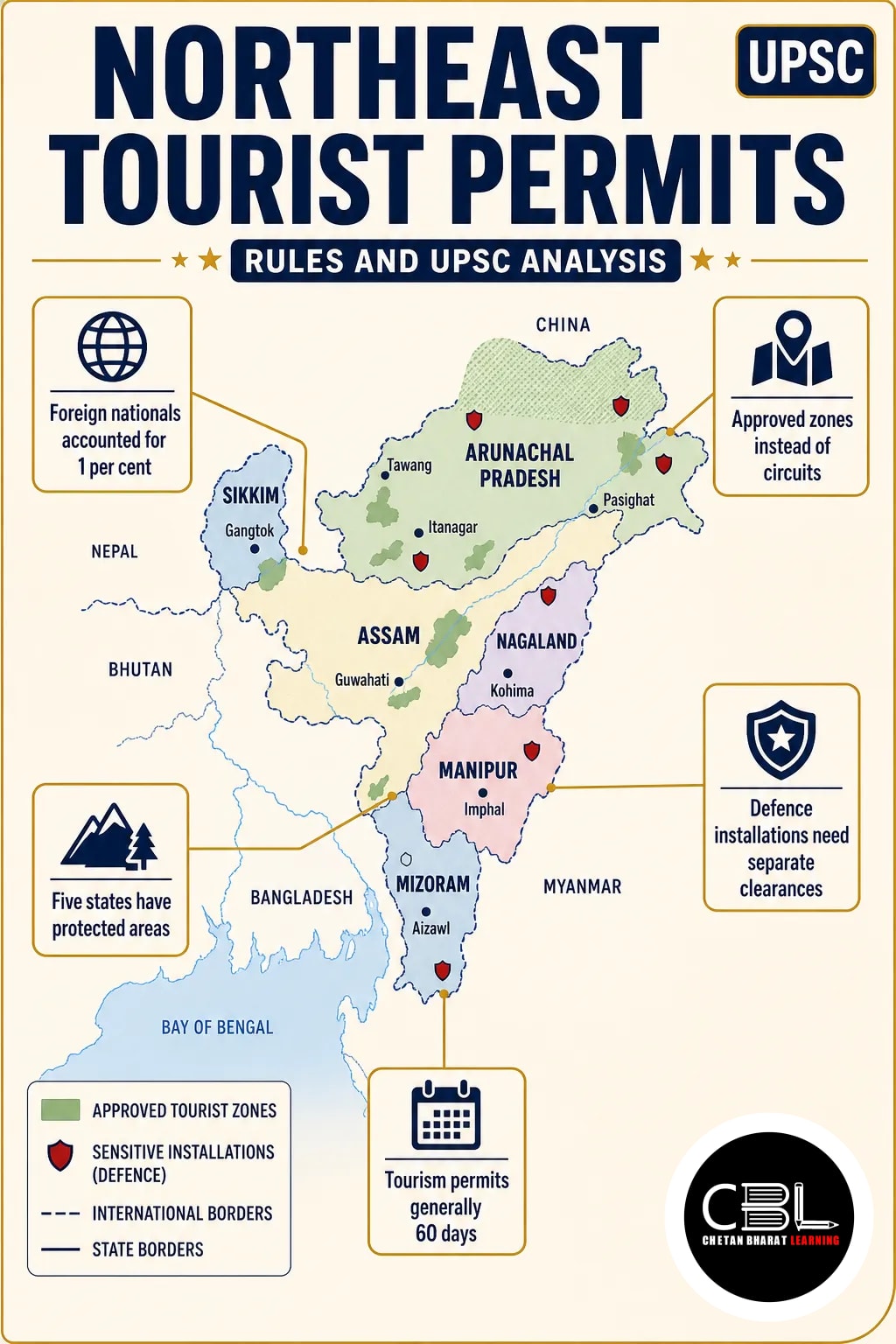
Northeast tourist permits regulate foreign nationals’ access to designated protected and restricted areas in the region. Five northeastern states have protected areas for foreign nationals: Arunachal Pradesh, Sikkim, Manipur, Mizoram and Nagaland.
The reported reforms simplify applications and allow movement within approved zones instead of confining permit holders to specified circuits or spots. However, a permit does not authorise entry into defence, paramilitary or sensitive installations. Those locations continue to require separate, specialised clearances.
This distinction matters for examination answers: easier access is not unrestricted access. Moreover, the reported provisions concern foreign nationals; they should not be treated as a statement of rules for every domestic traveller.
Why are the rules in the news?
The 14th international tourism mart in Tawang brought permit reform into focus as states sought more foreign visitors. Representatives from all eight northeastern states attended a technical session led by the Ministry of Home Affairs.
Participants discussed easier entry alongside safety. In addition, Union Tourism and Culture Minister Gajendra Singh Shekhawat stressed a calibrated approach that recognises national security and regional strategic concerns.
The scale of the opportunity is clear, although the source does not specify the period covered by the tourist data. Foreign nationals accounted for just 1 per cent of the 1.5 crore tourists recorded across the region. Therefore, the figure shows a small foreign share, not the cause of that share or the success of the reforms.
How do the application and movement rules work?
Foreign nationals can use online or offline channels to apply, while permit conditions define their permitted movement.
| Feature | Reported provision |
|---|---|
| Online application | Through Indian diplomatic missions before arrival or Foreigners Regional Registration Offices (FRROs). |
| Offline application | Direct submission within the host state or union territory. |
| Tourism duration | Generally 60 days, according to Mizoram Tourism Department officials. |
| Non-tourism duration | 180 days, extendable up to a year in select cases, according to the same officials. |
| Movement | Freedom within approved zones rather than restriction to specified circuits or spots. |
Hotels and travel agents must also comply with reporting requirements, including submission of Form-III reports to registration officers. Meanwhile, authorities must verify the genuine purpose of travel. The duration figures come from Mizoram officials and should not be assumed to apply identically to every case.
Why does easier access matter?
Simpler procedures can make it easier for prospective visitors and operators to plan travel in the Northeast. However, their impact will depend on implementation as well as connectivity and infrastructure.
- Tourism potential: Tour operators highlighted Buddhist tourism in Arunachal Pradesh, the birthplace of the sixth Dalai Lama. For related cultural context, see the coverage of Buddha relics in Arunachal.
- Visitor choice: Movement within approved zones can allow travellers to plan beyond fixed circuits. However, this remains subject to permit boundaries and special clearances.
- Connectivity: Better access depends on transport as well as paperwork. For example, the Mizoram roads coverage provides context on regional connectivity.
- Local opportunity: Greater visitor access could support accommodation, guiding and transport services. Nevertheless, the source does not quantify these potential gains.
What are the policy challenges and way forward?
The central challenge is to reduce avoidable delays without weakening scrutiny in strategically sensitive areas. Consequently, reform requires coordination between tourism authorities, registration officers and security agencies.
First, clear public guidance should distinguish approved zones from installations requiring separate permission. This can reduce confusion for visitors and operators while preserving existing security controls. Second, application channels should give applicants clear instructions on documents, status and applicable conditions.
Third, registration officers need reliable reporting from hotels and travel agents. However, compliance should focus on verification rather than unnecessary repetition of paperwork. Finally, governments can track foreign visitor numbers and processing outcomes to assess whether easier procedures improve access without compromising safety.
Overall, the policy test is not simply whether more permits are issued. Rather, it is whether accountable processing, visitor convenience and security safeguards work together across participating jurisdictions.
Source: Indian Express, 1 November 2026
State PCS General Studies may test the locations of northeastern states and the distinction between approved zones and sensitive installations. The topic also illustrates coordination between state tourism authorities and central security agencies.
Prelims Practice Corner
Mains Practice Questions
Frequently Asked Questions
Which northeastern states have protected areas for foreign nationals?
Arunachal Pradesh, Sikkim, Manipur, Mizoram and Nagaland have such areas. Therefore, foreign visitors must check applicable permit conditions before travelling.
Can foreign visitors apply for permits online?
Yes, through Indian diplomatic missions before arrival or through Foreigners Regional Registration Offices. In addition, applicants can submit applications offline within the host state or union territory.
Does a tourist permit allow entry to sensitive installations?
No, because defence, paramilitary and sensitive installations require separate, specialised clearances. Movement under the reported reform remains limited to approved zones.
What share of Northeast tourists were foreign nationals?
Foreign nationals accounted for 1 per cent of the reported total. However, the source does not specify the period covered by the data.
Related Current Affairs
Preparing for UPSC, PCS or HCS?
Talk to a mentor at Chetan Bharat Learning, Chandigarh. Free guidance on choosing the right exam and building a study plan.
Chat on WhatsAppCall 97793 53345UPSC / IAS / PCS coaching in Chandigarh · Trusted by aspirants across Punjab & Haryana

 Ananya RanaIAS · AIR 60
 Aditya SharmaIAS · AIR 70
 Ria Kaur SethiIPS · AIR 89
 Aman AloonIRS · AIR 295
 Sumer Singh VirkIRS · AIR 335
 Shivani PanchalIAS

Leave a Reply
You must be logged in to post a comment.