
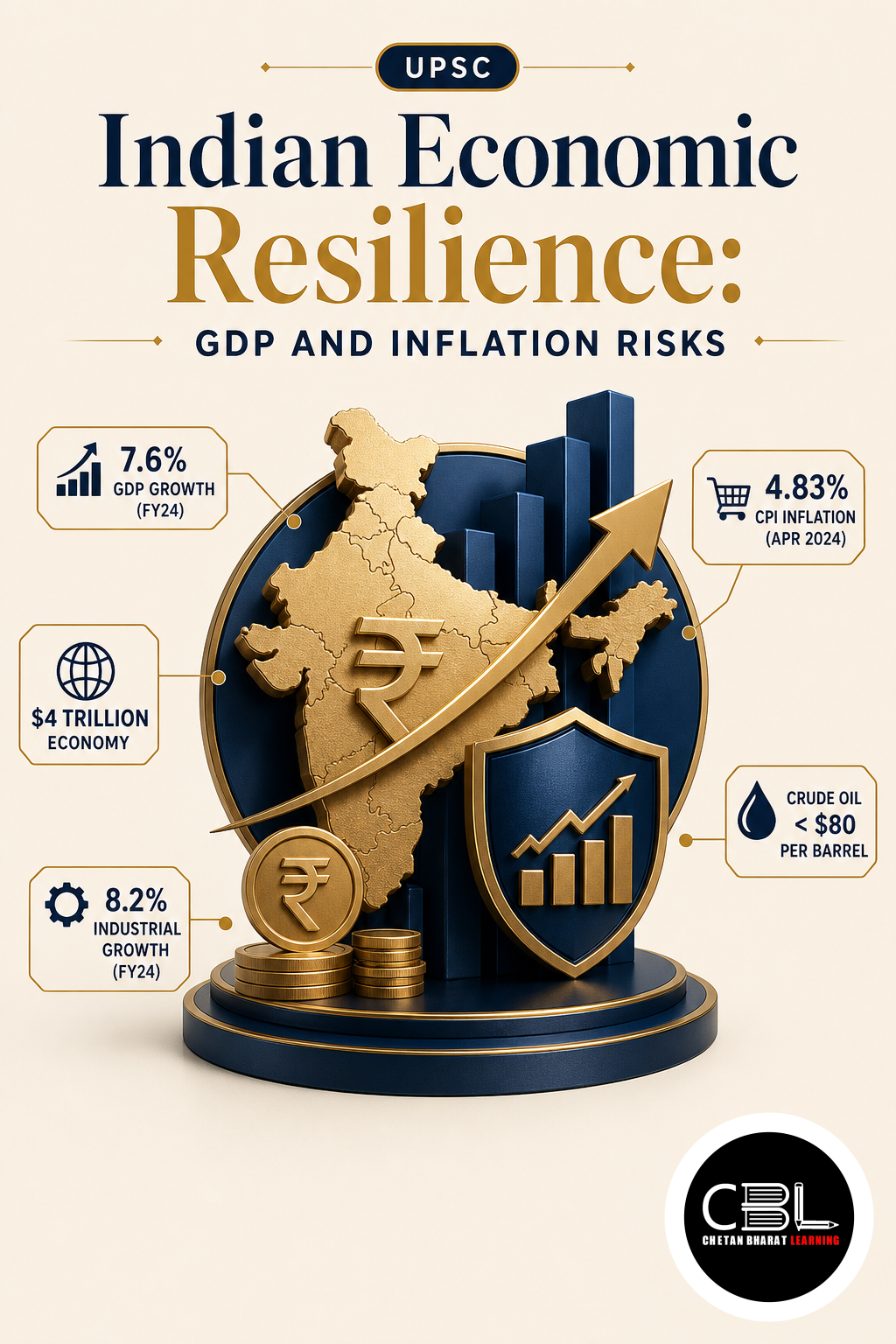

Indian Economic Resilience has stood out despite serious external shocks. The pattern reflects strong domestic demand, policy support and a sizeable services cushion, while low inflation and a manageable external account can still hide vulnerable components. For related developments, see the daily current affairs archive.
What is Indian Economic Resilience?
Indian Economic Resilience is the ability of an economy to absorb shocks while preserving growth, price stability, financial confidence and external sustainability. For UPSC, resilience must be judged through multiple macroeconomic indicators rather than one headline number. Strong output can coexist with weaknesses in employment, investment, household purchasing power or the external sector.
In the source framework, GDP, inflation, the current account, services and remittances form five connected pillars. Consumption and investment support domestic activity, while government spending and net exports shape aggregate demand. Services earnings and remittances add external buffers, but a common global shock can still weaken several pillars together.
Why is Indian Economic Resilience in News?
The news analysis highlights an unusual combination of strong GDP growth, moderating inflation, a manageable current account, robust services exports and high remittance inflows. These indicators suggest that several domestic and external buffers are operating together. Indian Economic Resilience in this context therefore depends on the interaction of output, prices and foreign-exchange earning capacity rather than on GDP alone.
The source also stresses that resilience should not be confused with immunity. Wars, protectionism, oil-price volatility, slowing global growth, supply-chain disruptions and unstable capital flows can affect more than one pillar simultaneously. For UPSC preparation, aspirants can track official GDP and national-accounts releases through the Ministry of Statistics and Programme Implementation and compare them with inflation and external-sector indicators.
Key Features
Five linked supports explain the resilience described in the source, but each support has a different economic mechanism.
- Growth has multiple demand engines: Consumption, investment, government expenditure and net exports jointly determine output, while housing, infrastructure, public spending and services can reinforce activity. Lower borrowing costs, stronger household demand and public investment can reinforce these channels, although each works through a different transmission path.
- Headline inflation can conceal composition: The source distinguishes headline inflation from core inflation and highlights the importance of food, fuel and supply shocks. Food, fuel, weather shocks and imported inputs can lift the headline measure, while core inflation excludes volatile food and fuel components. This makes headline versus core inflation an important distinction for policy analysis.
- The current account is cushioned by invisibles: A widening merchandise trade deficit does not automatically produce a proportionately large current account deficit. India’s earnings from services exports and remittance inflows can offset part of the goods gap. This is why the balance of payments must be read beyond merchandise trade alone.
- Services provide growth and foreign exchange: IT and software, financial services, business services, transport, tourism and education-related services contribute to output and external receipts. The source emphasises that services can support both GDP expansion and current-account stability by generating domestic value added and foreign-exchange receipts.
- Remittances stabilise household and external finances: Money sent home by Indians working abroad supports consumption, housing, education and savings. These transfers also bring foreign exchange into the economy, making remittances a useful buffer when the merchandise trade balance deteriorates.
Together, these channels form a resilience chain: growth sustains demand, moderate inflation protects purchasing power, services generate foreign exchange, remittances support incomes and the current account remains more manageable. The useful UPSC lesson is that macroeconomic indicators interact; they should not be interpreted as independent scorecards. The CBL economy current affairs section can be used to connect these indicators with monetary, fiscal and external-sector topics.
Aspirants should also distinguish between a buffer and a permanent source of strength. Services exports and remittances can absorb pressure from a goods deficit, but they do not erase India’s exposure to imported energy or global demand. Similarly, low headline inflation can preserve real purchasing power, yet the benefit weakens if food and other essential goods become expensive for households. Reading the five pillars together gives a more accurate picture of macroeconomic resilience than any single quarterly statistic.
Challenges
Sustaining Indian Economic Resilience requires attention to the quality of the present support, not only the headline rate.
- Oil and geopolitical exposure: Higher crude prices can worsen the import bill, weaken the rupee and raise transport and production costs. A prolonged West Asia disruption can therefore affect inflation, the trade balance and corporate margins simultaneously.
- Inflation may reappear through goods: Food and fuel shocks can reappear quickly within headline inflation. Weather shocks, crop losses, freight disruptions and imported commodity costs can raise the CPI even when recent inflation looks moderate.
- Services exports face structural uncertainty: External demand can weaken during a global slowdown, especially when major markets reduce spending or impose new trade barriers. Since services receipts help finance the goods deficit, softer export growth can expose the current account to pressure.
- Protectionism can weaken external demand: Tariffs and trade barriers can reduce export opportunities, alter supply chains and delay investment decisions. The impact can spread from merchandise exporters to logistics, business services and firms integrated with global production networks.
- Climate and supply shocks remain potent: Monsoon variation, heat waves, floods, crop shocks and logistics disruptions can raise food prices and production costs. These pressures can weaken purchasing power while forcing tighter monetary conditions if inflation becomes persistent.
The central analytical risk is overconfidence. A strong aggregate number can be produced when one sector compensates for another, but the offset may not persist. UPSC answers should therefore examine employment intensity, private investment, household demand, credit quality and external vulnerability alongside GDP. For broader revision, the UPSC current affairs coverage helps connect these moving indicators with policy decisions.
Way Forward
Policy should aim to convert cyclical resilience into structural resilience. That requires deeper private investment, efficient logistics, diversified energy sourcing, stronger domestic supply chains and employment-intensive manufacturing. Better agricultural productivity and storage can reduce food-price volatility, while diversified export markets can lower dependence on a narrow set of external demand centres.
Monetary and fiscal authorities also need to watch the interaction between headline and core inflation, exchange-rate pressures, commodity costs and credit quality. Durable Indian Economic Resilience will depend on productivity and investment rather than temporary offsets between sectors. The Reserve Bank of India provides official monetary-policy and external-sector material useful for tracking these risks.
FAQs on Indian Economic Resilience
Why can strong GDP data coexist with economic risks?
GDP is an aggregate and can rise even when some sectors remain weak. Sectoral composition, employment, investment and external vulnerability determine whether the expansion is structurally broad-based.
How do services exports help India’s current account?
Earnings from exported services bring foreign exchange into India and can offset part of a merchandise trade deficit. IT and business services are therefore important to both growth and external stability.
Why are remittances important for macroeconomic resilience?
Remittances support household income and supply foreign exchange without creating debt. They can cushion the current account, although they cannot substitute for stronger exports and domestic productivity.
Related Current Affairs
Preparing for UPSC, PCS or HCS?
Talk to a mentor at Chetan Bharat Learning, Chandigarh. Free guidance on choosing the right exam and building a study plan.
Chat on WhatsAppCall 97793 53345UPSC / IAS / PCS coaching in Chandigarh · Trusted by aspirants across Punjab & Haryana
Leave a Reply
You must be logged in to post a comment.