
UPSC Mapping
Prelims
WTO, BRICS and International Trade Agreements
Mains
GS Paper II — International Institutions and Agreements
Quick Facts
| Participants | A Subset of WTO Members |
|---|---|
| WTO Legal Route | Annex 4 |
| Incorporation Rule | Consensus Required |
| Current Trigger | BRICS New Delhi Declaration 2026 |
What are Plurilateral Trade Agreements?
Plurilateral Trade Agreements are negotiated among a group of countries rather than the entire WTO membership. Participating members accept the agreed obligations, while non-participants generally remain outside those commitments. This structure differs from a multilateral agreement, whose rules apply across the organisation’s membership after collective negotiations. The plurilateral route can help willing members advance when universal consensus remains difficult.
Within the WTO system, a participating group may request formal incorporation of an agreement into Annex 4 of the Marrakesh Agreement. Article X.9 requires the Ministerial Conference to decide such addition exclusively by consensus. Existing Annex 4 agreements include the Agreement on Government Procurement and the Agreement on Trade in Civil Aircraft. Their obligations bind their parties rather than every WTO member, preserving a legal distinction between multilateral and plurilateral commitments.
Why are Plurilateral Trade Agreements in News?
The 2026 BRICS New Delhi Declaration stated that members recognised the importance of identifying appropriate pathways for plurilateral initiatives to enter the WTO legal framework. It included development-oriented issues and the possible formulation of forward-looking rules. The language appeared significant because India chaired the summit and had recently defended a more restrictive position at the WTO’s Fourteenth Ministerial Conference. The complete language appears in the official New Delhi Declaration.
At MC14 in Cameroon, India insisted that incorporating plurilateral outcomes should require consensus and must not impose obligations on non-participants. It opposed adding the Investment Facilitation for Development Agreement without broader legal safeguards. For Plurilateral Trade Agreements, the BRICS declaration may represent a willingness to discuss pathways rather than reject the model categorically. This interpretation remains an inference because the declaration does not withdraw India’s objections or accept any specific pending agreement.
Key Features
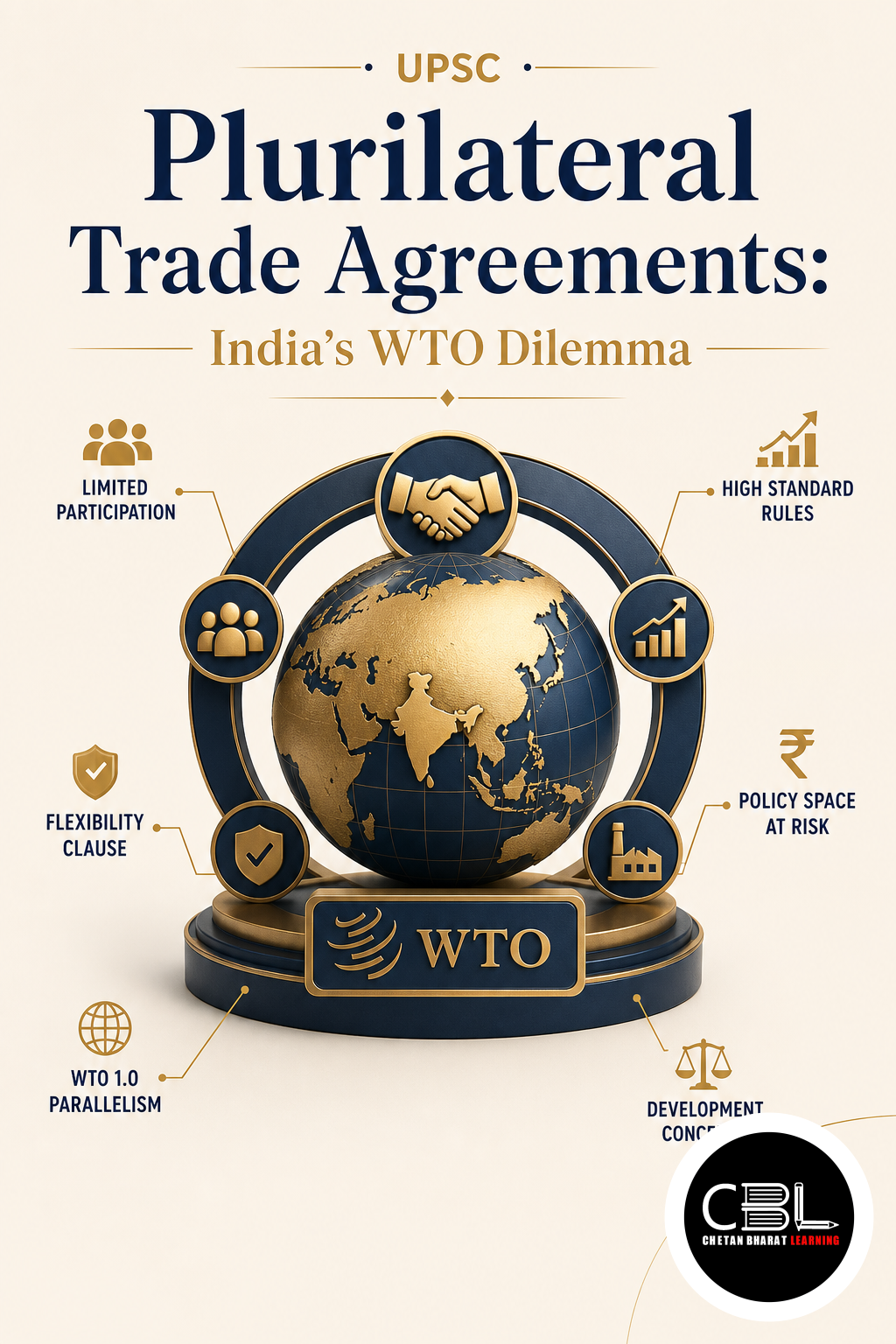
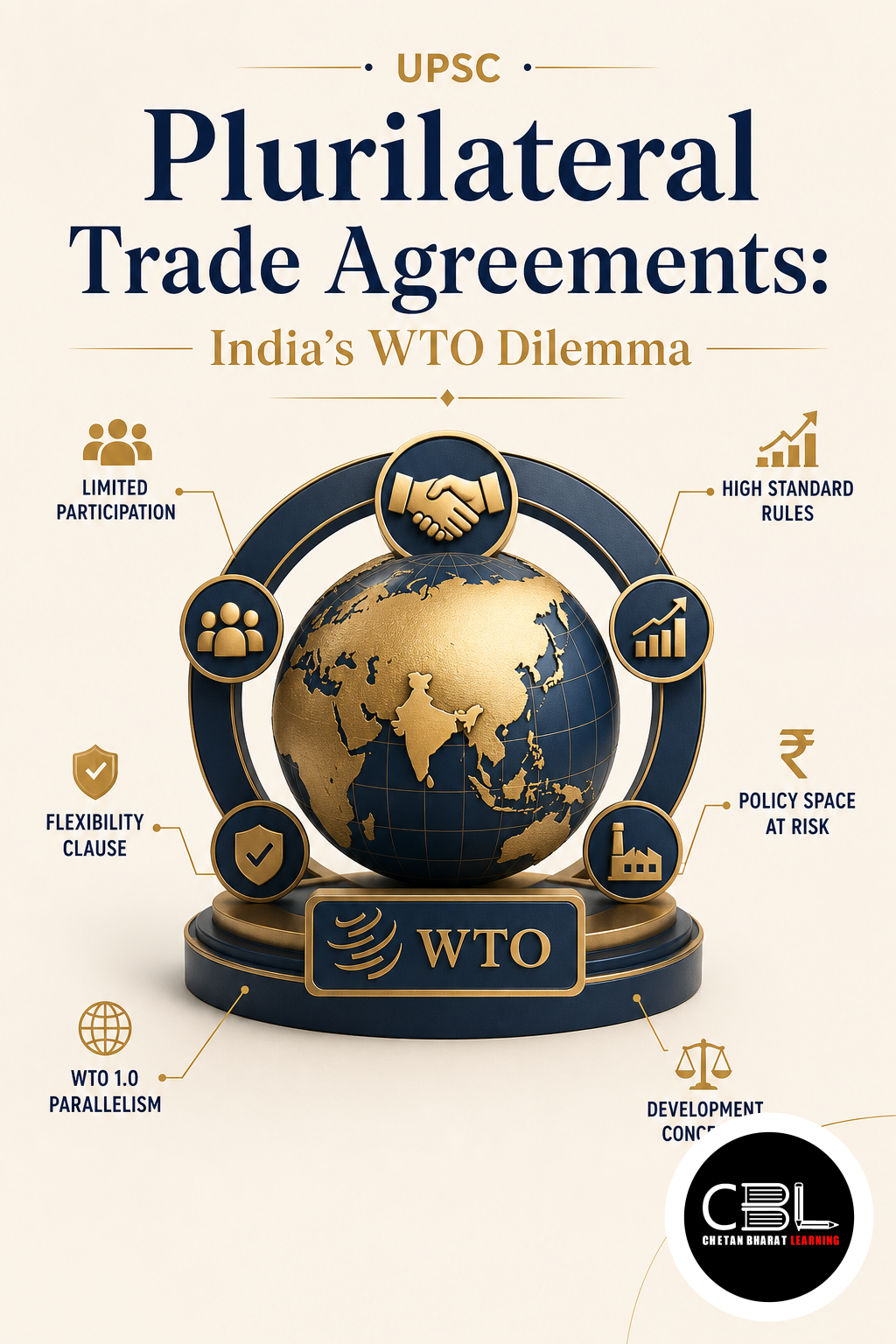
- Limited participation: A subset of interested WTO members negotiates common rules, allowing other members to remain outside the arrangement unless they later decide to join.
- Party-specific obligations: Members accepting the agreement follow its commitments, while the arrangement should not reduce existing WTO rights or impose additional duties on non-participating countries.
- Consensus for Annex 4: Formal addition of a new plurilateral agreement to the WTO rulebook requires consensus, giving every member a voice over institutional incorporation.
- Open-accession potential: Many proposed arrangements allow additional members to join after meeting their conditions, which can gradually expand participation without waiting for universal agreement at the beginning.
- Issue-specific negotiations: Current debates cover investment facilitation, digital commerce, services regulation and environmental concerns, where negotiating interests and domestic capacities differ considerably among WTO members.
Challenges
- Fragmentation risk: Multiple agreements with different memberships and obligations can divide the WTO into overlapping regulatory groups, weakening the predictability of a common multilateral rulebook.
- Unequal rule-making power: Economically powerful members may possess greater technical and negotiating capacity, enabling them to shape standards before developing countries can assess their consequences.
- Indirect spillovers: Non-participants may face commercial pressure to follow standards created by a coalition when major markets or global firms begin treating those rules as practical requirements.
- Development-policy constraints: Rules concerning investment, data, subsidies or regulation may restrict domestic policy space before poorer members acquire the administrative and technological capacity needed for compliance.
- Strategic exclusion costs: Staying outside new negotiations can protect immediate autonomy but may prevent India from shaping emerging rules affecting its services, digital and investment interests. CBL’s economy current affairs analysis covers related trade-policy developments.
Way Forward
India should treat Plurilateral Trade Agreements as instruments requiring clear safeguards rather than automatic acceptance or rejection. It can propose common guardrails covering transparency, open accession, technical assistance and special and differential treatment. New agreements should preserve the rights of non-participants and avoid imposing obligations through indirect institutional mechanisms. Their negotiating processes should publish texts early and provide developing countries sufficient time to evaluate regulatory, fiscal and social consequences.
India should also participate actively in discussions affecting digital trade, services and investment, even when it does not immediately join the final agreement. Early engagement can protect policy space while allowing Indian businesses and experts to influence emerging standards. Members must continue prioritising unresolved multilateral questions, including food security, agricultural support and restoration of a fully functioning dispute-settlement system. The Marrakesh Agreement legal text provides the basis for maintaining consensus and institutional legitimacy. A balanced approach can combine negotiating flexibility with an inclusive multilateral trading system.
Prelims Practice Corner
Q1. In the context of the WTO, what is a plurilateral agreement?
- (a) An agreement binding every WTO member
- (b) An agreement among a subset of members
- (c) A treaty between only two countries
- (d) A decision issued by the WTO Secretariat
Answer: (b) A plurilateral agreement contains commitments accepted by a group rather than the entire WTO membership.
Q2. Under the Marrakesh Agreement, adding a new plurilateral agreement to Annex 4 requires which decision-making method?
- (a) Simple majority
- (b) Two-thirds majority
- (c) Consensus
- (d) Approval by the Director-General alone
Answer: (c) Article X.9 requires the Ministerial Conference to decide exclusively by consensus.
Q3. Which of the following are currently included among WTO Annex 4 agreements? 1. Agreement on Government Procurement 2. Agreement on Trade in Civil Aircraft 3. Agreement on Agriculture
- (a) 1 only
- (b) 1 and 2 only
- (c) 2 and 3 only
- (d) 1, 2 and 3
Answer: (b) Government Procurement and Trade in Civil Aircraft are plurilateral, while the Agreement on Agriculture is multilateral.
Q4. India’s objection to incorporating the Investment Facilitation for Development Agreement has primarily emphasised which concern?
- (a) Investment rules require no international cooperation
- (b) Incorporation without agreed safeguards could weaken consensus and WTO mandates
- (c) Only developed countries receive foreign investment
- (d) WTO agreements cannot address administrative procedures
Answer: (b) India has demanded consensus, legal clarity and protection of non-participants’ rights before institutional incorporation.
Q5. Consider the following statements: 1. A plurilateral agreement necessarily binds all WTO members. 2. Open accession can allow additional members to join later. 3. Such agreements may advance negotiations where universal consensus is difficult. How many statements are correct?
- (a) Only one
- (b) Only two
- (c) All three
- (d) None
Answer: (b) Statements 2 and 3 are correct; non-participants generally do not accept the agreement’s obligations.
Mains Practice Questions
Q1. Differentiate between multilateral and plurilateral agreements within the WTO system. Why has India approached the latter cautiously? (10 marks)
Answer Structure:
- Intro: Define multilateral and plurilateral agreements through their membership and legal obligations.
- Body: Discuss consensus, Annex 4, non-participant rights, development concerns, policy space and unequal negotiating capacity.
- Conclusion: Support transparent, open and development-sensitive negotiations within the WTO framework.
Q2. Does the 2026 BRICS New Delhi Declaration indicate a shift in India’s approach to plurilateral initiatives at the WTO? Critically examine. (15 marks)
Answer Structure:
- Intro: Mention the declaration’s support for identifying appropriate legal pathways.
- Body: Contrast this language with India’s MC14 stance, discuss possible tactical flexibility, unresolved guardrails and strategic costs of exclusion.
- Conclusion: Describe the declaration as a possible opening for engagement rather than a confirmed policy reversal.
FAQs on Plurilateral Trade Agreements
Why does India oppose some Plurilateral Trade Agreements?
India fears that smaller groups could create influential rules without universal participation or adequate development safeguards. It also seeks protection against additional obligations being imposed on non-participants.
What did the BRICS New Delhi Declaration say about plurilateral initiatives?
It recognised the importance of identifying appropriate pathways for such initiatives within the WTO legal framework. It also referred to development-oriented issues and forward-looking rules.
Has India formally reversed its WTO position?
No formal reversal has been announced. The declaration suggests possible flexibility in discussing legal pathways, but India’s demands concerning consensus, safeguards and non-participant rights remain relevant.
Related Current Affairs
Preparing for UPSC, PCS or HCS?
Talk to a mentor at Chetan Bharat Learning, Chandigarh. Free guidance on choosing the right exam and building a study plan.
Chat on WhatsAppCall 97793 53345UPSC / IAS / PCS coaching in Chandigarh · Trusted by aspirants across Punjab & Haryana
Leave a Reply
You must be logged in to post a comment.