
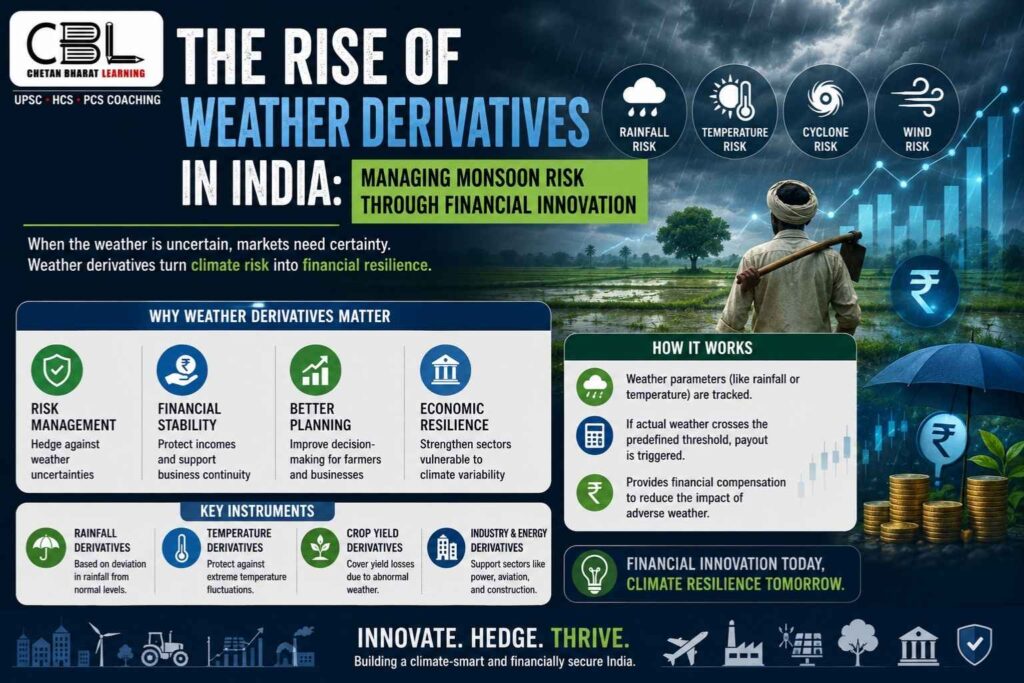
Why Weather Risk Is Becoming an Economic Challenge
India’s economy remains deeply dependent on the monsoon. From agriculture and food inflation to rural consumption and commodity markets, rainfall variability continues to influence multiple sectors of the economy.
To address this growing uncertainty, the National Commodity and Derivatives Exchange (NCDEX) is set to launch India’s first exchange-traded weather derivatives contract called RAINMUMBAI.
The initiative represents an important step toward climate risk management and financial innovation in India’s commodity ecosystem.
Students preparing through UPSC Coaching in Chandigarh and IAS Coaching in Chandigarh should closely follow topics like climate finance, agricultural risk management, monsoon variability, and commodity market reforms because these themes are highly important for GS Paper 3, Essay, and UPSC Interview preparation.
What Are Weather Derivatives?
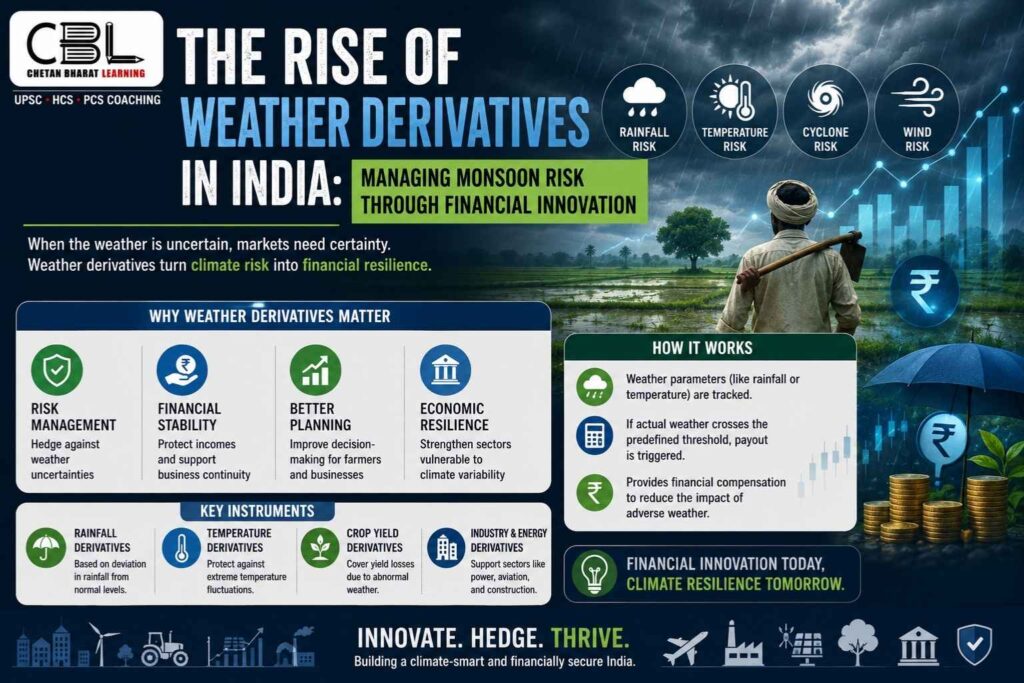
Weather derivatives are financial instruments that help businesses and farmers protect themselves against unpredictable weather conditions.
Unlike traditional insurance, weather derivatives do not compensate for physical damage. Instead, payouts are linked to measurable weather indicators such as:
- Rainfall levels
- Temperature variations
- Humidity
- Wind patterns
This allows businesses to hedge against climate-related economic losses.
How the NCDEX Weather Contract Will Work
The NCDEX weather derivatives contract has been developed in collaboration with:
- IIT Bombay
- India Meteorological Department (IMD)
The contract uses rainfall data collected from:
✔ Automatic Weather Stations (AWS)
✔ Santacruz observatory data
✔ Colaba rainfall data
The derivatives contract will be traded on the exchange within a specified trading window.
This creates a market-driven mechanism for managing climate uncertainty.
Why India Needs Weather Derivatives
1. Rising Climate Variability
India is witnessing:
- Erratic monsoons
- Unseasonal rainfall
- Heatwaves
- Extreme weather events
These disruptions create financial uncertainty for:
- Farmers
- Commodity traders
- Agri-businesses
- Food processing industries
Weather derivatives can reduce economic shocks caused by climate instability.
2. Agricultural Risk Management
Agriculture remains highly vulnerable to rainfall fluctuations.
Poor monsoon performance often leads to:
- Crop losses
- Lower rural income
- Food inflation
- Supply-chain disruptions
Weather-based financial products can improve resilience in the agricultural economy.
3. Strengthening Climate Finance Ecosystems
The introduction of weather derivatives reflects the growing importance of climate-linked financial instruments globally.
Such instruments help:
✔ Improve financial planning
✔ Reduce uncertainty
✔ Increase investor confidence
✔ Build economic resilience
This also aligns India with global climate finance trends.
The Role of Technology and Data
The success of weather derivatives depends heavily on:
- Accurate meteorological data
- Real-time monitoring systems
- Predictive climate analytics
- Advanced weather modeling
India’s expanding digital infrastructure and meteorological capabilities are making such financial innovations increasingly feasible.
Economic and Policy Significance
The launch of exchange-traded weather derivatives indicates a broader shift toward:
- Market-based climate adaptation
- Data-driven financial systems
- Advanced commodity market reforms
It also demonstrates how climate governance is increasingly intersecting with financial regulation and economic planning.
Challenges and Concerns
Despite the potential benefits, several concerns remain:
Data Reliability
Weather-linked contracts require highly accurate and transparent climate data.
Awareness and Participation
Many farmers and small businesses may lack awareness about derivative instruments.
Market Liquidity
A successful derivatives market requires sufficient trading participation and investor confidence.
Regulatory Oversight
Strong regulatory monitoring is essential to prevent speculative misuse and market manipulation.
Prelims Pointers
Important Institutions
- NCDEX
- SEBI
- IMD
- IIT Bombay
Key Concept
Weather derivatives are financial instruments linked to measurable weather parameters rather than physical asset damage.
Purpose
- Monsoon risk hedging
- Climate risk management
- Agricultural resilience
Mains Perspective
Possible Question
“Climate-linked financial instruments can strengthen economic resilience in climate-vulnerable economies like India.” Discuss.
Key Dimensions to Include
- Agricultural vulnerability
- Climate finance
- Risk management
- Financial innovation
- Data governance
- Market regulation
Frequently Asked Questions (FAQ)
How are weather derivatives different from insurance?
Insurance compensates for actual physical damage, while weather derivatives provide payouts based on predefined weather indicators.
Why are weather derivatives important for India?
India’s economy is highly dependent on monsoon patterns. Weather derivatives help reduce economic uncertainty caused by climate variability.
Who benefits from weather derivatives?
- Farmers
- Commodity traders
- Agri-businesses
- Food processing industries
- Energy companies
Why is the NCDEX initiative significant?
It marks India’s first exchange-traded weather derivatives contract and strengthens climate risk management capabilities in financial markets.
Conclusion: Climate Finance Meets Economic Resilience
The launch of NCDEX weather derivatives reflects the growing intersection of:
- Climate governance
- Financial innovation
- Agricultural resilience
- Economic risk management
As climate uncertainty becomes a defining feature of modern economies, weather-linked financial instruments may become increasingly important for protecting livelihoods, stabilizing markets, and strengthening long-term economic resilience.
“In the age of climate volatility, economic resilience will increasingly depend not only on rainfall itself, but on how effectively societies manage climate risk.”
Related Current Affairs
Preparing for UPSC, PCS or HCS?
Talk to a mentor at Chetan Bharat Learning, Chandigarh. Free guidance on choosing the right exam and building a study plan.
Chat on WhatsAppCall 97793 53345UPSC / IAS / PCS coaching in Chandigarh · Trusted by aspirants across Punjab & Haryana
Leave a Reply
You must be logged in to post a comment.