

UPSC Mapping
Prelims
- Virtual Magnets
- Electric Motors
- Rare-Earth Magnets
- Electromagnets
Mains
- GS Paper III: Science & Technology, Innovation and Electric Mobility
| Technology | Software-Controlled Magnetic Fields |
|---|---|
| Motor Materials | Copper and Steel |
| Application | Electric Vehicle Motors |
| Significance | Reduced Rare-Earth Dependence |
Article
What are Virtual Magnets?
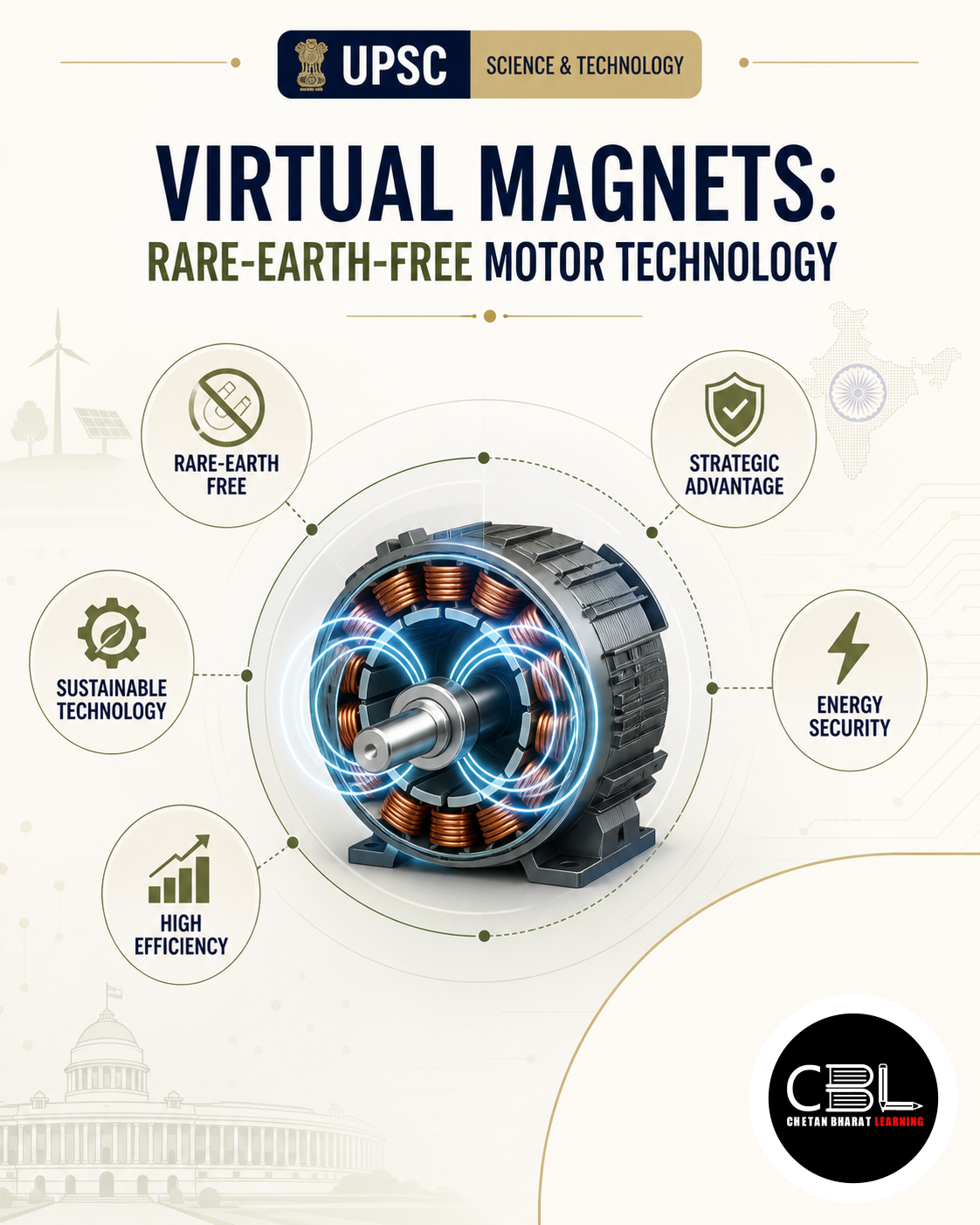
Virtual Magnets are an emerging motor technology that creates magnetic behaviour without using conventional permanent rare-earth magnets. Instead, the system employs wireless power transfer and sophisticated software algorithms to generate electric fields inside the motor that function like permanent magnets.
This approach enables electric motors to be manufactured primarily using copper and steel, eliminating the need for expensive rare-earth magnetic materials. The innovation seeks to improve supply chain resilience while maintaining motor performance.
Why are Virtual Magnets in News?
Bengaluru-based startup Vimag Labs has reportedly developed a virtual magnet technology capable of replacing permanent rare-earth magnets used in electric motors. The development has attracted attention because it addresses global concerns over dependence on rare-earth supply chains, particularly for electric vehicle manufacturing.
Official information on India’s innovation ecosystem is available through the Department of Science and Technology.
Key Features
- Rare-earth-free motors: The technology replaces permanent magnets with electronically generated magnetic fields, allowing motors to use only copper and steel.
- Wireless power transfer: Advanced wireless energy transfer and software algorithms generate electric fields that behave like permanent magnets inside the motor.
- Supply chain security: Nearly 90–95% of global rare-earth magnet processing is concentrated in China, making alternative technologies strategically important.
- Electric vehicle applications: The technology is particularly relevant for EV motors, where permanent rare-earth magnets are widely used for high efficiency and compact size.
- Sustainable innovation: Reducing dependence on rare-earth mining can lower environmental impacts associated with extraction and processing.
Challenges
- Performance validation: Large-scale testing is needed to demonstrate efficiency, durability and reliability comparable to permanent magnet motors.
- Manufacturing transition: Existing production systems may require redesign to accommodate new motor architectures.
- Cost competitiveness: Initial development and commercialisation costs may remain high until economies of scale are achieved.
- Technology adoption: Industries may take time to transition from well-established permanent magnet technologies.
- Research investment: Continuous innovation and engineering improvements are necessary for widespread deployment.
Way Forward
India should continue investing in indigenous research on advanced motor technologies, power electronics and material science to strengthen technological self-reliance. Encouraging startups and industry partnerships can accelerate commercial adoption.
Diversifying supply chains while supporting innovation in electric mobility will strengthen India’s clean energy transition and manufacturing competitiveness. Official innovation programmes are available through Startup India.
Prelims Package
Q1. Virtual Magnets primarily aim to replace:
(a) Lithium-ion batteries (b) Rare-earth permanent magnets (c) Electric circuits (d) Semiconductors
Answer: (b) Rare-earth permanent magnets.
Q2. Virtual Magnets generate magnetic behaviour using:
(a) Solar panels (b) Wireless power transfer and software algorithms (c) Nuclear reactions (d) Hydraulic systems
Answer: (b) Wireless power transfer and software algorithms.
Q3. Conventional EV motors commonly use permanent magnets made from:
(a) Aluminium (b) Rare-earth materials (c) Silicon (d) Carbon fibre
Answer: (b) Rare-earth materials.
Q4. An electromagnet is produced when:
(a) Heat is applied to iron (b) Electric current passes through copper coils around a ferromagnetic core (c) Magnets are cooled (d) A battery is removed
Answer: (b) Electric current passes through copper coils around a ferromagnetic core.
Q5. The majority of global rare-earth magnet processing is concentrated in:
(a) India (b) Japan (c) China (d) Australia
Answer: (c) China.
Mains Package
Q1. Discuss the significance of Virtual Magnets in reducing dependence on rare-earth materials for electric vehicle manufacturing. (10 marks)
Answer Structure:
Intro: Introduce Virtual Magnet technology.
Body: Working mechanism, supply-chain significance, EV applications, advantages and challenges.
Conclusion: Highlight its role in promoting technological self-reliance.
Q2. Explain the working principles of electric motors and evaluate the potential of emerging motor technologies for India’s clean energy transition. (15 marks)
Answer Structure:
Intro: Explain the importance of magnetic fields in electric motors.
Body: Permanent magnets, electromagnets, virtual magnets, rare-earth dependency and innovation.
Conclusion: Emphasise indigenous technological development for sustainable mobility.
FAQs
What are Virtual Magnets?
Virtual Magnets are an emerging technology that creates magnet-like behaviour inside electric motors using wireless power transfer and advanced software instead of permanent rare-earth magnets.
Why are rare-earth magnets important in EVs?
Rare-earth permanent magnets enable electric vehicle motors to achieve high efficiency, compact size and strong magnetic performance. Their supply, however, is highly concentrated globally.
How does an electromagnet differ from a permanent magnet?
A permanent magnet produces a constant magnetic field without electricity, whereas an electromagnet becomes magnetic only when electric current flows through coils wound around a ferromagnetic core.
Related Current Affairs
Preparing for UPSC, PCS or HCS?
Talk to a mentor at Chetan Bharat Learning, Chandigarh. Free guidance on choosing the right exam and building a study plan.
Chat on WhatsAppCall 97793 53345UPSC / IAS / PCS coaching in Chandigarh · Trusted by aspirants across Punjab & Haryana
Leave a Reply
You must be logged in to post a comment.