

UPSC Mapping
| Prelims | Mains |
|---|---|
| Andromeda Galaxy, Green Valley, Local Group, Hubble Space Telescope | GS Paper I: Physical Geography and Space Science |
Quick Facts
| Also Known As | Messier 31 (M31) |
|---|---|
| Distance | About 2.5 million light-years |
| Galaxy Type | Barred Spiral Galaxy |
| Galaxy Group | Local Group |
What is Andromeda Galaxy?
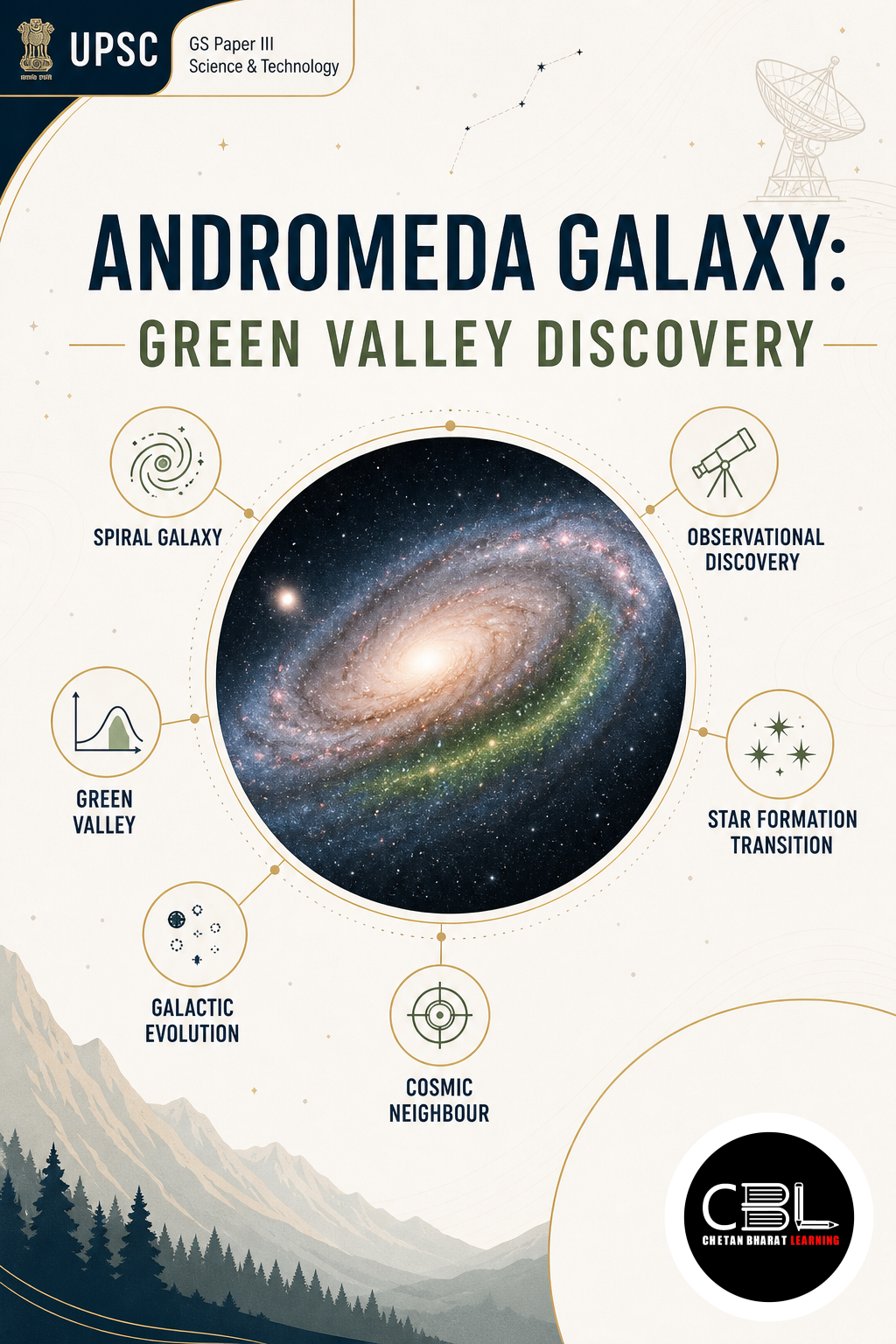
Andromeda Galaxy, also known as Messier 31 (M31), is a massive barred spiral galaxy located in the constellation Andromeda, approximately 2.5 million light-years from Earth. It is the nearest major spiral galaxy to the Milky Way.
Andromeda is the largest member of the Local Group, a collection of more than 80 galaxies that also includes the Milky Way. It spans over 220,000 light-years and contains nearly one trillion stars, making it significantly larger than our galaxy.
Why is Andromeda Galaxy in News?
Astronomers analysed observations from the Hubble Space Telescope and found that Andromeda’s rate of star formation has declined rapidly during the last 40 million years. The study classifies the galaxy within the Green Valley, an intermediate stage between the actively star-forming Blue Cloud galaxies and the inactive Red Sequence galaxies.
Key Features
- Nearest major spiral galaxy: At about 2.5 million light-years away, Andromeda is the closest large spiral galaxy to the Milky Way.
- Largest member of the Local Group: The galaxy spans more than 220,000 light-years and contains roughly one trillion stars.
- Green Valley galaxy: It represents a transitional phase where star formation is slowing as the galaxy evolves from active to relatively inactive.
- Visible without telescopes: Under sufficiently dark skies, Andromeda appears as a faint elongated smudge visible to the unaided eye.
- Future collision: Andromeda is moving towards the Milky Way at approximately 110 km/s and is expected to merge with it in about 4–5 billion years, eventually forming a giant elliptical galaxy.
Challenges
- Immense distances: Observations require highly sensitive telescopes and sophisticated imaging techniques.
- Complex stellar evolution: Reconstructing star formation history demands extensive data analysis across multiple wavelengths.
- Dynamic galactic interactions: Gravitational interactions with nearby galaxies influence long-term evolution.
- Observation constraints: Dust clouds and varying stellar populations complicate astronomical measurements.
- Long timescales: Galactic evolution occurs over billions of years, requiring indirect scientific evidence.
Way Forward
Future observations using advanced space- and ground-based telescopes will improve understanding of galaxy formation, stellar evolution and dark matter. Long-term monitoring of Andromeda will also refine predictions regarding its interaction with the Milky Way.
Prelims Practice Corner
- Q1. Andromeda Galaxy is also known as: (a) M13 (b) M31 (c) M87 (d) M101
Answer: (b) Messier 31 (M31). - Q2. The Andromeda Galaxy belongs to which galaxy group? (a) Virgo Cluster (b) Local Group (c) Coma Cluster (d) Sculptor Group
Answer: (b) Local Group. - Q3. The Green Valley represents: (a) A nebula (b) A transitional stage between star-forming and inactive galaxies (c) A type of black hole (d) A star cluster
Answer: (b) Transitional stage. - Q4. Approximately how far is the Andromeda Galaxy from Earth? (a) 250,000 light-years (b) 2.5 million light-years (c) 25 million light-years (d) 250 million light-years
Answer: (b) 2.5 million light-years. - Q5. The Milky Way and Andromeda are expected to: (a) Drift apart (b) Remain unchanged (c) Collide and merge into a giant elliptical galaxy (d) Become dwarf galaxies
Answer: (c) Merge in about 4–5 billion years.
Mains Practice Questions
- Q1. Discuss the significance of the Andromeda Galaxy in understanding galaxy evolution and the future of the Milky Way. (10 marks)
Answer Structure
- Intro: Introduce the Andromeda Galaxy.
- Body: Green Valley classification, Local Group, stellar evolution and future merger with the Milky Way.
- Conclusion: Highlight its importance in modern astrophysical research.
- Q2. Explain the Green Valley classification of galaxies and its significance in the study of galaxy evolution. (15 marks)
Answer Structure
- Intro: Define Green Valley galaxies.
- Body: Blue Cloud, Green Valley, Red Sequence, star formation and observational evidence.
- Conclusion: Explain why transitional galaxies help understand cosmic evolution.
FAQs on Andromeda Galaxy
Why is the Andromeda Galaxy important?
It is the nearest major spiral galaxy to the Milky Way and provides valuable insights into galaxy formation, stellar evolution and the future interaction between large galaxies.
What is the Green Valley in astronomy?
Green Valley is a transitional category of galaxies positioned between actively star-forming Blue Cloud galaxies and quiescent Red Sequence galaxies, reflecting declining star formation.
Will the Milky Way collide with the Andromeda Galaxy?
Yes. Astronomers estimate that the two galaxies will merge in approximately 4–5 billion years, eventually forming a giant elliptical galaxy.
Related Current Affairs
Preparing for UPSC, PCS or HCS?
Talk to a mentor at Chetan Bharat Learning, Chandigarh. Free guidance on choosing the right exam and building a study plan.
Chat on WhatsAppCall 97793 53345UPSC / IAS / PCS coaching in Chandigarh · Trusted by aspirants across Punjab & Haryana
Leave a Reply
You must be logged in to post a comment.