
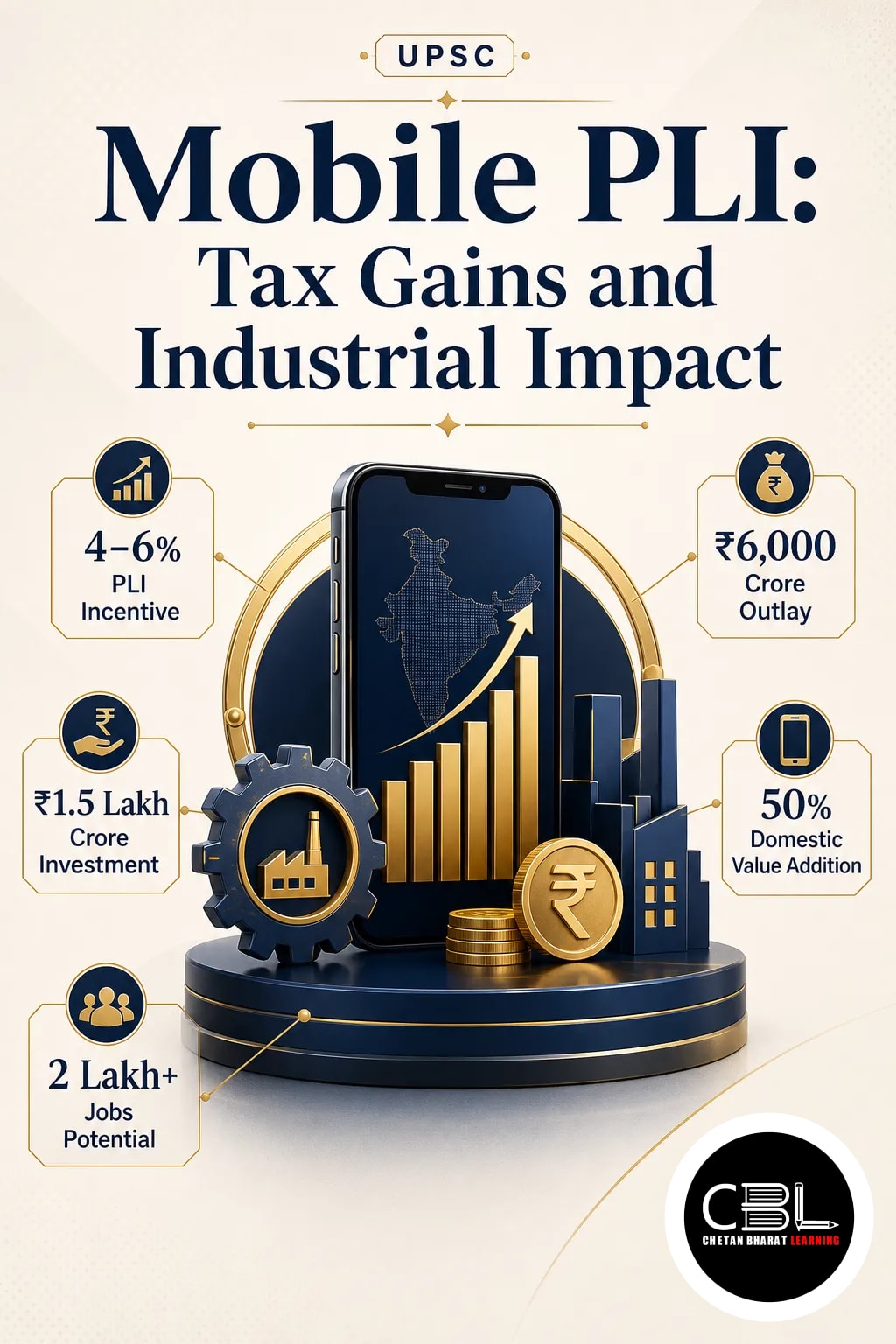

Mobile PLI has become a key test case for India’s manufacturing strategy. See how it connects with the broader industrial push in this electronics component policy update.
What is mobile PLI?
The mobile PLI refers to the production-linked incentive framework for mobile phone manufacturing in India. It rewards eligible firms for incremental production and supports local value addition in a strategic sector.
The policy is part of India’s wider effort to deepen electronics manufacturing, reduce import dependence, and strengthen export capacity. In this case, official data shared by the government is being used to show the scheme’s fiscal and industrial returns.
Why in News?
Union minister Ashwini Vaishnaw said the government collected ₹3.25 lakh crore in taxes against a ₹19,000 crore incentive outlay under the mobile PLI. He stated that the amount included about ₹25,000 crore in direct tax and ₹3 lakh crore in GST from beneficiaries.
The data was shared in response to criticism of India’s subsidy-based approach to electronics manufacturing. The government also highlighted that mobile imports have fallen to around 0.02% of domestic demand in 2024-25, compared with about 75% ten years ago.
Key Features
- Fiscal return The government claims the tax revenue from the mobile industry far exceeds the incentive payout.
- Export growth India exported mobile phones worth ₹2 lakh crore in FY25, showing stronger outward competitiveness.
- Import substitution Mobile imports have become almost negligible relative to domestic demand, indicating deeper local production.
- Manufacturing expansion Electronic goods production rose to about ₹11.3 lakh crore in 2024-25 from about ₹1.9 lakh crore in 2014-15.
- Employment linkage The minister said electronics manufacturing employs 25 lakh people, with mobile manufacturing accounting for 12 lakh.
- Next policy step The government has rolled out the Mobile Phone Manufacturing Scheme with a larger incentive outlay of ₹62,500 crore.
Challenges
- Component dependence The article notes criticism that India still imports components, which can limit domestic value addition.
- Policy sustainability Incentive-led manufacturing must eventually stand on productivity, scale, and supplier depth.
- Global competition India faces established ecosystems in other manufacturing hubs, especially in electronics.
- Brand transition Moving from assembly-led output to a recognised Indian smartphone brand remains a tougher task.
Way Forward
India will need stronger local sourcing, better logistics, and deeper component ecosystems to sustain the gains from mobile PLI. That would improve value addition and reduce the gap between assembly growth and core manufacturing capability.
The government’s stated target of an Indian smartphone brand by October 2028 shows that the next phase is about capability building, not just output growth. For UPSC, the topic links industrial policy with trade, jobs, and supply-chain resilience.
Source: The Hindu, 28 October 2026
- Electronics Component Manufacturing Scheme: UPSC Guide (10 Oct 2026)
- Rajmargyatra Application: Features and UPSC Analysis (21 Oct 2026)
This topic matters for state PCS because industrial policy, employment generation, and export-led manufacturing are recurring governance themes. It also helps in questions on Make in India, ease of doing business, and the role of incentives in attracting investment.
FAQ
Why is mobile PLI considered important for India?
It has helped build domestic production capacity and reduce dependence on imported phones. The government also cites rising exports and tax collections as evidence of broader economic gains.
Does the data prove that subsidies are unnecessary?
The data supports the claim that incentives can generate larger economic activity. Still, long-term success depends on component ecosystems, technology depth, and competitiveness without support.
What should UPSC aspirants remember from this topic?
Focus on the link between industrial policy, exports, tax revenue, and employment. Also note the shift from import dependence toward domestic manufacturing capacity.
Related Current Affairs
Preparing for UPSC, PCS or HCS?
Talk to a mentor at Chetan Bharat Learning, Chandigarh. Free guidance on choosing the right exam and building a study plan.
Chat on WhatsAppCall 97793 53345UPSC / IAS / PCS coaching in Chandigarh · Trusted by aspirants across Punjab & Haryana
Leave a Reply
You must be logged in to post a comment.