

UPSC Mapping
- Prelims: Species, IUCN Status, CITES, CMS, Desert Ecosystems
- Mains: GS Paper III – Biodiversity Conservation & International Cooperation
| Scientific Name | Chlamydotis macqueenii |
|---|---|
| IUCN Status | Vulnerable |
| CITES | Appendix I |
| CMS | Appendix I |
Article
What is Houbara Bustard?
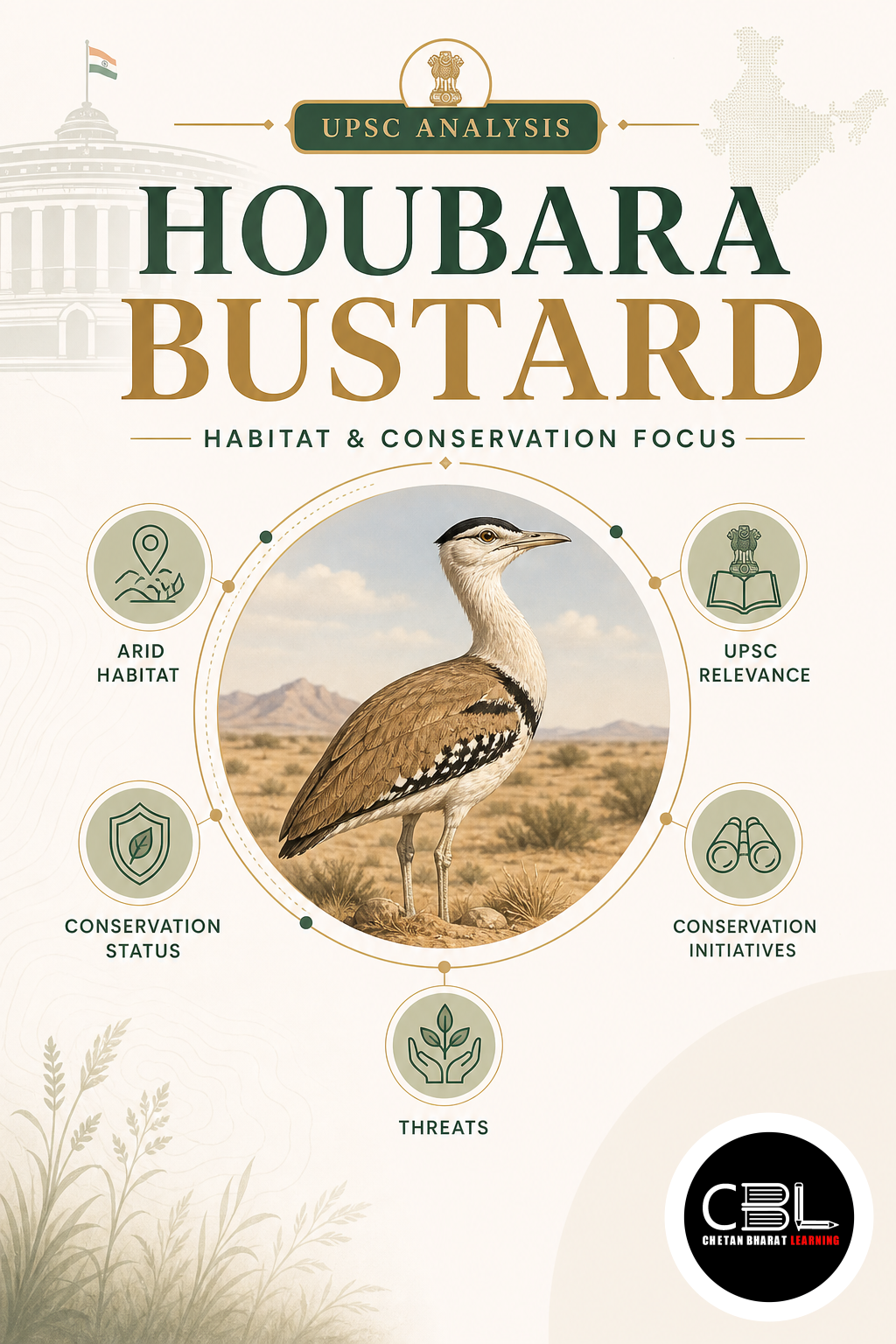
Houbara Bustard (Asian Houbara or Chlamydotis macqueenii) is a medium-to-large migratory bird belonging to the bustard family (Otididae). It is adapted to arid and semi-arid environments such as deserts, gravel plains, dry steppes and shrublands across Central Asia, the Middle East and parts of South Asia.
In India, the species is mainly recorded in the Thar Desert of Rajasthan and parts of the Rann of Kutch in Gujarat during its winter migration. Its cryptic plumage provides excellent camouflage against desert landscapes.
Why is Houbara Bustard in News?
Uzbekistan, Kazakhstan and the United Arab Emirates jointly released 672 captive-bred Houbara Bustards into the Aral Sea region of Karakalpakstan. The programme demonstrates how captive breeding and international collaboration can support the recovery of threatened migratory species.
The initiative is also viewed as an important model for transboundary biodiversity conservation across migratory flyways. Official conservation information is available through the Convention on Migratory Species (CMS).
Key Features of Houbara Bustard
- Desert adaptation: Thrives in sandy deserts, gravel plains and dry shrublands with minimal water availability.
- Excellent camouflage: Sandy-brown plumage helps it blend into desert surroundings and avoid predators.
- Ground-dwelling bird: It walks and runs efficiently, taking flight mainly when threatened.
- Omnivorous diet: Feeds on seeds, shoots, insects, locusts, beetles, lizards and other small invertebrates.
- Long-distance migration: Populations breeding in Central Asia migrate southwards to Pakistan, India and the Arabian Peninsula during winter.
Challenges
- Habitat degradation: Expansion of agriculture and infrastructure reduces suitable desert habitats.
- Illegal hunting: Hunting along migratory routes remains a major conservation concern.
- Migration risks: The bird depends on multiple countries for successful migration, requiring coordinated protection.
- Climate change: Changing desert ecosystems may alter breeding and wintering habitats.
- Need for international cooperation: Long-term recovery depends upon coordinated conservation among range countries.
Way Forward
Conservation of the Houbara Bustard requires protection of breeding, migratory and wintering habitats through coordinated international action. Strengthening scientific monitoring, habitat restoration and community participation can improve the survival of the species.
Captive breeding programmes, supported by habitat conservation and strict enforcement against illegal hunting, can contribute to long-term recovery of this flagship desert bird.
Prelims Practice Corner
-
Q1. The Houbara Bustard belongs to which family?
- (a) Anatidae
- (b) Otididae
- (c) Accipitridae
- (d) Phasianidae
Answer: (b) It belongs to the bustard family Otididae.
-
Q2. The IUCN status of the Houbara Bustard is:
- (a) Endangered
- (b) Vulnerable
- (c) Near Threatened
- (d) Least Concern
Answer: (b) The species is listed as Vulnerable.
-
Q3. Under CITES, the Houbara Bustard is included in:
- (a) Appendix I
- (b) Appendix II
- (c) Appendix III
- (d) Not Listed
Answer: (a) It is included in Appendix I of CITES.
-
Q4. Which Indian region serves as a wintering habitat for the Houbara Bustard?
- (a) Western Ghats
- (b) Sundarbans
- (c) Thar Desert
- (d) Nilgiris
Answer: (c) The species winters in the Thar Desert and adjoining arid regions.
-
Q5. The Convention on Migratory Species (CMS) primarily focuses on:
- (a) Marine pollution
- (b) Migratory wildlife conservation
- (c) Forest certification
- (d) Climate finance
Answer: (b) CMS promotes international cooperation for conserving migratory species.
Mains Practice Questions
-
Q1. Discuss the ecological significance of the Houbara Bustard and the importance of transboundary conservation for migratory species. (10 marks)
Answer Structure:
- Intro: Introduce the species.
- Body: Habitat, threats, migratory nature, conservation agreements and international cooperation.
- Conclusion: Highlight ecosystem-based conservation.
-
Q2. Evaluate the role of international conventions such as CITES and CMS in conserving migratory wildlife. (15 marks)
Answer Structure:
- Intro: Explain the need for global conservation agreements.
- Body: Objectives, achievements, implementation challenges and India’s role.
- Conclusion: Emphasise coordinated global biodiversity governance.
FAQs on Houbara Bustard
- What is the Houbara Bustard?
- It is a migratory desert bird belonging to the bustard family, found across Central Asia, the Middle East and parts of South Asia.
- What is its conservation status?
- The Houbara Bustard is listed as Vulnerable on the IUCN Red List and is included in Appendix I of both CITES and the Convention on Migratory Species.
- Why is the Houbara Bustard important for UPSC?
- The species is relevant for GS Paper III and Prelims because of its conservation status, migratory behaviour, desert habitat and association with international environmental conventions.
Related Current Affairs
Preparing for UPSC, PCS or HCS?
Talk to a mentor at Chetan Bharat Learning, Chandigarh. Free guidance on choosing the right exam and building a study plan.
Chat on WhatsAppCall 97793 53345UPSC / IAS / PCS coaching in Chandigarh · Trusted by aspirants across Punjab & Haryana
Leave a Reply
You must be logged in to post a comment.