

UPSC Mapping
| Prelims | Economy, Government Schemes and Manufacturing |
|---|---|
| Mains | GS Paper III – Industry, Investment and Economic Development |
What is Electronics Component Manufacturing Scheme?
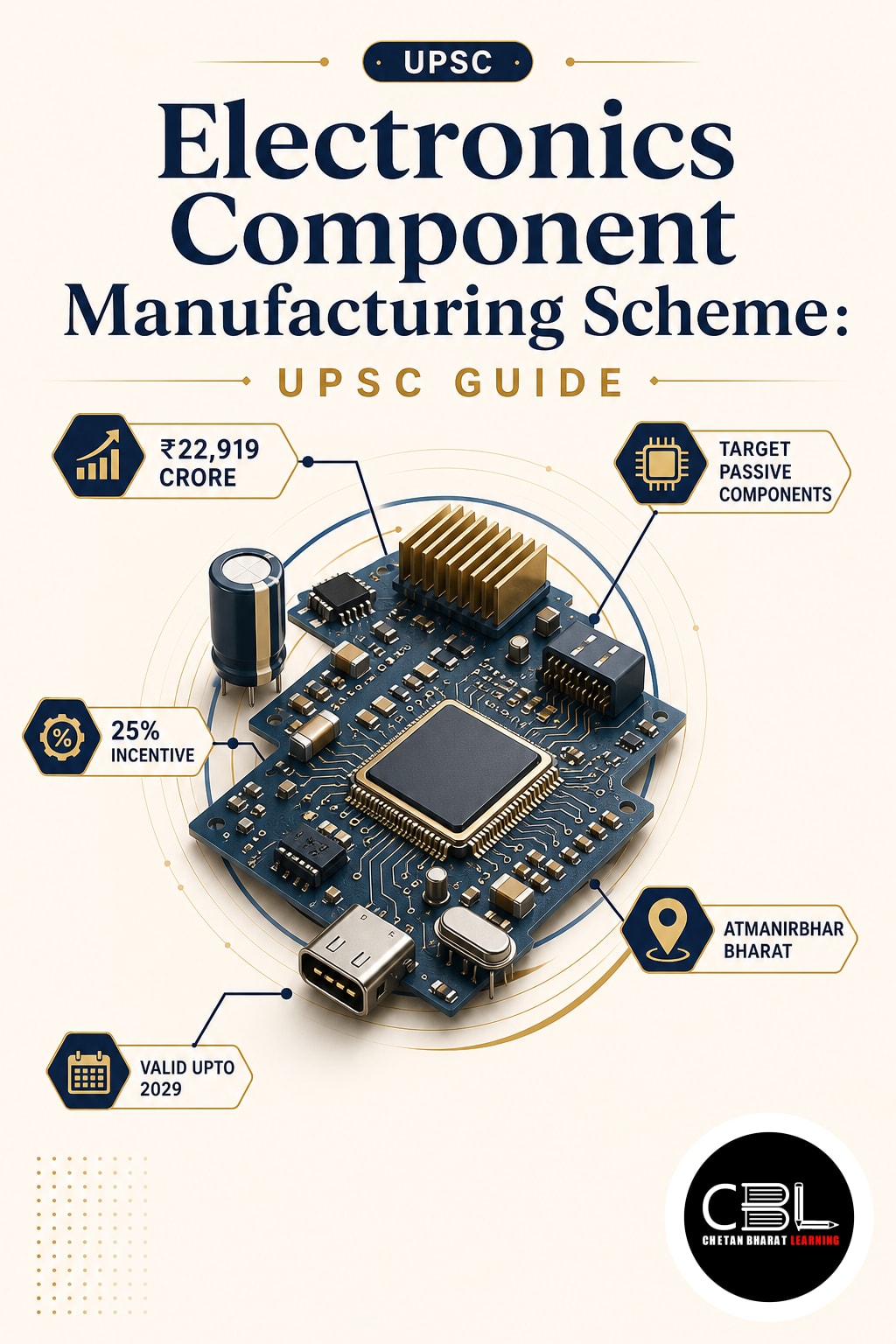
The Electronics Component Manufacturing Scheme (ECMS) is a Government of India initiative notified on 8 April 2025. It seeks to establish a strong domestic ecosystem for producing electronic components, sub-assemblies, raw materials and specialised manufacturing equipment.
The scheme is administered by the Ministry of Electronics and Information Technology (MeitY). Its central objective is to integrate India’s electronics industry with Global Value Chains (GVCs) while increasing domestic value addition.
ECMS operates over six years, with an optional one-year gestation period for eligible manufacturers to begin commercial production. Capital expenditure incentives have a separate five-year availability period under the scheme guidelines.
Unlike initiatives primarily focused on assembling finished electronic products, ECMS emphasises manufacturing essential inputs such as camera modules, printed circuit boards, passive components and specialised equipment. These components support smartphones, computers, telecommunications systems and other electronic devices.
Why in News?
The Government of India has highlighted how the Electronics Component Manufacturing Scheme is strengthening domestic electronics production and supporting India’s emergence as a major global manufacturing centre. The initiative builds on significant expansion in the country’s electronics industry over the past decade.
According to government data, the value of electronics production increased nearly sixfold, from ₹1.9 lakh crore in FY 2014–15 to ₹11.3 lakh crore in FY 2024–25. India has also become the world’s second-largest mobile phone manufacturer by production volume.
India now manufactures approximately 99.2% of mobile phones used domestically, marking a transition from substantial import dependence towards large-scale domestic production. Electronics exports have also expanded considerably, becoming one of India’s leading export categories.
Despite growth in finished-product manufacturing, deeper component localisation remains important. The scheme seeks to address this structural gap by expanding domestic supply chains and supporting higher-value production activities. The Press Information Bureau’s electronics sector backgrounder provides additional context on the industry’s expansion.
Key Features
- Turnover-linked incentives: Eligible manufacturers receive financial incentives linked to qualifying sales of specified electronic components, encouraging sustained commercial production and market expansion.
- Capital expenditure incentives: The scheme provides support for eligible investments in manufacturing infrastructure, plant and machinery, helping reduce the initial cost of establishing advanced production facilities.
- Hybrid incentive mechanism: Certain product segments can receive a combination of turnover-linked and capital expenditure-linked support, depending on their manufacturing requirements and scheme conditions.
- Employment-linked support: A prescribed portion of incentives is linked to verified direct employment generation, connecting industrial investment with measurable job creation.
- High-value manufacturing: Target segments include camera sub-assemblies, multilayer Printed Circuit Boards (PCBs), electronic components, enclosures and specialised capital equipment used in electronics production.
- Global Value Chain integration: ECMS encourages domestic and international companies to manufacture important components in India and supply them to global electronics producers.
- Domestic value addition: Greater local production of components can reduce dependence on imported inputs and strengthen India’s capacity to manufacture advanced electronic products.
- Complementary government programmes: The scheme works alongside the National Policy on Electronics 2019, Production-Linked Incentive programmes, Semicon India Programme, SPECS and Electronics Manufacturing Clusters initiatives.
Challenges
- Dependence on imported components: India continues to require foreign-sourced electronic inputs and specialised equipment for several manufacturing activities, exposing producers to international supply-chain disruptions.
- High capital requirements: Advanced component manufacturing requires substantial investment in machinery, precision technologies, quality testing and reliable industrial infrastructure.
- Technology limitations: Developing globally competitive manufacturing capabilities requires sustained research, indigenous design expertise and access to advanced production technologies.
- Skilled workforce requirements: Component production requires engineers, technicians and workers trained in precision manufacturing, automation and industrial quality control.
- Global competition: Established electronics manufacturing centres benefit from economies of scale, mature supplier networks and technological expertise, creating competitive pressures for emerging producers.
- Implementation and compliance: Manufacturers must fulfil investment, production and employment conditions. Delays in verification or incentive disbursement could affect project planning and financial viability.
Way Forward
India should strengthen research, innovation and indigenous technology development to move beyond assembly-oriented electronics manufacturing. Collaboration among universities, research institutions and manufacturers can improve domestic design and component production capabilities.
The government should support integrated electronics manufacturing clusters with reliable power, logistics, testing facilities and skilled personnel. Such infrastructure can improve productivity while reducing manufacturing costs for domestic enterprises and international investors.
Greater participation by micro, small and medium enterprises (MSMEs) can expand supplier networks and promote regional industrial development. Training programmes should focus on emerging manufacturing technologies and industry-specific skill requirements.
Transparent incentive administration, predictable policies and effective coordination between the Union and states can strengthen investor confidence. Detailed eligibility provisions and product categories are available through the official ECMS portal.
The long-term success of Electronics Component Manufacturing will depend on combining industrial incentives with technology acquisition, domestic innovation and competitive export capabilities. A stronger component ecosystem can support skilled employment, improve supply-chain resilience and enhance India’s position in global trade. Aspirants can follow other industrial development policies through the daily current affairs archive.
Punjab & Haryana PCS Angle
For Punjab PCS and Haryana HCS, ECMS is relevant to industrial policy, investment promotion, skilled employment and manufacturing-led economic growth. Candidates should examine how states can attract electronics manufacturing through industrial infrastructure, technical education, reliable power supply and MSME integration into supply chains. The scheme can also be connected to broader questions about Make in India, export competitiveness and cooperative federalism.
Prelims Practice Corner
Q1. Which ministry administers the Electronics Component Manufacturing Scheme?
- Ministry of Heavy Industries
- Ministry of Electronics and Information Technology
- Ministry of Commerce and Industry
- Ministry of Science and Technology
Answer: (b) The Ministry of Electronics and Information Technology administers ECMS to promote domestic electronics component production.
Q2. Which types of financial incentives are provided under ECMS?
- Export subsidies only
- Interest-free loans only
- Tax exemptions only
- Turnover-linked, capital expenditure-linked and hybrid incentives
Answer: (d) ECMS offers differentiated turnover-linked, capex-linked and hybrid incentives based on eligible product categories.
Q3. Which of the following products is directly associated with the target segments under ECMS?
- Multilayer Printed Circuit Boards
- Agricultural fertilisers
- Conventional petrol engines
- Pharmaceutical formulations
Answer: (a) Multilayer Printed Circuit Boards are among the electronic components targeted for domestic manufacturing under ECMS.
Q4. In which year was the Electronics Component Manufacturing Scheme notified?
- 2019
- 2023
- 2025
- 2026
Answer: (c) The Electronics Component Manufacturing Scheme was notified on 8 April 2025.
Q5. Consider the following statements regarding ECMS:
1. The scheme seeks to integrate India’s electronics industry with Global Value Chains.
2. It exclusively supports manufacturing of finished smartphones.
3. A portion of the incentives is linked to direct employment generation.
Which statements are correct?
- 1 and 2 only
- 1 and 3 only
- 2 and 3 only
- 1, 2 and 3
Answer: (b) Statements 1 and 3 are correct. ECMS focuses on components and supply-chain inputs rather than exclusively supporting finished smartphone manufacturing.
Mains Practice Questions
Q1. India’s electronics manufacturing industry has expanded rapidly, but deeper domestic value addition remains essential. Discuss the significance of the Electronics Component Manufacturing Scheme in strengthening India’s industrial competitiveness. (15 marks)
Answer Structure:
- Intro: Highlight the growth of India’s electronics industry and the need for domestic component manufacturing.
- Body: Examine incentive mechanisms, domestic value addition, import dependence, global supply-chain integration, employment generation, technology development and manufacturing challenges.
- Conclusion: Recommend integrated industrial policies combining investment incentives, indigenous innovation, skilled labour and export competitiveness.
Q2. Explain how targeted industrial incentives can help India integrate into Global Value Chains. Illustrate with reference to the Electronics Component Manufacturing Scheme. (10 marks)
Answer Structure:
- Intro: Define Global Value Chains and explain their relevance to industrial development.
- Body: Discuss turnover-linked and capex-linked incentives, supplier networks, manufacturing infrastructure, foreign investment, technological capabilities and employment-linked support.
- Conclusion: Emphasise the importance of domestic capabilities, predictable policies and higher value addition for sustained global competitiveness.
Frequently Asked Questions
What is the main objective of the Electronics Component Manufacturing Scheme?
The scheme aims to build a strong domestic electronics component manufacturing ecosystem by attracting investment and increasing local production. It also seeks to integrate Indian manufacturers into Global Value Chains and reduce reliance on imported components.
Which ministry implements ECMS and when was it notified?
ECMS is administered by the Ministry of Electronics and Information Technology. The scheme was notified on 8 April 2025 and provides differentiated manufacturing incentives for eligible product categories.
How is ECMS different from Production-Linked Incentive schemes?
ECMS specifically targets electronic components, sub-assemblies and manufacturing inputs, using turnover-linked, capex-linked and hybrid support. Other PLI programmes cover designated products such as mobile phones and IT hardware, with incentives linked to qualifying incremental production or sales.
Related Current Affairs
Preparing for UPSC, PCS or HCS?
Talk to a mentor at Chetan Bharat Learning, Chandigarh. Free guidance on choosing the right exam and building a study plan.
Chat on WhatsAppCall 97793 53345UPSC / IAS / PCS coaching in Chandigarh · Trusted by aspirants across Punjab & Haryana
Leave a Reply
You must be logged in to post a comment.