

UPSC Mapping
| Prelims | Polity and Governance |
|---|---|
| Mains | GS Paper 2 (Polity & Internal Security) |
| Proposed Base Year | 1951 |
|---|---|
| Primary Supporters | Meitei and Naga groups |
| Key Opponents | Kuki-Zo Council |
Article
The proposed Manipur NRC update using the 1951 base year has ignited intense political debate across Northeast India. Aspiring civil servants must understand its profound socio-political implications for regional stability and governance. The State Home Minister recently informed the Legislative Assembly about this controversial citizenship verification proposal. This administrative move aims to identify and deport undocumented immigrants residing within the state borders. Explore our daily current affairs archive for more structured updates on such critical national policies.
What is Manipur NRC?
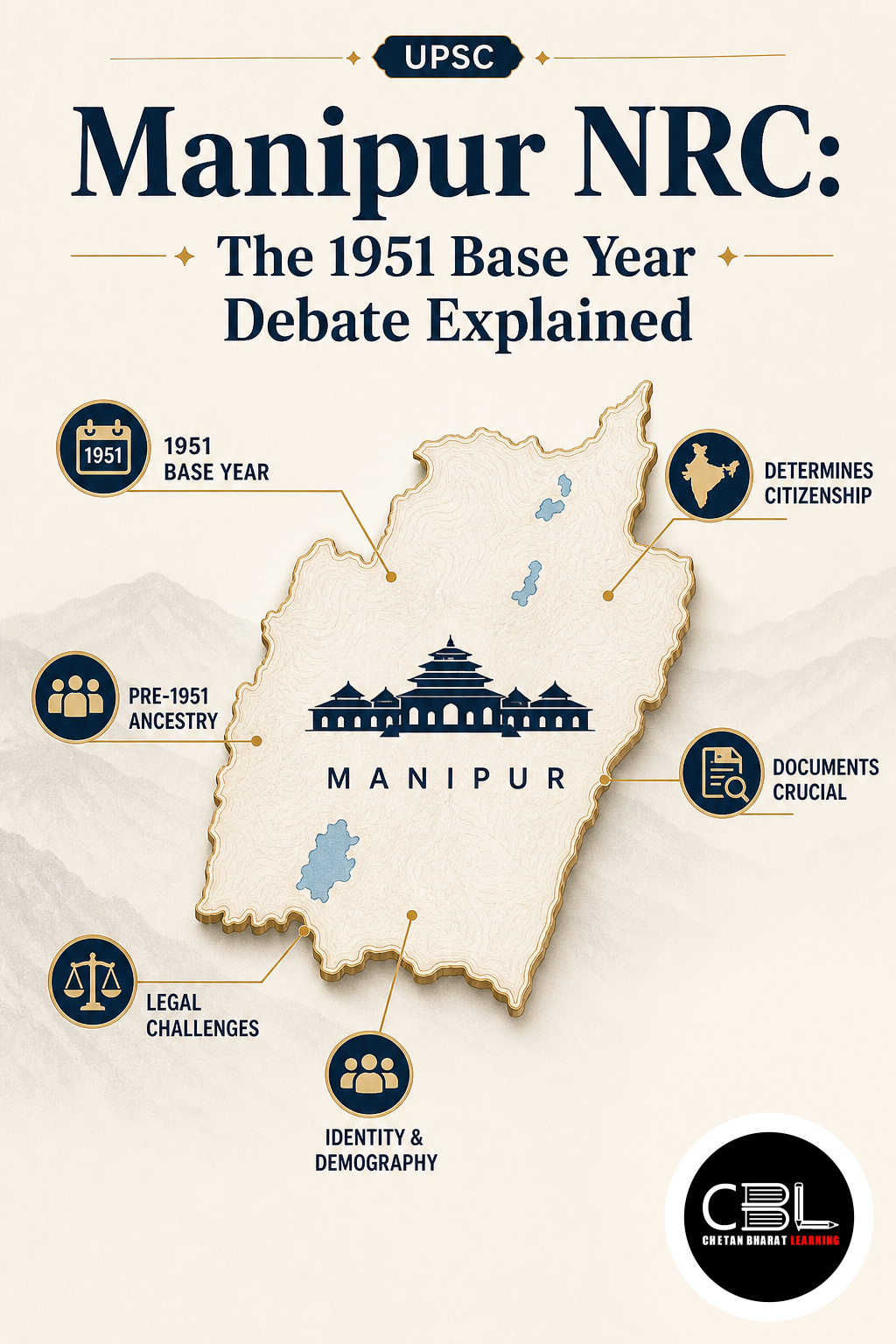
The Manipur NRC refers to the proposed update of the National Register of Citizens specifically for the state of Manipur. The state government intends to use the 1951 census data as the foundational cutoff year for verifying citizenship. This demographic approach directly mirrors the controversial verification exercise previously conducted in the neighboring state of Assam. The primary objective is to detect undocumented immigrants. The state aims to deport those who entered after 1951.
This demographic exercise holds immense significance for the delicate ethnic balance in the entire region. Various indigenous groups argue that unchecked migration has severely altered the historical demographic composition of the state. They demand strict verification to protect their unique cultural identity and traditional land rights. The Manipur NRC thus becomes a critical administrative tool for preserving the historical demographic fabric of the state.
Why is Manipur NRC in News?
State Home Minister Konthoujam Govindas recently announced this proposal during a formal Manipur Assembly session. The sudden announcement triggered immediate polarization among the diverse ethnic communities residing in the state. Meitei and Naga organizations strongly advocate for completing this exercise before any upcoming national Census. Conversely, several Kuki organizations have described this sudden demand as both premature and entirely unjustified.
The Centre recently deferred the Census exercise in Manipur due to prevailing law and order issues. Meanwhile, the state government reported pushing back 14,992 identified illegal immigrants into neighboring Myanmar. This aggressive administrative action highlights the urgency the state places on strict border management protocols. You can verify these demographic updates through the official PIB release on home affairs.
Protests continue in Imphal demanding the immediate implementation of the citizenship verification process. The controversy reflects wider disagreements among communities over migration and demographic exercises. The Manipur NRC remains a deeply contentious political flashpoint requiring sensitive and inclusive handling.
Key Features
- 1951 Base Year: The exercise uses the first post-independence census data as the absolute cutoff for proving legacy citizenship in the state.
- Legacy Data Verification: Applicants must provide documentary evidence linking their ancestry to residents present in the state before 1951.
- Pre-Census Priority: Local indigenous groups demand this verification must precede the national Census to prevent any demographic manipulation.
- Deportation Framework: The process includes identifying declared foreigners and facilitating their safe repatriation to their countries of origin.
- Tribunal Adjudication: Foreigners Tribunals will handle all appeals and disputes arising from the exclusion of names from the final register.
Challenges in Manipur NRC
- Ethnic Polarization: The demand has deepened existing fault lines between the Meitei, Naga, and Kuki communities, risking further violent clashes.
- Documentary Scarcity: Many genuine citizens lack the requisite legacy documents due to historical displacement and poor historical record-keeping.
- Administrative Burden: Conducting a massive verification exercise requires immense logistical resources, which the state currently lacks entirely.
- Legal Complexities: Determining the citizenship status of marginalized groups often leads to prolonged litigation in specialized Foreigners Tribunals.
- International Friction: Aggressive deportation drives to Myanmar complicate already sensitive bilateral relations and cross-border management protocols.
Way Forward
To resolve the Manipur NRC deadlock, the government must prioritize inclusive dialogue among all ethnic stakeholders. A unilateral imposition of the register will only exacerbate existing tensions and destabilize the region further. The Centre should facilitate a mediated consensus on the cutoff year and verification modalities. Building mutual trust is absolutely essential before initiating any large-scale demographic exercise in the state.
Moreover, strengthening border fencing and surveillance will address illegal migration more effectively than punitive citizenship drives. The NITI Aayog has consistently emphasized the need for holistic development to address the root causes of migration. This comprehensive strategy will ultimately ensure lasting peace and demographic stability in Northeast India.
Prelims Practice Corner
Q1. Consider the following statements regarding the proposed Manipur NRC:
1. It proposes to use 1951 as the base year for citizenship verification.
2. The Kuki-Zo Council has strongly supported this demand.
Which of the statements given above is/are correct?
(a) 1 only (b) 2 only (c) Both 1 and 2 (d) Neither 1 nor 2
Answer: (a) The Kuki-Zo Council has described the demand as premature and unjustified.
Q2. Which communities primarily demand the NRC update before the Census in Manipur?
(a) Kuki and Mizo (b) Meitei and Naga (c) Bodo and Assamese (d) Chakma and Hajong
Answer: (b) Meitei and Naga organizations advocate for completing the NRC exercise before the Census.
Q3. According to recent government reports, how many identified illegal immigrants were pushed back into Myanmar?
(a) 5,432 (b) 9,871 (c) 14,992 (d) 24,475
Answer: (c) The government informed the Assembly that 14,992 identified illegal immigrants had been pushed back.
Q4. Which quasi-judicial body handles appeals and disputes regarding citizenship exclusion in India?
(a) National Human Rights Commission (b) Foreigners Tribunal (c) Supreme Court (d) National Green Tribunal
Answer: (b) Foreigners Tribunals handle appeals and disputes arising from the exclusion of names from the NRC.
Q5. The Centre recently deferred which demographic exercise in Manipur due to law and order issues?
(a) Delimitation (b) Census (c) Economic Survey (d) Electoral Roll Revision
Answer: (b) The Centre deferred the Census exercise in Manipur due to prevailing security concerns.
Mains Practice Questions
Q1. Discuss the socio-political implications of updating the NRC with a 1951 base year in Manipur. (150 words, 10 marks)
Answer Structure:
Intro: Define the proposed Manipur NRC and its 1951 base year context.
Body: Implications (deepens ethnic fault lines, documentary scarcity, administrative burden, international friction); Divergent perspectives (Meitei/Naga support vs. Kuki opposition).
Conclusion: Emphasize need for inclusive dialogue and mediated consensus before implementation.
Q2. ‘Citizenship verification in border states requires a balance between national security and ethnic harmony.’ Critically examine with reference to Manipur. (250 words, 15 marks)
Answer Structure:
Intro: Contextualize demographic and security challenges of Northeast border states.
Body: National security (curbing illegal migration, border management); Ethnic harmony (risk of polarization, exclusion of marginalized groups, need for trust-building); Way forward (holistic development, robust fencing, inclusive dialogue).
Conclusion: Summarize that sustainable security depends on equitable policies that do not alienate any community.
FAQs on Manipur NRC
What is the proposed base year for the Manipur NRC?
The state government has proposed using the 1951 census data as the foundational cutoff year for verifying citizenship in Manipur.
Which communities primarily support the Manipur NRC update?
Meitei and Naga organizations strongly advocate for completing the NRC exercise before the national Census and delimitation processes.
Why do Kuki organizations oppose the Manipur NRC?
The Kuki-Zo Council has described the demand as premature and unjustified, arguing that politically motivated demands should not obstruct the Census process.
Related Current Affairs
Preparing for UPSC, PCS or HCS?
Talk to a mentor at Chetan Bharat Learning, Chandigarh. Free guidance on choosing the right exam and building a study plan.
Chat on WhatsAppCall 97793 53345UPSC / IAS / PCS coaching in Chandigarh · Trusted by aspirants across Punjab & Haryana
Leave a Reply
You must be logged in to post a comment.