
UPSC Mapping
| Exam | Topic |
|---|---|
| Prelims | UNFCCC, Paris Agreement and CBDR-RC Principle |
| Mains | GS Paper III — Environment and Climate Change |
What is Climate Equity?
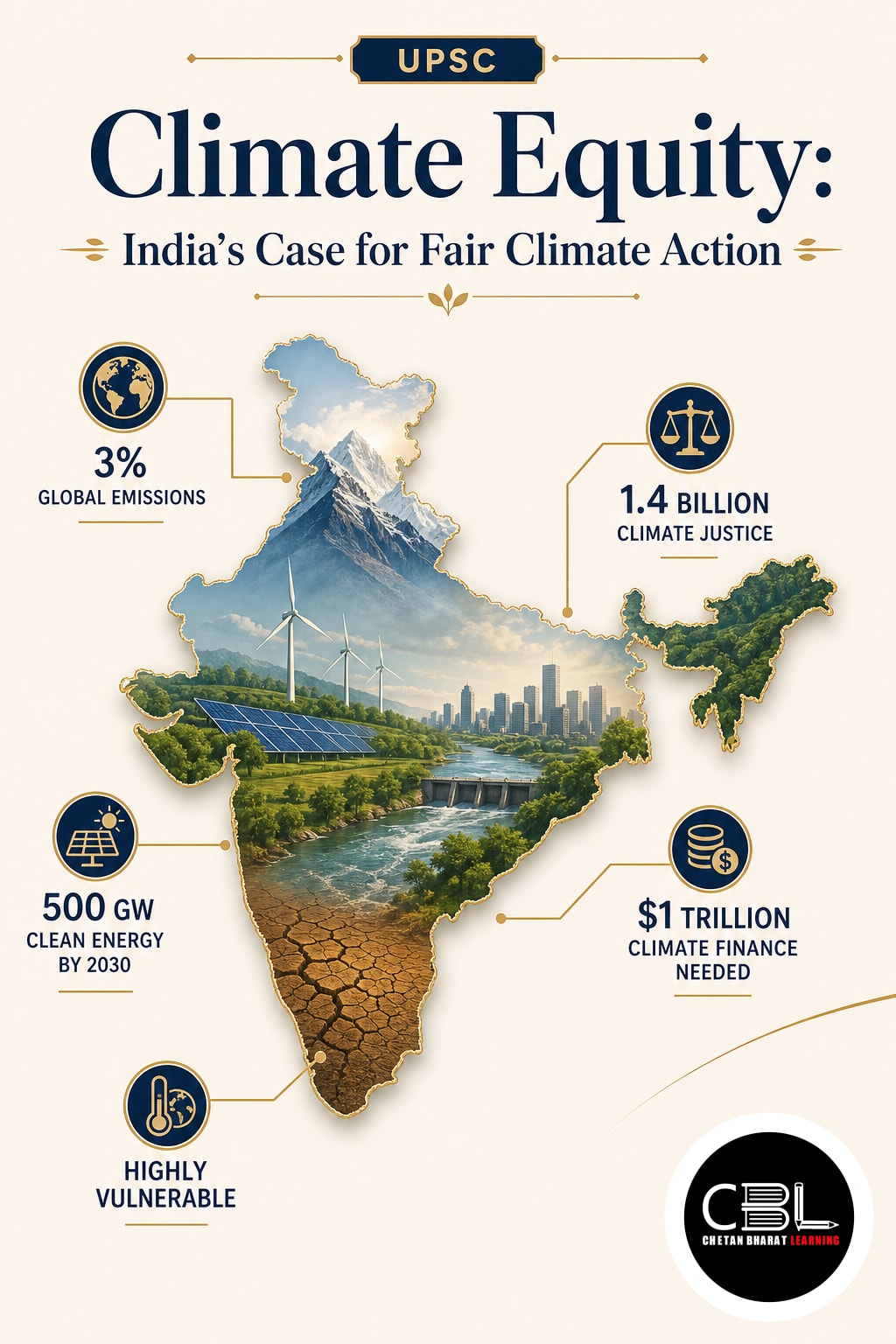
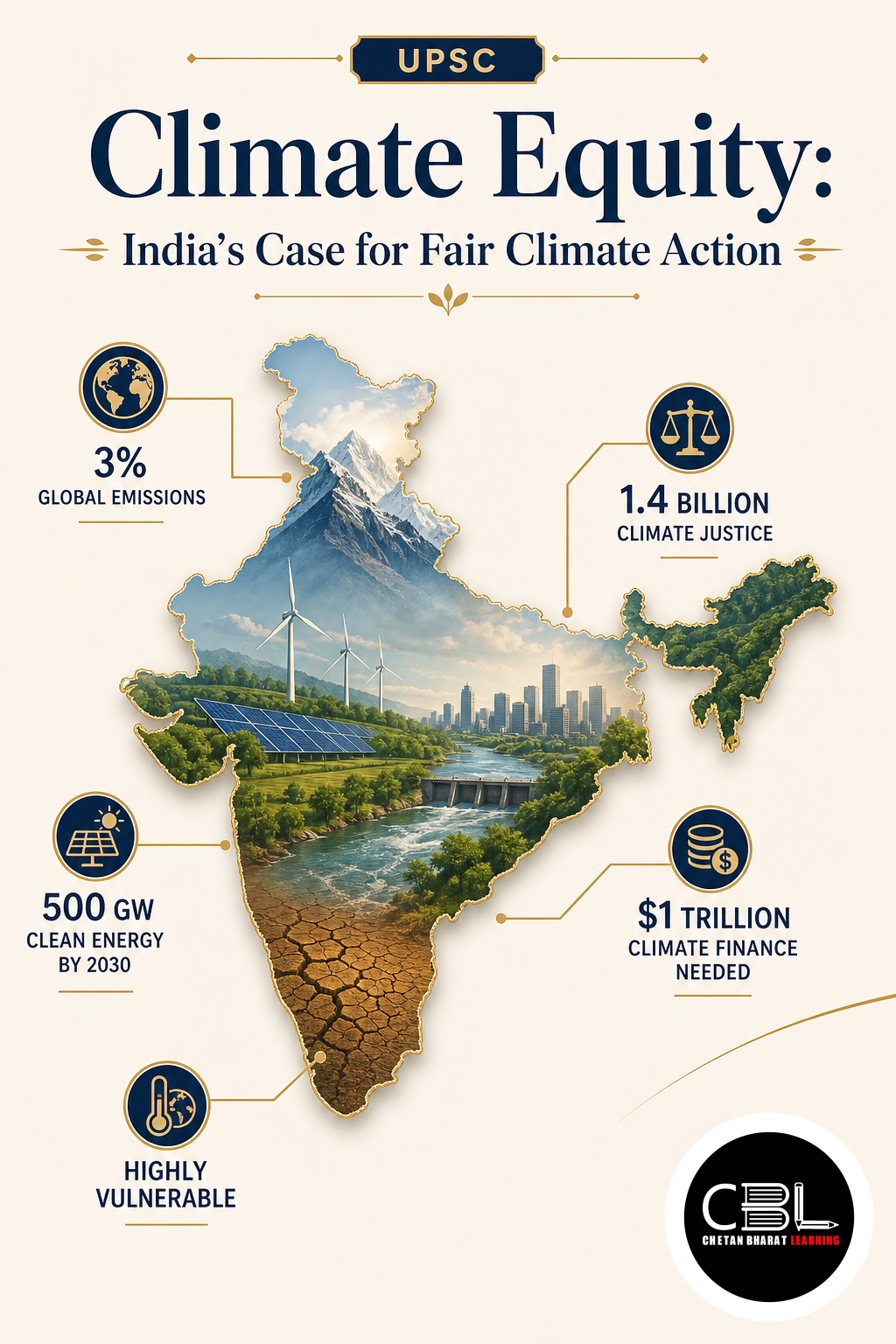
Climate Equity means distributing the burdens and benefits of environmental action fairly among countries, communities and generations. It recognises that states differ in their historical contribution to global warming, financial capacity and vulnerability. Fairness therefore requires obligations based on responsibility, capability and developmental circumstances.
The idea appears in the UNFCCC principle of common but differentiated responsibilities and respective capabilities. Every country must address climate change, but developed economies should undertake deeper action and provide support. This approach prevents a uniform burden from restricting poverty reduction and essential development in lower-income countries.
Why is Climate Equity in News?
Climate Equity received renewed attention at an international conference organised by the National Green Tribunal in New Delhi. Prime Minister Narendra Modi highlighted disparities in historical and per-capita carbon emissions. He argued that development and environmental protection must advance together rather than operate as competing priorities.
The two-day conference brought together judges, environmental experts, administrators and institutional representatives from India and other countries. Discussions addressed environmental governance, implementation gaps and stronger cooperation between science, law and public policy. The official PIB release presented India’s domestic environmental progress and its demand for fair global responsibility.
Key Features
An equitable framework examines emissions, capabilities and vulnerability instead of relying on identical obligations for every country.
- Historical responsibility: Industrialised countries used fossil fuels extensively during their development, creating a larger share of the accumulated greenhouse gases driving present warming.
- Per-capita assessment: Emissions measured per person reveal large differences hidden by national totals and provide a fairer picture of individual consumption patterns.
- Differentiated obligations: All countries should act, but the scale and speed of action should reflect national capabilities, developmental conditions and past contributions.
- Financial and technological support: Developed countries should provide predictable finance, accessible technology and capacity building for mitigation, adaptation and climate-resilient development.
- Protection of vulnerable groups: Climate policy must consider communities that contributed little to warming but face severe livelihood, health and displacement risks.
Challenges
Agreement on fairness remains difficult because countries interpret responsibility, capability and adequate support through different economic and strategic interests.
- Disputed burden sharing: Developed countries emphasise current and future emissions, while developing countries stress cumulative emissions and the remaining need for economic growth.
- Climate-finance gap: Vulnerable states require predictable grants and affordable finance, yet funding can remain inadequate, delayed or difficult to access.
- Technology barriers: High costs, intellectual-property restrictions and limited technical capacity can slow the adoption of clean technologies in developing economies.
- Adaptation pressures: Heatwaves, floods, droughts and coastal risks demand immediate spending, although adaptation often attracts less private investment than emission-reduction projects.
- Domestic transition costs: India must expand clean energy while protecting employment, affordable electricity and regional economies dependent on fossil fuels.
Way Forward
Climate Equity should guide negotiations on mitigation targets, adaptation support, technology transfer and loss-and-damage assistance. Developed economies need to demonstrate leadership through faster domestic reductions and dependable finance. International institutions should simplify funding access and prioritise countries facing severe impacts despite limited historical responsibility.
India should continue expanding renewable energy, clean mobility, efficient transport and climate-resilient infrastructure without compromising poverty reduction. Transparent reporting can strengthen its negotiating position and demonstrate accountable domestic action. The global process under the United Nations climate framework must connect ambition with finance, technology and a just transition.
Prelims Practice Corner
Q1. The principle of common but differentiated responsibilities and respective capabilities is associated with:
Answer: (b) The UNFCCC recognises common responsibility while differentiating obligations according to national circumstances and capabilities.
Q2. Which indicator best highlights differences in individual-level carbon use among countries?
Answer: (b) Per-capita emissions divide national emissions by population and reveal average individual-level disparities.
Q3. Consider the following statements about climate justice: 1. It considers historical responsibility for emissions. 2. It recognises differing national capacities. 3. It requires every country to accept identical obligations. Which statements are correct?
Answer: (a) Climate justice supports differentiated action rather than identical obligations for countries with unequal responsibilities and capabilities.
Q4. The Loss and Damage Fund primarily seeks to assist:
Answer: (b) The mechanism addresses losses and damages suffered by particularly vulnerable developing countries.
Q5. Which institution organised the 2026 conference on the Future of Environment and Climate Dynamics?
Answer: (a) The National Green Tribunal organised the two-day international conference in New Delhi.
Mains Practice Questions
Q1. Historical emissions and unequal capabilities must shape the distribution of global climate obligations. Discuss. (15 marks)
Intro: Introduce climate justice and the principle of differentiated responsibilities.
Body: Examine cumulative emissions, per-capita disparities, national capabilities, development needs, finance and technology transfer.
Conclusion: Advocate ambitious action supported by a transparent and fair burden-sharing framework.
Q2. How can India reconcile its developmental aspirations with its international climate commitments? (15 marks)
Intro: Explain India’s dual requirement of economic development and environmental protection.
Body: Cover renewable energy, clean transport, energy efficiency, adaptation, just transition, finance and resilient infrastructure.
Conclusion: Present sustainable development as the bridge between poverty reduction and responsible climate action.
FAQs on Climate Equity
What is India’s position on Climate Equity?
India supports ambitious environmental action based on historical responsibility, national capability and per-capita disparities. It also seeks adequate finance and technology for developing countries.
Why are historical emissions important in climate negotiations?
Carbon dioxide remains in the atmosphere for long periods, making accumulated emissions relevant to present warming. Historical emissions also show how earlier fossil-fuel use supported industrial development.
Can development and environmental protection advance together?
Yes. Renewable energy, efficient transport, resilient infrastructure and cleaner production can support development while reducing environmental harm. Policy design must also protect vulnerable workers and communities.
Related Current Affairs
Preparing for UPSC, PCS or HCS?
Talk to a mentor at Chetan Bharat Learning, Chandigarh. Free guidance on choosing the right exam and building a study plan.
Chat on WhatsAppCall 97793 53345UPSC / IAS / PCS coaching in Chandigarh · Trusted by aspirants across Punjab & Haryana
Leave a Reply
You must be logged in to post a comment.