
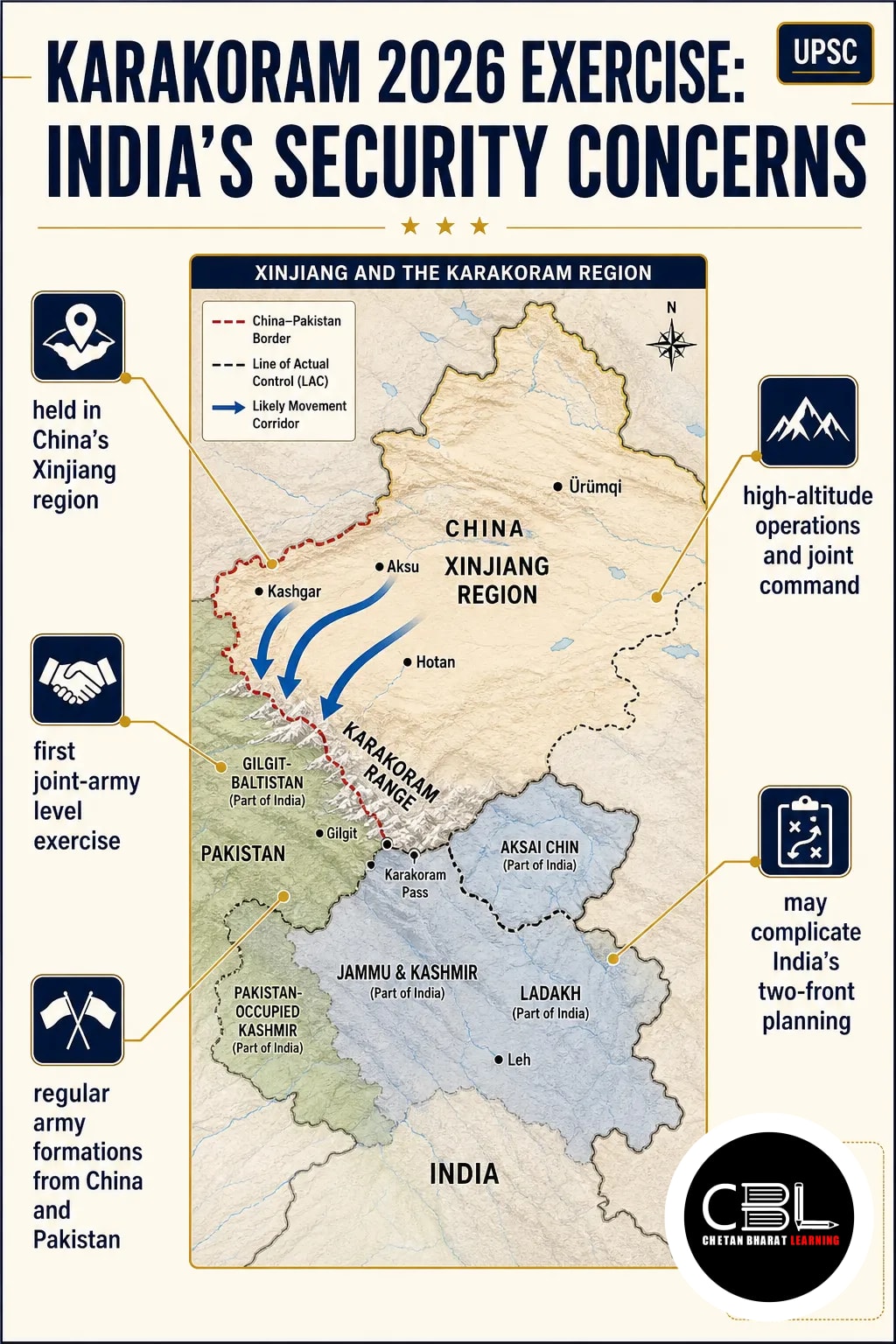

Karakoram 2026 exercise brought Chinese and Pakistani army formations together in Xinjiang for high-altitude training. The exercise adds an operational dimension to a partnership that matters for India’s regional security.
Quick answer: The Karakoram 2026 exercise was China and Pakistan’s first joint-army level exercise, held in Xinjiang from 14 to 22 October 2026. It trained regular formations in high-altitude operations, drones and joint command. For India, closer coordination raises questions about a potential two-front security challenge.
What happened during the Karakoram 2026 exercise?
China’s People’s Liberation Army (PLA) and the Pakistan Army trained together in Xinjiang from 14 to 22 October 2026. The exercise involved regular army formations and marked their first joint-army level exercise.
Its high-altitude focus is relevant to the PLA’s Western Theatre Command, which oversees the border with India. Moreover, the exercise extended cooperation beyond the earlier Sea Guardian, Warrior and Shaheen exercise series.
| Feature | Details |
|---|---|
| Phase one | Up to 19 October; specialised tactics, close-quarter combat and drone operations |
| Phase two | Joint command, mixed formations, counterterrorism clearance, manoeuvres and coordinated fire drills |
| Equipment | Chinese small arms, armoured assault vehicles, infantry fighting vehicles, artillery and drones |
China’s Ministry of National Defence described the exercise as an opportunity to deepen cooperation and tactical integration. In practical terms, mixed formations let troops practise working across national military structures.
How has China–Pakistan defence cooperation evolved?
The partnership has moved beyond equipment purchases towards closer operational cooperation, although it is not a formal alliance. Its strategic history helps explain why the exercise matters to India.
Under the 1963 Sino-Pakistan Boundary Agreement, Pakistan ceded the Shaksgam Valley to China. India claims the territory as part of the former princely state of Jammu and Kashmir. Subsequently, China contributed to Pakistan’s nuclear and missile programmes, adding a strategic dimension to the relationship.
More recently, Chinese and Pakistani security personnel conducted a joint patrol at Mantika Pass, near Khunjerab Pass. The pass lies at approximately 4,700 metres in the upper Hunza area of Gilgit-Baltistan. The patrol points to institutional engagement on border management; however, it is distinct from the army exercise.
The source also cites evidence of accelerated Chinese deliveries of PL-15E air-to-air missiles, air defence and electronic platforms during the May 2025 crisis. Thus, equipment supply and joint training must be assessed together, while recognising that they are different forms of cooperation.
Why does the exercise matter for India?
The exercise matters because closer China–Pakistan coordination could complicate India’s defence planning across its northern and western fronts.
- Interoperability: Joint drills can help forces work together through shared procedures, communications and command practices.
- High-altitude experience: Training in Xinjiang is relevant to operations in demanding terrain; however, one exercise does not establish a joint war plan.
- Common platforms: Chinese equipment in Pakistan’s inventory can support familiarity with weapons and support systems; its operational effect depends on training and maintenance.
- Two-front planning: India must consider simultaneous pressures on different borders, including the allocation of forces, logistics and intelligence.
Interoperability means the ability of different forces to operate together effectively. It does not, by itself, prove that the partners will fight jointly in a future conflict.
Military exercises also serve different diplomatic purposes. For comparison, CBL has covered India–Myanmar naval exercise IMNEX and the India–Oman exercise Naseem Al Bahr.
What are the wider regional concerns?
The partnership’s effects extend beyond the immediate exercise area through equipment supply and regional military contacts.
Bangladesh has advanced plans to purchase Chinese J-10CE fighters, while its pilots are to receive training from Pakistan at Jessore airbase. The source also notes discussions on air defence radar integration and tank upgrades. However, discussions and plans should not be treated as completed procurement or operational integration.
Dhaka, Beijing and Islamabad have not formed a strategic trilateral, according to the source. Nevertheless, India must assess how separate defence relationships could affect regional capabilities without assuming a common command or alliance.
What should India’s response prioritise?
India’s response should combine military preparedness with sustained diplomacy and careful assessment of actual capabilities.
- Intelligence and assessment: Monitor exercises, equipment transfers and border activity while distinguishing intent from demonstrated capability.
- Joint preparedness: Improve coordination among India’s services for high-altitude logistics, surveillance and responses to simultaneous pressures.
- Technology and resilience: Strengthen counter-drone capabilities, secure communications and equipment maintenance; also protect critical logistics chains.
- Diplomacy: Maintain channels with neighbouring countries and China to manage tensions, while building practical regional partnerships.
Overall, a coherent strategy should prepare for converging capabilities without treating every bilateral activity as evidence of an imminent conflict.
Source: Indian Express Explained, 12 November 2026
Asked in State PCS: Previous Year Questions
- Punjab PCS Mains 2018 (GS Paper 3): What is the China Pakistan Economic Corridor? What are its implications for India’s security?
This question links China–Pakistan cooperation to India’s security; therefore, distinguish economic connectivity from military cooperation.
Punjab PCS and Haryana HCS may test the exercise alongside border geography and India’s security challenges. In addition, Mains answers can distinguish equipment purchases from interoperability and strategic coordination.
Prelims Practice Corner
Mains Practice Questions
Frequently Asked Questions
Where was the Karakoram 2026 exercise held?
It was held in China’s Xinjiang Uyghur Autonomous Region. The Chinese and Pakistani armies trained there from 14 to 22 October 2026.
Was Karakoram-2026 a China–Pakistan joint-army exercise?
Yes, it was their first joint-army level exercise involving regular formations. Moreover, its activities included high-altitude training and joint command drills.
Why is the exercise significant for India?
It matters because closer military coordination may complicate India’s two-front planning. However, an exercise alone does not establish a joint war plan.
Related Current Affairs
Preparing for UPSC, PCS or HCS?
Talk to a mentor at Chetan Bharat Learning, Chandigarh. Free guidance on choosing the right exam and building a study plan.
Chat on WhatsAppCall 97793 53345UPSC / IAS / PCS coaching in Chandigarh · Trusted by aspirants across Punjab & Haryana









Leave a Reply
You must be logged in to post a comment.