
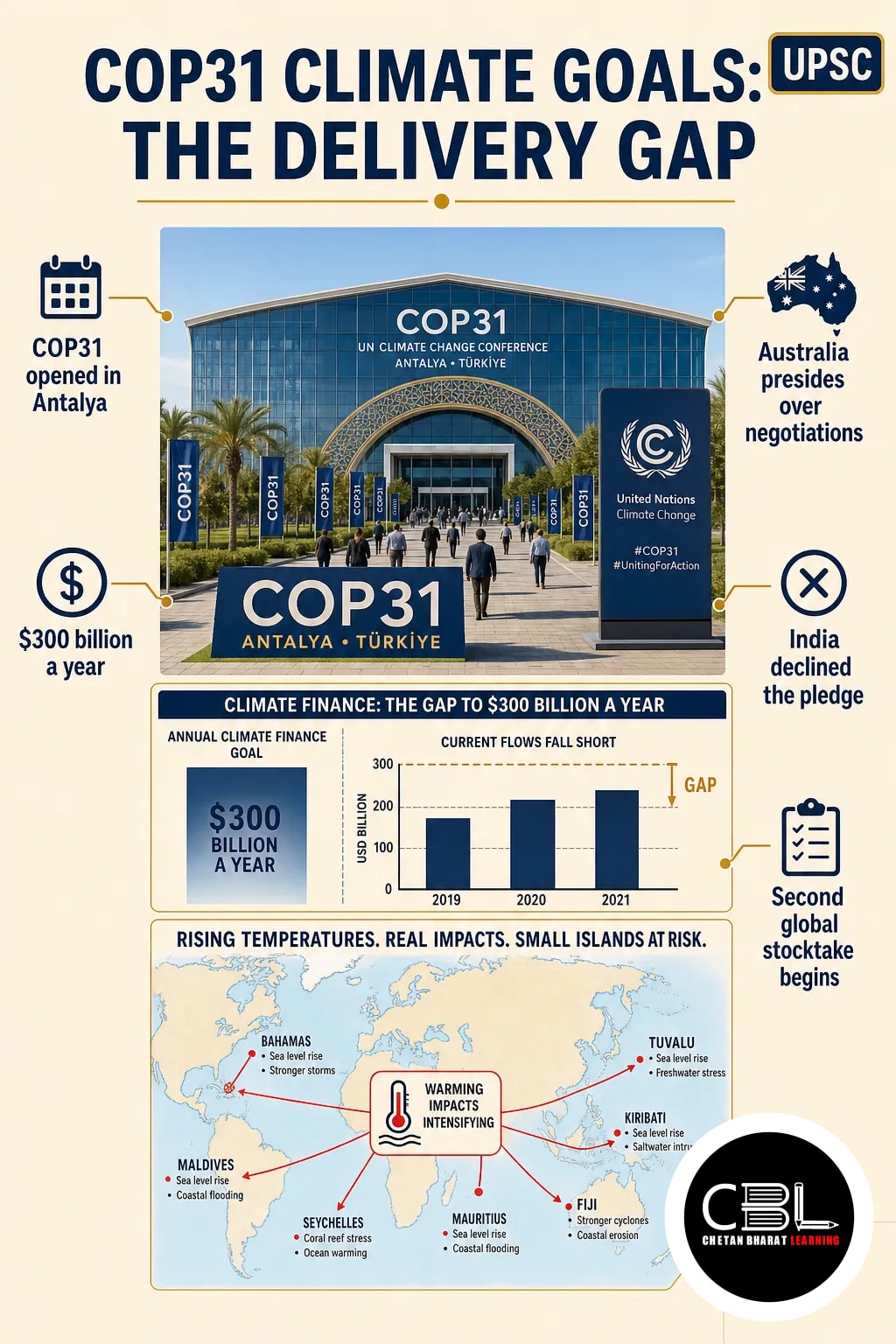

COP31 climate goals confront a gap between international promises and practical delivery. For wider context, explore CBL’s environment current affairs.
Quick answer: COP31 opened in Antalya, Türkiye, in November 2026, with Australia presiding over negotiations. Its central challenge is delivering earlier promises, including $300 billion a year by 2035 in climate finance. Meanwhile, India has declined an electrification pledge and called for predictable finance, technology transfer and nationally determined mitigation.
What is the climate commitments gap?
The climate commitments gap is the difference between agreed ambitions and the action or resources needed to realise them. In particular, a finance target does not automatically explain who will supply the funds or how vulnerable countries can access them.
Mitigation addresses greenhouse gas emissions, while adaptation helps societies adjust to climate impacts. Loss and damage concerns harm associated with climate change, including harm that adaptation cannot fully prevent. These needs overlap, but funding one does not necessarily meet the others.
The Paris Agreement seeks to keep warming well below 2°C above pre-industrial levels and pursue efforts to limit it to 1.5°C. Therefore, delivery matters alongside ambition: delayed implementation can make those goals harder to achieve.
Why is COP31 in the news?
The 31st Conference of the Parties (COP31) began in Antalya with climate finance and existing commitments central to its agenda. Türkiye hosts the meeting, while Australia presides over negotiations.
Before the summit, ministerial delegations visited Fiji and Tuvalu, highlighting small island countries’ vulnerability to warming. However, several prominent leaders, including some from European countries, skipped the meeting. CBL’s coverage of the India-Pacific partnership offers related regional context.
Meanwhile, the second global stocktake begins at COP31. This periodic assessment under the Paris Agreement examines collective progress towards its goals. The editorial notes uncertainty over the timing of the next reports of the Intergovernmental Panel on Climate Change (IPCC), which can inform policymakers’ response.
| Commitment or proposal | Status and delivery question |
|---|---|
| COP29 finance goal | $300 billion annually by 2035; practical arrangements for fund flows have been deferred to COP32. |
| COP30 adaptation finance call | A call to triple adaptation finance by 2035; implementation remains central. |
| Fossil-fuel transition | COP30 ended without a formal roadmap; a voluntary roadmap before COP31 remains outside formal negotiating text. |
| Electrification proposal | COP31 president Murat Kurum proposed raising electricity’s share of total energy consumption from 23% to 35% by 2035. |
Why set new climate targets?
New targets can give countries a common direction and make long-term climate ambition easier to assess. They can also encourage governments to connect energy policy with emissions reduction.
- Shared signals: An electrification goal can focus attention on the role of electricity in energy transitions.
- Collective review: The global stocktake can identify gaps between existing action and the Paris Agreement’s goals.
- Political visibility: Moreover, a measurable goal can help citizens assess whether governments are moving towards a stated outcome.
However, a higher electricity share alone does not establish how clean that electricity is. Consequently, the energy source and the emissions associated with generation also matter.
What limits delivery and climate equity?
Unclear funding arrangements, unequal capacity and weak implementation can turn ambitious commitments into incomplete outcomes.
- Finance access: Although COP29 set a 2035 finance goal, the practical flow of funds remains unresolved until COP32 negotiations.
- Scale of need: The Loss and Damage fund approved $21 million for Nepal; the editorial contrasts this with needs in billions.
- Transition pathways: Countries differ in resources and development needs; therefore, a uniform numerical pledge may not suit every national pathway.
- Negotiating context: The United States’ withdrawal from the Paris Agreement and financial strain in Europe complicate cooperation. The West Asia war also forms part of the summit’s background.
- Formal versus voluntary action: A voluntary fossil-fuel roadmap outside negotiating text does not carry the same status as a formal COP outcome.
India has declined to sign the proposed electrification pledge. Instead, it has emphasised predictable finance, technology transfer and nationally determined approaches to mitigation. Its position connects delivery with the principle of common but differentiated responsibilities and respective capabilities, which recognises differing national circumstances.
What should a delivery-focused approach include?
A delivery-focused approach should connect every headline promise to funding, access and transparent progress checks.
- Clarify finance pathways: Negotiators could specify funding sources, timelines and access procedures rather than rely on an aggregate target alone.
- Track adaptation separately: Clear reporting could show whether adaptation finance reaches vulnerable countries and supports locally identified needs.
- Support national pathways: Technology transfer and predictable finance can help countries select feasible mitigation measures without applying one transition model everywhere.
- Use the stocktake: Countries can link the assessment’s findings to future plans and explain how they intend to close identified gaps.
- Assess outcomes: Alongside electrification, governments should examine electricity sources and implementation progress.
Useful for Essay and GS IV: A credible promise is measured not only by its ambition, but also by the institutions and resources that make delivery possible.
Source: The Hindu Editorial, 13 November 2026
- FIPIC Meeting: India-Pacific Partnership at UNGA (28 Oct 2026)
Punjab PCS and Haryana HCS General Studies can test the distinction between mitigation and adaptation, as well as climate finance. In addition, candidates can examine how state planning translates national climate objectives into local action.
Prelims Practice Corner
Mains Practice Questions
Frequently Asked Questions
Where is COP31 being held?
COP31 is being held in Antalya, Türkiye. Meanwhile, Australia presides over the negotiations.
What climate finance goal did COP29 agree on?
COP29 agreed on $300 billion a year by 2035. However, decisions on how climate funds will flow have been deferred to COP32.
Did India sign the COP31 electrification pledge?
No, India declined to sign it. Instead, India called for predictable climate finance, technology transfer and nationally determined mitigation approaches.
What is the global stocktake?
The global stocktake is a periodic assessment of collective progress under the Paris Agreement. Its second cycle begins at COP31 and can inform future climate action.
Related Current Affairs
Preparing for UPSC, PCS or HCS?
Talk to a mentor at Chetan Bharat Learning, Chandigarh. Free guidance on choosing the right exam and building a study plan.
Chat on WhatsAppCall 97793 53345UPSC / IAS / PCS coaching in Chandigarh · Trusted by aspirants across Punjab & Haryana









Leave a Reply
You must be logged in to post a comment.