

UPSC Syllabus Mapping
| GS Paper | GS-III |
|---|---|
| Subject | Indian Economy and Science & Technology — Digital Payments, Financial Inclusion, FinTech and Cybersecurity |
What is Offline UPI?
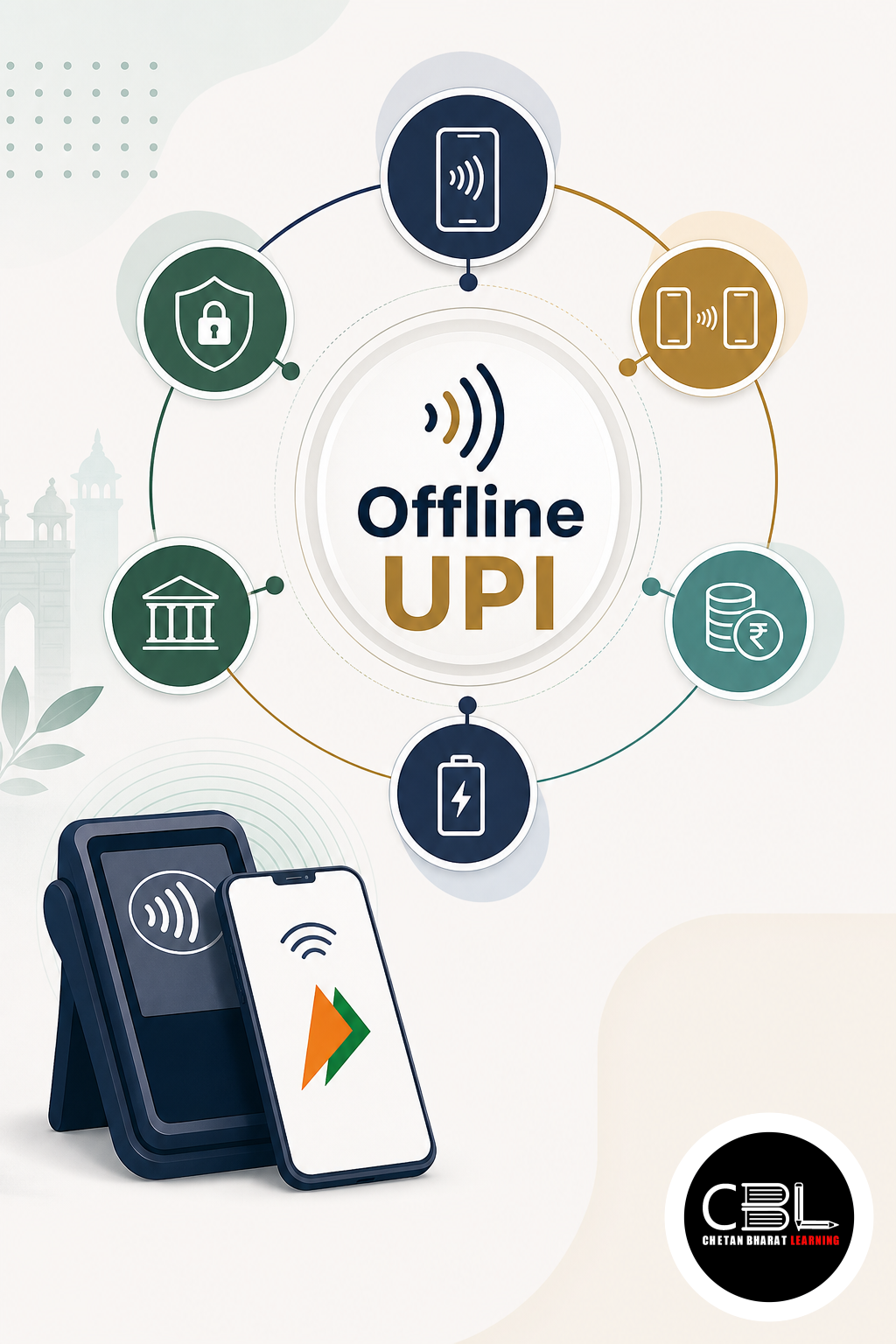
The proposed system is a contactless payment architecture designed to function when real-time internet connectivity is unavailable at the point of transaction. It builds upon India’s Unified Payments Interface ecosystem but differs from a conventional online UPI payment, in which the payment instruction normally travels through connected digital infrastructure for immediate authorisation and processing.
The proposal uses Near Field Communication, or NFC, for short-range communication between compatible devices. NFC allows two electronic devices placed very close to each other to exchange information wirelessly. A customer could therefore tap an NFC-enabled smartphone against a compatible merchant terminal. Because the local communication does not itself require mobile internet, the payment interaction can potentially continue in areas where network connectivity is absent or temporarily disrupted.
Why is Offline UPI in News?
The National Payments Corporation of India is reported to be developing a system capable of supporting NFC-based merchant transactions even when real-time network access is unavailable. The objective is to address an important weakness of digital payments: a user may have sufficient funds and a functioning smartphone, yet a transaction can still fail because of poor cellular coverage, overloaded networks or temporary internet disruption.
Such capability could be useful in underground metro systems, remote markets, transport environments and locations with intermittent connectivity. However, an offline architecture requires safeguards different from conventional connected payments because the bank cannot necessarily verify every transaction in real time. The proposal should therefore be understood as a developing payment architecture whose final limits and operating rules would depend on the framework ultimately approved and implemented. Aspirants can follow authoritative payment-system developments through the Reserve Bank of India.
Key Features of Offline UPI
- Pre-authorisation: A limited balance or cryptographically protected payment credentials could be provisioned while the device is connected to the banking ecosystem.
- NFC communication: The customer taps a compatible smartphone against an NFC-enabled merchant terminal, allowing the devices to exchange transaction information locally.
- Tokenisation: Secure tokens can reduce exposure of underlying account credentials and help control the reuse of payment authorisations.
- Store-and-forward: Transaction records can be stored securely and forwarded to the payment network when internet connectivity becomes available.
- Deferred reconciliation: Because real-time bank communication may be absent, the system must reconcile offline transaction records after reconnection.
- Risk limits: Offline balances and transaction ceilings can restrict the potential financial exposure created by delayed online verification.
This model should also be distinguished from existing low-value payment arrangements. UPI Lite is designed to simplify small-value transactions, while UPI Lite X has introduced offline functionality using NFC in supported circumstances. The proposed merchant-focused architecture seeks to advance the broader objective of maintaining payment acceptance even during connectivity gaps. Final technical and regulatory specifications will determine exactly how it differs from existing products.
Challenges Related to Offline Digital Payments
The greatest technical challenge is preventing double spending. In a conventional online payment, the system can check account status and update balances centrally. During a disconnected transaction, that immediate verification may be unavailable. Secure hardware, single-use credentials, transaction counters, cryptographic controls and strict offline limits are therefore important to ensure that the same authorised value cannot be fraudulently spent multiple times.
Deferred settlement also creates operational questions. A transaction may appear complete to the customer and merchant even though final bank-to-bank processing occurs later. Systems require clear rules for failed synchronisation, duplicate records, compromised devices and disputes. Consumer protection becomes especially important because users should understand when a payment has been locally accepted and when settlement has been conclusively reconciled.
Hardware availability can constrain adoption. NFC functionality is common in many newer smartphones but is not universal, particularly across lower-cost or older devices. Merchants also require compatible terminals. An NFC-only approach could consequently improve resilience for some users without solving the broader inclusion challenge faced by people using basic phones. Aspirants can connect such developments with financial inclusion and India’s digital public infrastructure through the UPSC current affairs library.
Way Forward for Resilient Digital Payments
Offline payment design should follow a risk-based model. Transaction and cumulative offline limits can restrict exposure, while strong device authentication and cryptographic tokenisation can make stolen credentials less useful. The architecture should also maintain auditable records so that transactions can be reconstructed and reconciled when devices return online. Security testing must cover lost phones, tampered terminals, replay attacks and attempts to manipulate device clocks or stored balances.
Interoperability and accessibility will determine whether the technology becomes widely useful. Merchants should not require expensive specialised infrastructure that makes acceptance uneconomic for small businesses. At the same time, India needs multiple complementary offline-payment technologies because NFC-equipped smartphones represent only one section of the population. Feature-phone solutions and other low-connectivity payment channels remain important for genuine financial inclusion.
The final architecture should preserve the strengths that made UPI widely adopted: interoperability, ease of use and low friction, while adding resilience without creating disproportionate fraud risk. The National Payments Corporation of India is the primary institutional source for developments concerning UPI products and payment infrastructure. If implemented with robust security and consumer safeguards, offline capability could make India’s digital payment system more dependable where connectivity is unreliable.
Prelims Practice Corner
-
1. The Unified Payments Interface is operated by: (a) SEBI (b) NPCI (c) IRDAI (d) NABARD
Answer: (b) NPCI -
2. Near Field Communication is best described as: (a) A satellite navigation technology (b) A short-range wireless communication technology (c) A long-distance optical-fibre protocol (d) A cryptocurrency consensus mechanism
Answer: (b) NFC enables short-range wireless communication between compatible devices. -
3. Consider the following statements regarding an offline digital payment system:
1. It may require transaction records to be reconciled after connectivity returns.
2. Limits on offline transaction value can reduce financial risk.
3. Preventing double spending is an important technical challenge.
Answer: (d) 1, 2 and 3. -
4. Tokenisation in digital payments primarily helps by: (a) Converting rupees into cryptocurrency (b) Replacing sensitive payment credentials with protected digital identifiers (c) Increasing internet bandwidth (d) Eliminating the need for cybersecurity
Answer: (b) Tokenisation can reduce exposure of sensitive underlying payment credentials. -
5. Which of the following could constrain widespread adoption of NFC-based offline payments?
1. Absence of NFC hardware on some smartphones
2. Requirement for compatible merchant terminals
3. Need to manage fraud during deferred settlement
Answer: (d) 1, 2 and 3.
Mains Practice Questions
-
1. Offline digital payments can strengthen the resilience of India’s digital public infrastructure but create new cybersecurity and settlement risks. Discuss. (10 marks)
Outline: Connectivity dependence → offline payment concept → NFC and pre-authorisation → financial inclusion and resilience → double spending → deferred settlement → hardware limitations → risk-based safeguards. -
2. India’s next phase of digital payment innovation must combine convenience with inclusion, interoperability and consumer protection. Examine. (15 marks)
Outline: UPI ecosystem → payment accessibility → low-connectivity regions → offline architecture → smartphone and feature-phone divide → cybersecurity → dispute resolution → interoperability → regulatory oversight → inclusive digital economy.
FAQs on Offline UPI
- How can a UPI payment work without internet connectivity?
- A compatible system can use pre-authorised payment value or secure credentials stored on a device, exchange transaction information locally through technologies such as NFC and reconcile the transaction with the payment network after connectivity returns.
- What is NFC in digital payments?
- Near Field Communication is a short-range wireless technology that allows compatible devices placed close together to exchange information, enabling contactless tap-and-pay interactions.
- What is the main risk in an offline payment system?
- A central challenge is ensuring that disconnected devices cannot reuse the same authorised value or credentials for multiple fraudulent transactions before reconciliation. Secure tokens, hardware protections and transaction limits can help manage this risk.
Related Current Affairs
Preparing for UPSC, PCS or HCS?
Talk to a mentor at Chetan Bharat Learning, Chandigarh. Free guidance on choosing the right exam and building a study plan.
Chat on WhatsAppCall 97793 53345UPSC / IAS / PCS coaching in Chandigarh · Trusted by aspirants across Punjab & Haryana
Leave a Reply
You must be logged in to post a comment.