
Why Is This News Important?
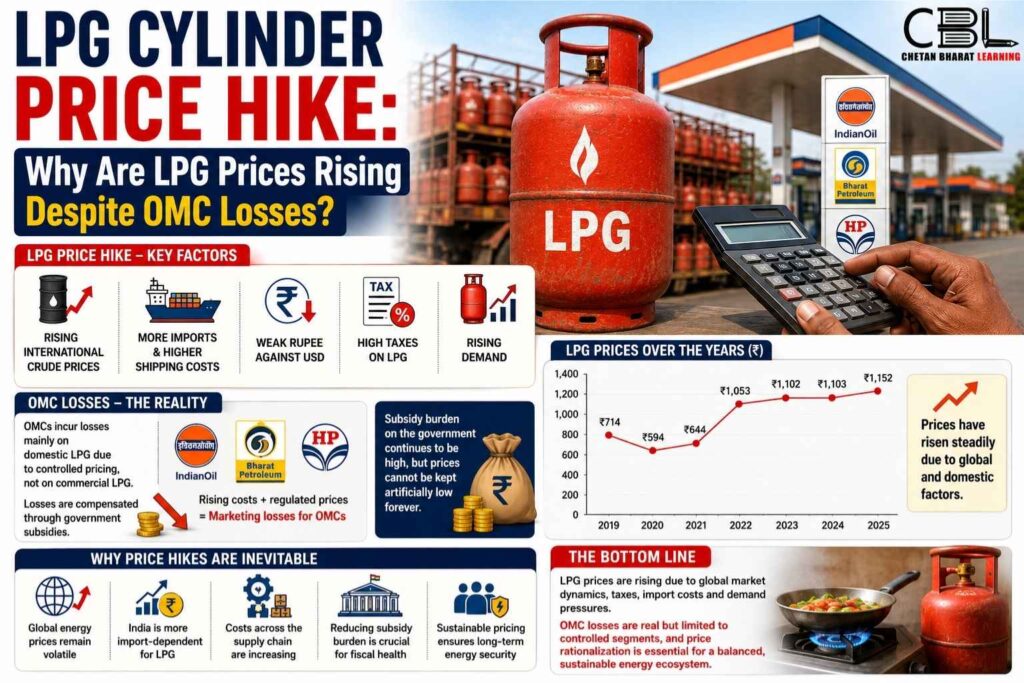
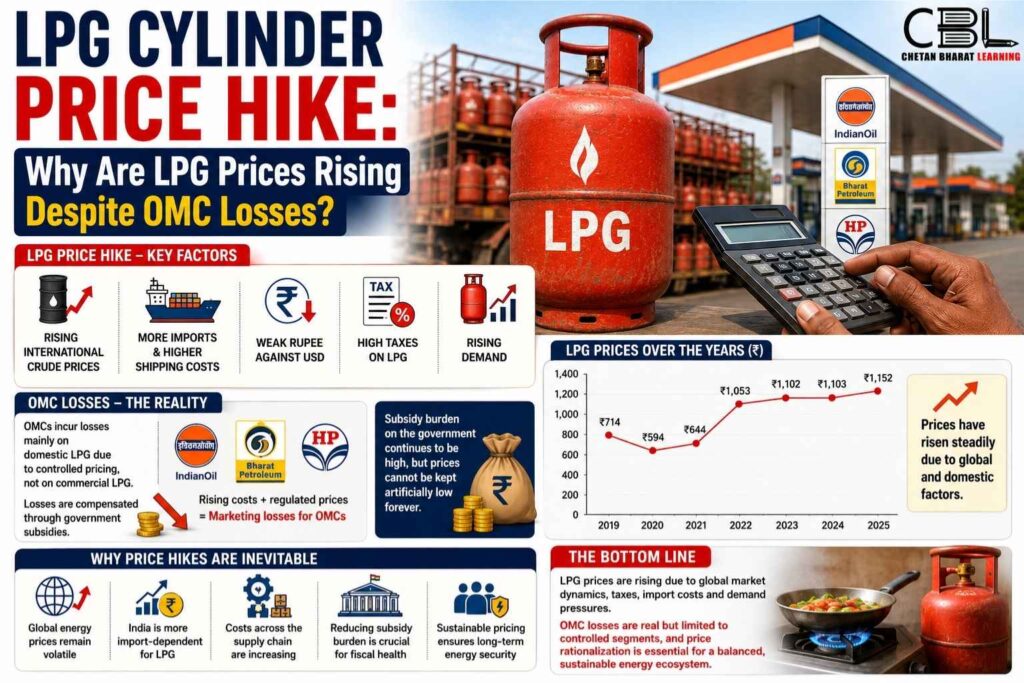
The Government of India has increased the price of domestic LPG cylinders by ₹29. This is the second major price revision after disruptions in global energy markets triggered by geopolitical tensions in West Asia.
Even after the latest increase, Oil Marketing Companies (OMCs) continue to incur losses of nearly ₹700 per cylinder, according to government estimates. This has once again brought attention to India’s energy security challenges, subsidy policies, and the difficult balance between consumer welfare and market realities.
For UPSC aspirants, this topic is important because it covers several key areas of the syllabus, including the Indian Economy, Energy Security, Subsidies, Inflation, and Government Welfare Schemes.
What Has Changed?
The price of a 14.2 kg domestic LPG cylinder has been increased by ₹29 across the country.
After the latest revision:
- Delhi: ₹942 per cylinder
- Mumbai: ₹941.50 per cylinder
- Kolkata: ₹968 per cylinder
- Chennai: ₹957.50 per cylinder
This follows an earlier increase of ₹60 announced in March, taking the cumulative increase to ₹89 per cylinder in recent months.
Despite these revisions, the government maintains that domestic LPG prices in India remain lower than those in several neighbouring countries.
Why Have LPG Prices Increased?
The primary reason behind the price increase is the rise in international LPG prices and disruptions in global supply chains.
The ongoing tensions in West Asia have affected energy transportation routes and increased uncertainty in international fuel markets. Since India imports a significant portion of its LPG requirements, fluctuations in global prices directly influence domestic fuel costs.
The situation worsened due to disruptions in shipping routes and concerns regarding energy supplies passing through strategically important maritime chokepoints.
As international prices increased, OMCs faced rising procurement costs, making price revisions necessary.
Understanding India’s Dependence on LPG Imports
India is one of the world’s largest consumers of LPG.
Over the years, government schemes such as the Pradhan Mantri Ujjwala Yojana (PMUY) have significantly expanded LPG access across rural and urban households.
However, India’s domestic LPG production remains insufficient to meet total demand. A large share of LPG is imported from international markets, making the country vulnerable to external shocks.
Whenever global energy prices rise, the impact eventually reaches domestic consumers unless the government or OMCs absorb the additional costs.
This dependence highlights the importance of developing a long-term strategy for energy security and supply diversification.
Why Are OMCs Still Losing Money?
A common question is why Oil Marketing Companies continue to face losses even after LPG prices have been increased.
The answer lies in the difference between import costs and retail prices.
OMCs purchase LPG at international market rates. However, domestic selling prices are often influenced by affordability concerns and government policy decisions.
As a result:
- Import costs have increased sharply.
- Domestic prices have not increased proportionately.
- OMCs absorb part of the burden.
- Consumer prices remain lower than actual market-linked prices.
This gap between procurement costs and selling prices continues to create financial pressure on public sector oil companies.
The Role of Government Subsidies
The government has attempted to protect vulnerable households from the full impact of rising LPG prices.
Beneficiaries under the Pradhan Mantri Ujjwala Yojana continue to receive subsidy support.
Under the scheme:
- Eligible households receive financial assistance.
- The effective cost of LPG remains lower.
- Poor and rural families continue to have access to clean cooking fuel.
The subsidy mechanism reflects the government’s commitment to balancing economic realities with social welfare objectives.
Without such support, rising international prices could significantly affect household budgets.
Impact on Household Consumption
Rising LPG prices directly affect household expenditure.
Cooking fuel is an essential commodity, and any increase in its price impacts monthly family budgets.
However, recent data suggests that LPG consumption has declined in certain regions.
Several factors may be responsible:
- Higher fuel costs
- Seasonal demand fluctuations
- Economic pressures on households
- Supply disruptions in international markets
If prices continue rising over a prolonged period, some consumers may reduce LPG usage or seek alternative fuel options.
This remains a challenge for policymakers who aim to promote clean cooking fuel adoption across the country.
Impact on Inflation
Energy prices play a crucial role in determining inflation.
An increase in LPG prices can influence:
- Household expenses
- Transportation costs
- Production costs
- Service sector expenses
Although LPG is only one component of the energy sector, changes in fuel prices often create broader inflationary effects across the economy.
The government and the Reserve Bank of India closely monitor fuel price movements because they affect overall price stability.
Controlling inflation remains essential for maintaining economic growth and consumer confidence.
Energy Security Concerns for India
The recent LPG price hike has once again highlighted India’s energy security challenges.
Energy security refers to the uninterrupted availability of energy resources at affordable prices.
India faces several challenges:
- Heavy dependence on energy imports
- Geopolitical tensions in energy-producing regions
- Global price volatility
- Supply chain disruptions
The West Asia crisis has demonstrated how events occurring thousands of kilometres away can directly impact Indian consumers.
This is why India is increasingly focusing on:
- Diversifying energy sources
- Expanding strategic petroleum reserves
- Promoting renewable energy
- Strengthening energy partnerships
These measures aim to reduce vulnerability to future supply shocks.
What Does This Mean for the Indian Economy?
Energy remains a critical driver of economic activity.
Higher fuel prices can affect:
- Consumer spending
- Industrial production
- Logistics costs
- Economic growth
At the same time, keeping prices artificially low for extended periods can increase financial pressure on OMCs and government finances.
Therefore, policymakers must strike a balance between affordability and fiscal sustainability.
The current LPG pricing debate reflects the broader challenge of managing energy affordability while ensuring long-term economic stability.
For the Indian Economy, energy pricing decisions have implications that extend far beyond household consumption.
Government’s Long-Term Strategy
The government is pursuing multiple strategies to strengthen energy resilience.
These include:
- Expanding domestic energy production
- Encouraging renewable energy adoption
- Increasing LPG infrastructure
- Supporting strategic reserves
- Diversifying import sources
The objective is to reduce dependence on a limited number of suppliers and improve energy availability during periods of global uncertainty.
Such measures are crucial for ensuring sustainable economic development.
Why Is This Important for UPSC?
This topic is highly relevant for UPSC because it connects multiple syllabus areas.
Prelims Relevance
- LPG
- PMUY
- Energy Security
- OMCs
- Fuel Subsidies
Mains Relevance
- Indian Economy
- Energy Security
- Welfare Schemes
- Inflation
- Public Finance
- Global Energy Markets
Questions related to fuel pricing, subsidies, and energy security frequently appear in both Prelims and Mains examinations.
Prelims Pointers
| Topic | Key Fact |
|---|---|
| Fuel | LPG (Liquefied Petroleum Gas) |
| Price Increase | ₹29 |
| Beneficiaries | PMUY Households |
| Key Institutions | OMCs |
| Concern | Energy Security |
FAQ
Why have LPG prices increased?
LPG prices have increased due to rising international energy prices and supply disruptions.
Why are OMCs still facing losses?
OMCs purchase LPG at higher global prices but sell it domestically at relatively lower prices.
What is PMUY?
Pradhan Mantri Ujjwala Yojana provides LPG connections and subsidy support to eligible households.
Why is energy security important?
Energy security ensures reliable and affordable access to fuel resources, which is essential for economic growth and national development.
Conclusion
The latest LPG price hike demonstrates the complex relationship between global energy markets, domestic fuel pricing, and consumer welfare. While the increase may place additional pressure on household budgets, it also reflects the challenges faced by Oil Marketing Companies in maintaining supplies amid rising international costs.
The issue highlights the importance of energy security, subsidy management, and long-term policy planning for India. For UPSC aspirants, understanding these interconnected themes is essential for both Prelims and Mains preparation.
Stay updated with such important Economy and Energy Security topics through UPSC Coaching in Chandigarh and IAS Coaching in Chandigarh at Chetan Bharat Learning.
Related Current Affairs
Preparing for UPSC, PCS or HCS?
Talk to a mentor at Chetan Bharat Learning, Chandigarh. Free guidance on choosing the right exam and building a study plan.
Chat on WhatsAppCall 97793 53345UPSC / IAS / PCS coaching in Chandigarh · Trusted by aspirants across Punjab & Haryana
Leave a Reply
You must be logged in to post a comment.