
Why RBI’s Assessment Matters
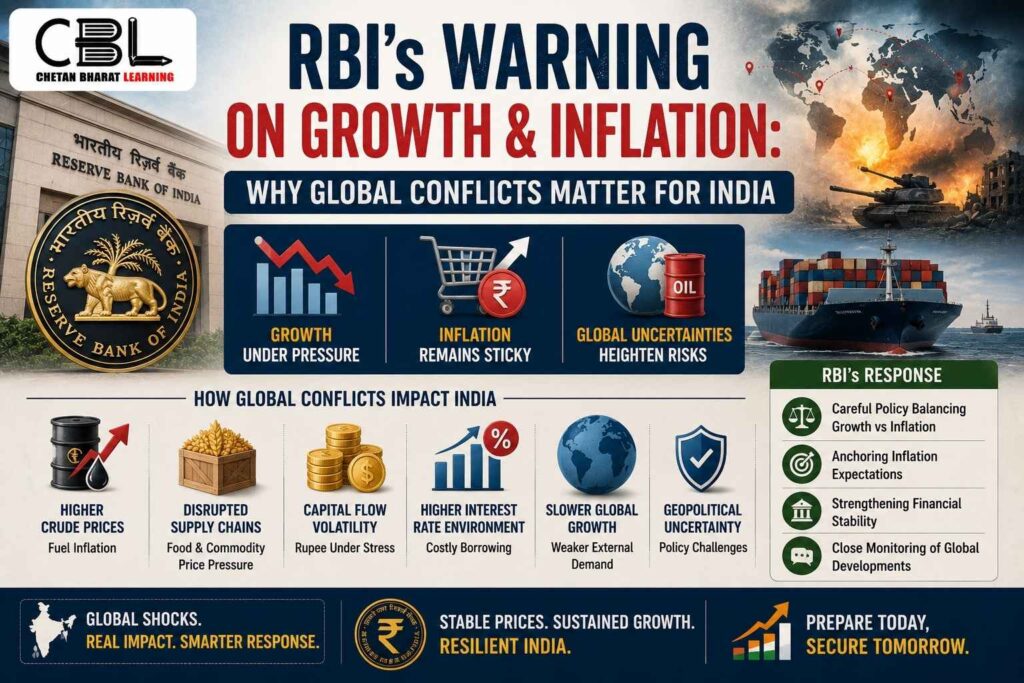
The Reserve Bank of India (RBI), in its Annual Report for FY26, has maintained a positive outlook on India’s economic growth. However, the central bank has also cautioned that geopolitical conflicts and wars could create short-term challenges for both economic growth and inflation.
In today’s interconnected world, economic performance is influenced not only by domestic policies but also by international developments. Events occurring thousands of kilometers away can directly affect fuel prices, trade flows, supply chains, and investment decisions within India.
The RBI’s observations highlight the growing importance of economic resilience in an era of geopolitical uncertainty.
Students preparing through UPSC Coaching in Chandigarh and IAS Coaching in Chandigarh should closely follow topics like inflation, monetary policy, economic growth, and global economic risks because these themes are highly important for GS Paper 3, Essay, and UPSC Interview preparation.
Understanding Economic Growth
Economic growth refers to the increase in the production of goods and services within an economy over a period of time.
A growing economy generally leads to:
- Higher incomes
- More employment opportunities
- Increased investment
- Improved living standards
India continues to remain one of the fastest-growing major economies, supported by:
✔ Strong domestic demand
✔ Infrastructure investment
✔ Digital transformation
✔ Expanding manufacturing capacity
What Is Inflation?
Inflation refers to a sustained increase in the general price level of goods and services.
Moderate inflation is considered normal in a growing economy. However, excessive inflation can reduce purchasing power and increase the cost of living.
Inflation affects:
- Households
- Businesses
- Government finances
- Investment decisions
This is why controlling inflation remains one of the RBI’s key responsibilities.
How Wars Affect Economic Growth
1. Supply Chain Disruptions
Global conflicts often interrupt trade routes and logistics networks.
As a result:
- Transportation costs increase
- Delivery timelines become uncertain
- Production costs rise
Industries dependent on imported raw materials are particularly vulnerable.
2. Reduced Investor Confidence
Geopolitical uncertainty can discourage investment.
Investors generally prefer stable environments. During periods of conflict:
- Capital flows may slow down
- Financial market volatility may increase
- Business expansion plans may be delayed
This can affect economic growth.
3. Trade Uncertainty
Conflicts can disrupt international trade relationships and create uncertainty in global markets.
Export-oriented sectors may face challenges if global demand weakens or trade routes become unstable.
How Wars Contribute to Inflation
Rising Energy Prices
One of the most immediate effects of geopolitical conflicts is the rise in energy prices.
India imports a large share of its:
- Crude oil
- Natural gas
- Energy resources
Higher energy prices increase:
- Transportation costs
- Manufacturing expenses
- Household fuel costs
These increases often contribute to inflation.
Commodity Price Shocks
Wars can disrupt the supply of important commodities such as:
- Food grains
- Fertilisers
- Industrial metals
- Energy products
Supply shortages typically lead to higher prices.
The RBI’s Role During Economic Uncertainty
The Reserve Bank of India uses monetary policy to maintain:
✔ Price stability
✔ Financial stability
✔ Sustainable growth
Key tools include:
- Repo rate adjustments
- Liquidity management
- Inflation targeting
- Market interventions
The RBI continuously monitors domestic and global developments to ensure macroeconomic stability.
Why India’s Growth Outlook Remains Positive
Despite global challenges, India possesses several strengths.
Strong Domestic Demand
India’s large consumer base provides resilience against external shocks.
Domestic consumption continues to support economic activity even during periods of global uncertainty.
Infrastructure Development
Large-scale investments in:
- Roads
- Railways
- Ports
- Digital infrastructure
are supporting long-term economic growth.
Demographic Advantage
India’s young workforce continues to provide opportunities for productivity growth and innovation.
Economic Resilience in a Changing World
Modern economies face multiple external risks, including:
- Geopolitical conflicts
- Climate-related disruptions
- Financial market volatility
- Supply chain challenges
Building resilience requires:
✔ Diversified supply chains
✔ Energy security
✔ Fiscal discipline
✔ Stable monetary policy
Prelims Pointers
Important Institution
- Reserve Bank of India (RBI)
Key Concepts
- Inflation
- Economic Growth
- Monetary Policy
- Repo Rate
Important Objective
Inflation Targeting
Mains Perspective
Possible Question
“Geopolitical conflicts increasingly influence domestic economic outcomes.” Discuss in the context of growth and inflation challenges faced by emerging economies like India.
Key Dimensions to Include
- Supply chains
- Energy security
- Inflation
- Investment climate
- Monetary policy
- Economic resilience
Frequently Asked Questions (FAQ)
Why can wars affect India’s economy?
Wars can disrupt supply chains, increase energy prices, reduce investment confidence, and create trade uncertainty.
How does inflation impact households?
Inflation reduces purchasing power by increasing the prices of goods and services.
What is RBI’s primary role during inflationary periods?
The RBI uses monetary policy tools to maintain price stability and support sustainable economic growth.
Why does India remain resilient despite global challenges?
Strong domestic demand, infrastructure investment, demographic advantages, and policy reforms support economic resilience.
Conclusion: Managing Growth Amid Global Uncertainty
The RBI’s assessment reflects a balanced view of India’s economic prospects. While growth remains strong, global geopolitical tensions continue to pose risks through inflationary pressures and economic uncertainty.
The challenge for policymakers is to maintain growth while protecting the economy from external shocks.
In an increasingly interconnected world, economic resilience has become as important as economic expansion itself.
“Sustainable growth is not just about growing faster—it is about remaining resilient when global uncertainty rises.”
Related Current Affairs
Preparing for UPSC, PCS or HCS?
Talk to a mentor at Chetan Bharat Learning, Chandigarh. Free guidance on choosing the right exam and building a study plan.
Chat on WhatsAppCall 97793 53345UPSC / IAS / PCS coaching in Chandigarh · Trusted by aspirants across Punjab & Haryana
Leave a Reply
You must be logged in to post a comment.