
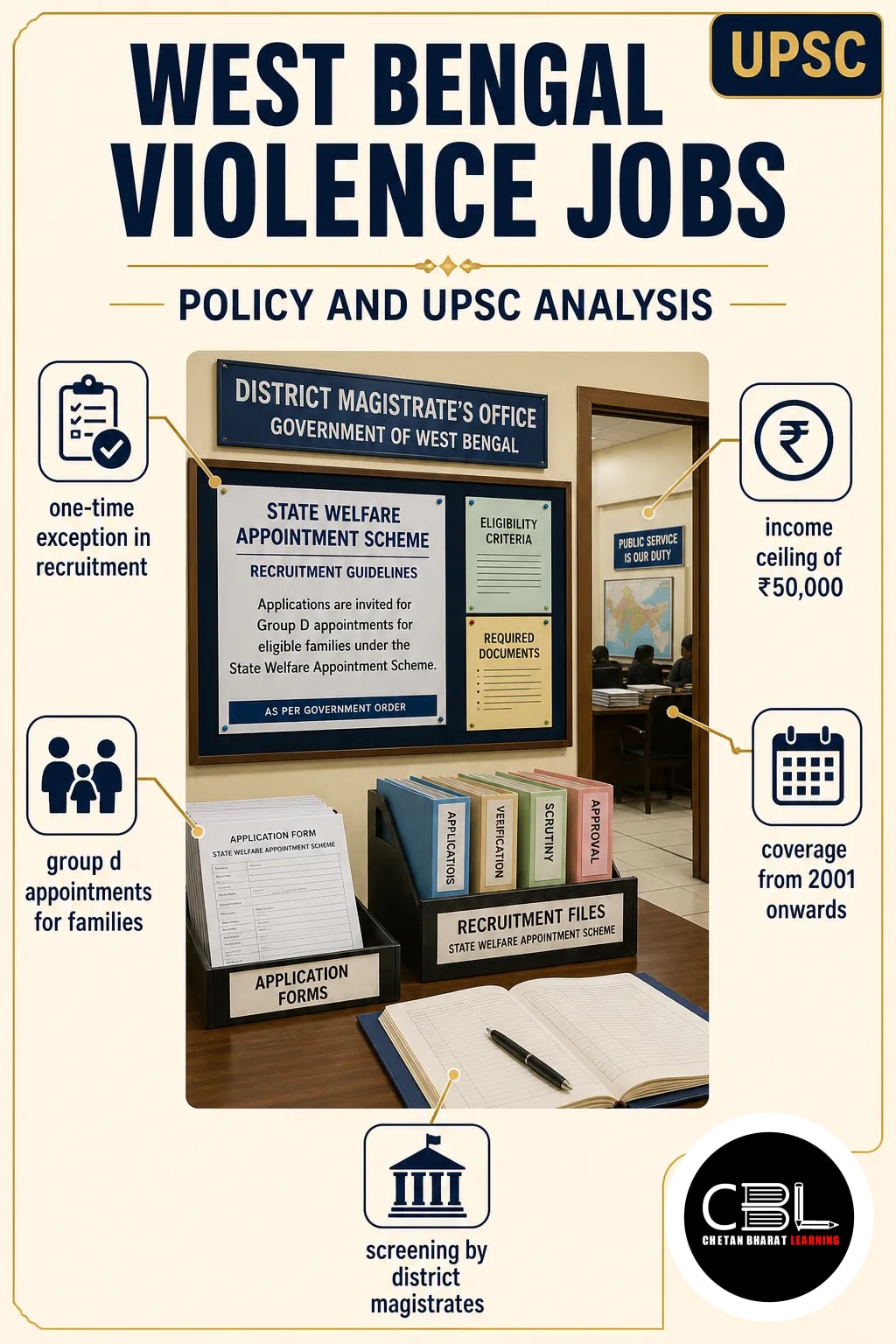

West Bengal violence jobs policy seeks to support families of people killed in political clashes through exceptional public appointments. The notification raises questions about victim support, fair recruitment and constitutional governance.
Quick answer: On 1 November 2026, West Bengal notified Group D jobs for eligible dependent family members of people killed in political violence from 2001 onwards. Under the West Bengal violence jobs policy, one family member may be considered per victim, subject to conditions including a monthly family income ceiling of ₹50,000.
What does the West Bengal violence jobs policy provide?
The policy provides for a Group D appointment for one eligible dependent family member of each person killed in political clashes. The state will make these appointments as a one-time exception, without affecting normal recruitment.
It covers cases from 2001 onwards, extending to roughly 25 years. Therefore, it encompasses incidents across periods when different political formations governed the state. The source does not specify the number of jobs or applications expected.
Why was the notification issued?
The notification followed Chief Minister Suvendu Adhikari’s announcement at Garbeta in Paschim Medinipur on 31 October 2026. Chief Secretary Manoj Agarwal signed it on 1 November.
West Bengal has witnessed political violence over several decades, particularly during panchayat elections. The Bharatiya Janata Party has alleged that Trinamool Congress targeted its supporters after 2016 and after the 2021 Assembly election; these are party allegations, not findings established by the notification.
Election-related security is also a wider governance issue. For context, see CBL’s coverage of clashes during Andhra Pradesh civic polls and security for local body elections.
Who can apply and how will screening work?
Eligible applicants include specified dependent relatives, while a district-level committee examines their applications. The Chief Minister asked families to apply to the District Magistrate.
| Requirement | Reported provision |
|---|---|
| Eligible relatives | Spouse, son, daughter or third-gender child of the deceased |
| Unmarried victim | A brother or sister may be considered, subject to specified conditions |
| Family income | Not more than ₹50,000 per month |
| Evidence | Incident details, first information report (FIR), death certificate and proof of relationship |
| Screening | Committee led by District Magistrates and Superintendents of Police |
The source does not detail all conditions for siblings or the complete appointment process. Therefore, applicants should check the notification for the full requirements rather than assume that every application will lead to a job.
What are the constitutional and governance implications?
The policy connects immediate support for bereaved households with constitutional principles governing public employment. Its implementation must distinguish a targeted exception from ordinary recruitment while applying consistent criteria.
Equality, employment and state responsibility
Article 14 guarantees equality before the law and equal protection of the laws. Similarly, Article 16 provides for equality of opportunity in public employment. A targeted exception therefore raises questions about its objective, eligibility criteria and consistent application; the notification alone does not establish a constitutional violation.
Police and public order are subjects in the State List of the Seventh Schedule. Consequently, state authorities have a central role in preventing violence and investigating offences, alongside administering victim support. For local elections, Article 243K provides for superintendence, direction and control of panchayat elections by the State Election Commission.
Relief is not the same as accountability
A job can help a household recover income after a death. However, employment does not by itself determine criminal responsibility or prevent future violence. Independent investigation, fair prosecution and election security remain separate governance tasks.
The one-member limit also directs assistance to one dependent rather than every affected relative. Moreover, the inclusion of a third-gender child makes the listed family categories more inclusive, although all applicants must still meet applicable conditions.
What implementation challenges could arise?
The main challenges concern evidence, impartial screening and access to a limited employment benefit. These are potential implementation risks, not findings that the notified process has failed.
- Older records: Because coverage starts in 2001, families may find it difficult to obtain or reconstruct incident documents.
- Classification: Screening must consistently assess whether a death falls within the policy’s political-clash criterion, without assuming that an FIR alone resolves every question.
- Political neutrality: Since cases can involve rival parties, consistent verification and reasoned decisions matter for public confidence.
- Unequal access: Families lacking documents or an eligible applicant may face barriers; the source does not specify alternative relief under this notification.
- Recruitment fairness: Although the government describes appointments as a one-time exception, transparent accounting can help distinguish them from normal recruitment.
What should guide implementation?
Clear criteria, accessible applications and impartial review can strengthen both victim support and administrative legitimacy. These are policy recommendations, not provisions confirmed in the source.
- Publish guidance: Explain evidence requirements, the income test and conditions for siblings in accessible language.
- Assist applicants: Help families locate official records and understand how to apply, especially for older incidents.
- Record reasons: Give applicants written decisions and provide a review mechanism to address errors or inconsistent treatment.
- Separate functions: Keep benefit screening distinct from criminal investigation and prosecution, while coordinating verification where necessary.
- Disclose aggregate progress: Publish applications, decisions and appointments without exposing sensitive personal information.
Overall, the West Bengal violence jobs measure addresses a specific loss of livelihood. Its fairness will depend on consistent administration; preventing political violence requires sustained attention beyond the employment decision.
Source: The Hindu, 1 November 2026
Punjab PCS and Haryana HCS General Studies may test district administration, state responsibility for public order and equality in public employment. This case also illustrates how states can design targeted assistance while maintaining transparent screening.
Prelims Practice Corner
Mains Practice Questions
Frequently Asked Questions
Who is eligible for jobs under the notification?
Specified dependent relatives of a person killed in political clashes may qualify, subject to the conditions. These include a spouse, son, daughter or third-gender child; a sibling of an unmarried victim may also be considered under specified conditions.
What is the income limit for an applicant’s family?
The family income must not exceed ₹50,000 per month. In addition, the applicant must supply incident details and the specified documents.
Do these appointments replace normal recruitment?
No, since the notification describes them as a one-time exception that will not affect normal recruitment. The posts are at the Group D level.
Who screens applications for these jobs?
A committee led by District Magistrates and Superintendents of Police screens applications. Meanwhile, the Chief Minister asked families to apply to the District Magistrate.
Related Current Affairs
Preparing for UPSC, PCS or HCS?
Talk to a mentor at Chetan Bharat Learning, Chandigarh. Free guidance on choosing the right exam and building a study plan.
Chat on WhatsAppCall 97793 53345UPSC / IAS / PCS coaching in Chandigarh · Trusted by aspirants across Punjab & Haryana

 Ananya RanaIAS · AIR 60
 Aditya SharmaIAS · AIR 70
 Ria Kaur SethiIPS · AIR 89
 Aman AloonIRS · AIR 295
 Sumer Singh VirkIRS · AIR 335
 Shivani PanchalIAS

Leave a Reply
You must be logged in to post a comment.