

UPSC Mapping
Important For
- Prelims: Indian Polity, Constitutional Bodies
- Mains: GS Paper II – Constitution and Governance
Quick Facts
| Institution | Constitutional Provision |
|---|---|
| Election Commission of India | Article 324 |
| Comptroller and Auditor General | Article 148 |
| Public Service Commissions | Articles 315–323 |
| Finance Commission | Article 280 |
What are Independent Institutions?
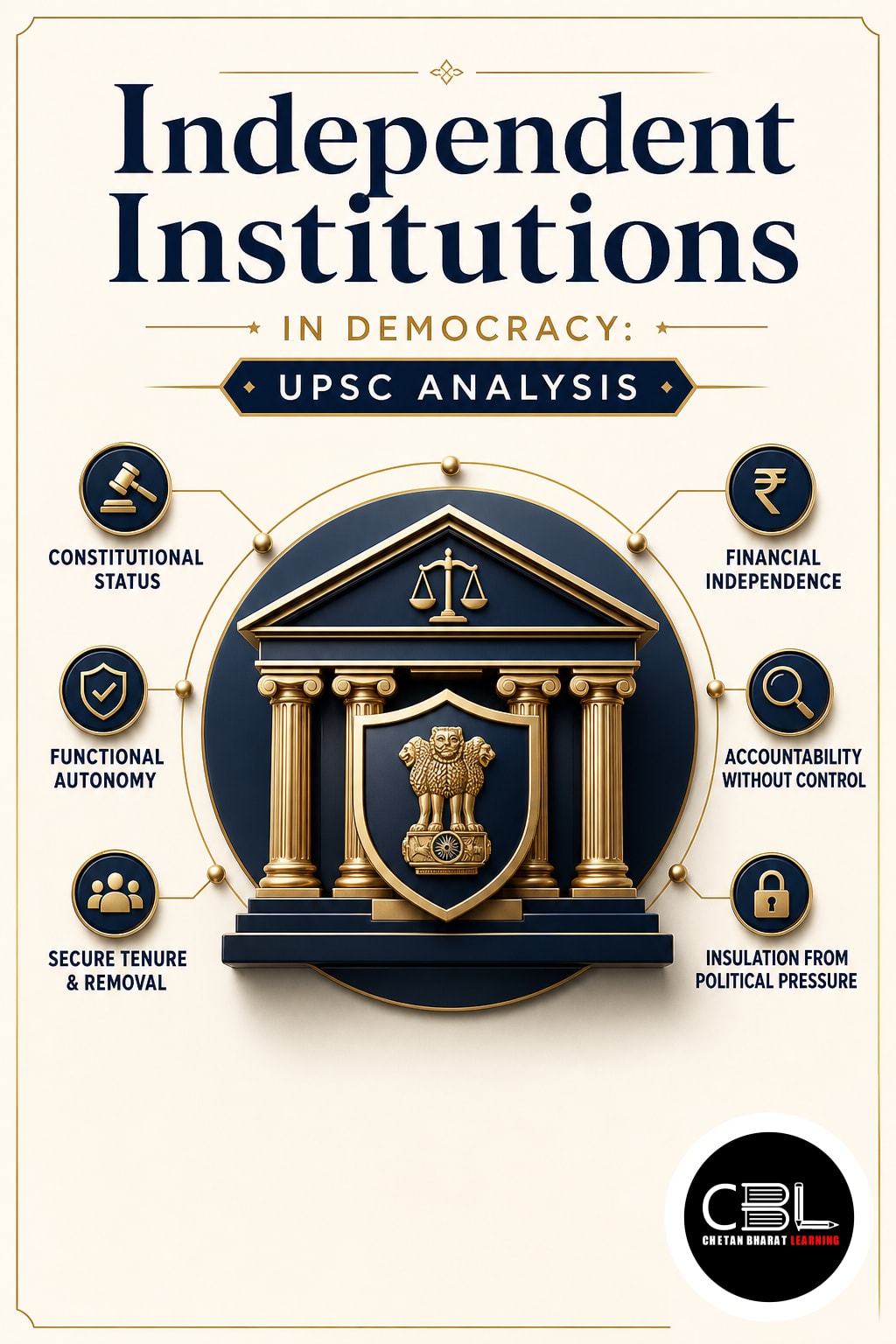
Independent Institutions are public authorities designed to perform important constitutional or statutory functions without improper political interference. Their autonomy helps maintain neutrality, transparency and accountability in democratic governance.
The Indian Constitution establishes institutions with different levels of protection from executive influence. These include the Election Commission of India, Comptroller and Auditor General, Union Public Service Commission, Finance Commission and an independent judiciary.
Each institution performs a distinct function, ranging from supervising elections to examining government expenditure and ensuring merit-based recruitment. Institutional independence does not mean freedom from scrutiny. These bodies must exercise their powers within constitutional, legal and procedural limits.
Why in News?
Recent Supreme Court proceedings concerning the functioning and appointment processes of the Election Commission of India have renewed discussion about institutional independence. The debate centres on whether constitutional safeguards adequately protect important public authorities from executive influence.
In T.N. Seshan v. Union of India (1995), the Supreme Court examined the functioning of the multi-member Election Commission and upheld its collective decision-making framework.
In Anoop Baranwal v. Union of India (2023), the Supreme Court emphasised the need for an independent appointment process. It prescribed an interim selection arrangement until Parliament enacted a law. Parliament subsequently passed the Chief Election Commissioner and Other Election Commissioners (Appointment, Conditions of Service and Term of Office) Act, 2023. The Supreme Court judgment remains important for understanding the constitutional principles involved.
Key Features
- Electoral neutrality: An independent Election Commission protects free and fair elections, political equality and the legitimacy of the popular mandate. Article 324 grants it responsibility for supervising and controlling specified elections.
- Financial accountability: The Comptroller and Auditor General audits public finances and supports legislative scrutiny of government expenditure. Article 148 provides constitutional protection for this office.
- Meritocracy in administration: UPSC conducts competitive recruitment independently of direct political patronage. Articles 315–323 provide constitutional provisions governing Union and State Public Service Commissions.
- Rule of law: Judicial independence enables courts to examine executive and legislative actions against constitutional requirements. The Supreme Court recognises judicial independence as an element of the basic structure doctrine.
- Fiscal federalism: The Finance Commission recommends principles for distributing financial resources between the Union and states, supporting constitutional financial relations.
- Public trust: Citizens are more likely to accept institutional decisions when authorities demonstrate impartiality, consistency and fairness, including when decisions conflict with their preferences.
Challenges
- Appointment processes: Executive influence in selecting institutional heads can raise concerns about neutrality and public confidence. Transparent selection arrangements are therefore essential.
- Financial dependence: Institutions dependent on executive-controlled resources may face practical constraints. Reliable funding and adequate administrative infrastructure support independent functioning.
- Administrative autonomy: Dependence on external departments for staffing and secretarial services can weaken functional independence. The Supreme Court highlighted the significance of an independent ECI secretariat.
- Independence without accountability: Autonomy must not become immunity from constitutional scrutiny. Institutions require transparent procedures, reasoned decisions and appropriate oversight.
- Institutional culture: Written safeguards alone cannot ensure impartiality. Constitutional morality, ethical leadership, restraint and respect for established conventions remain equally important.
Way Forward
India should strengthen transparent appointments, secure tenure and operational autonomy while retaining appropriate constitutional oversight. Selection procedures should prioritise professional competence, integrity and institutional credibility.
Adequate staffing, predictable financial resources and independent administrative arrangements can reduce unnecessary executive dependence. The constitutional protections available to the CAG illustrate the importance of safeguards for public accountability, as detailed in the official constitutional provisions of the CAG.
Institutional reform must also strengthen openness, internal ethics and procedural accountability. Regular legislative scrutiny, reasoned decisions and respect for judicial review can promote public confidence without undermining necessary autonomy.
Ultimately, independence and accountability are complementary democratic principles. Strong institutions protect constitutional values, improve governance and maintain public trust. Related electoral reforms can be studied through the discussion on simultaneous elections in India.
Prelims Practice Corner
Q1. Which Article of the Constitution establishes the Election Commission of India?
- (a) Article 280
- (b) Article 315
- (c) Article 324
- (d) Article 148
Answer: (c) Article 324 provides for the Election Commission and vests it with superintendence, direction and control of specified elections.
Q2. Consider the following statements: 1. The CAG enjoys constitutional protection under Article 148. 2. The CAG can be removed by the President at personal discretion. Which statement is correct?
- (a) 1 only
- (b) 2 only
- (c) Both 1 and 2
- (d) Neither 1 nor 2
Answer: (a) Article 148 protects the CAG, whose removal follows the same manner and grounds as those applicable to a Supreme Court judge.
Q3. Articles 315–323 of the Constitution primarily deal with:
- (a) Election Commission
- (b) Finance Commission
- (c) Public Service Commissions
- (d) Comptroller and Auditor General
Answer: (c) Articles 315–323 contain provisions relating to Union and State Public Service Commissions.
Q4. In Anoop Baranwal v. Union of India (2023), which officeholder was included in the Supreme Court’s interim selection committee for Election Commissioners?
- (a) Attorney General of India
- (b) Chief Justice of India
- (c) Comptroller and Auditor General
- (d) Speaker of Lok Sabha
Answer: (b) The interim arrangement included the Chief Justice of India alongside the Prime Minister and Leader of the Opposition or specified opposition leader, until Parliament made a law.
Q5. Which constitutional provision deals with the Finance Commission of India?
- (a) Article 148
- (b) Article 280
- (c) Article 312
- (d) Article 324
Answer: (b) Article 280 provides for the constitution and functions of the Finance Commission.
Mains Practice Questions
Q1. Independent constitutional institutions are essential for the effective functioning of democracy. Discuss their significance and the challenges to their autonomy in India. (15 marks)
Answer Structure:
- Introduction: Define institutional independence and its relationship with constitutional democracy.
- Body: Explain the roles of ECI, CAG, UPSC and judiciary; examine appointments, financial dependence, administrative autonomy and institutional culture.
- Conclusion: Recommend transparent selection, functional autonomy and accountability to strengthen democratic legitimacy.
Q2. Institutional independence must be balanced with constitutional accountability. Examine with reference to the Election Commission of India. (10 marks)
Answer Structure:
- Introduction: Explain Article 324 and the Election Commission’s constitutional role.
- Body: Discuss appointment mechanisms, security of tenure, financial autonomy, administrative independence, judicial scrutiny and reasoned decision-making.
- Conclusion: Emphasise that autonomy and accountability together protect free and fair elections.
Frequently Asked Questions
Why are independent institutions important in democracy?
They protect constitutional governance by ensuring fair elections, independent audits, merit-based recruitment and the rule of law. Their impartiality strengthens accountability and public trust.
Which constitutional bodies protect institutional accountability in India?
Important institutions include the Election Commission of India, Comptroller and Auditor General, Union and State Public Service Commissions and the Finance Commission. Each performs a distinct constitutional function with different safeguards.
Can an independent institution be held accountable?
Yes. Institutional independence protects decision-making from improper influence but does not eliminate constitutional, legal or procedural accountability. Transparency, judicial review and lawful oversight remain important safeguards.
Related Current Affairs
Preparing for UPSC, PCS or HCS?
Talk to a mentor at Chetan Bharat Learning, Chandigarh. Free guidance on choosing the right exam and building a study plan.
Chat on WhatsAppCall 97793 53345UPSC / IAS / PCS coaching in Chandigarh · Trusted by aspirants across Punjab & Haryana
Leave a Reply
You must be logged in to post a comment.