
UPSC Mapping
| Exam Stage | Topics |
|---|---|
| Prelims | Fundamental Rights, Information Commissions and Transparency Laws |
| Mains | GS Paper II: Governance; GS Paper IV: Probity and Accountability |
Quick Facts
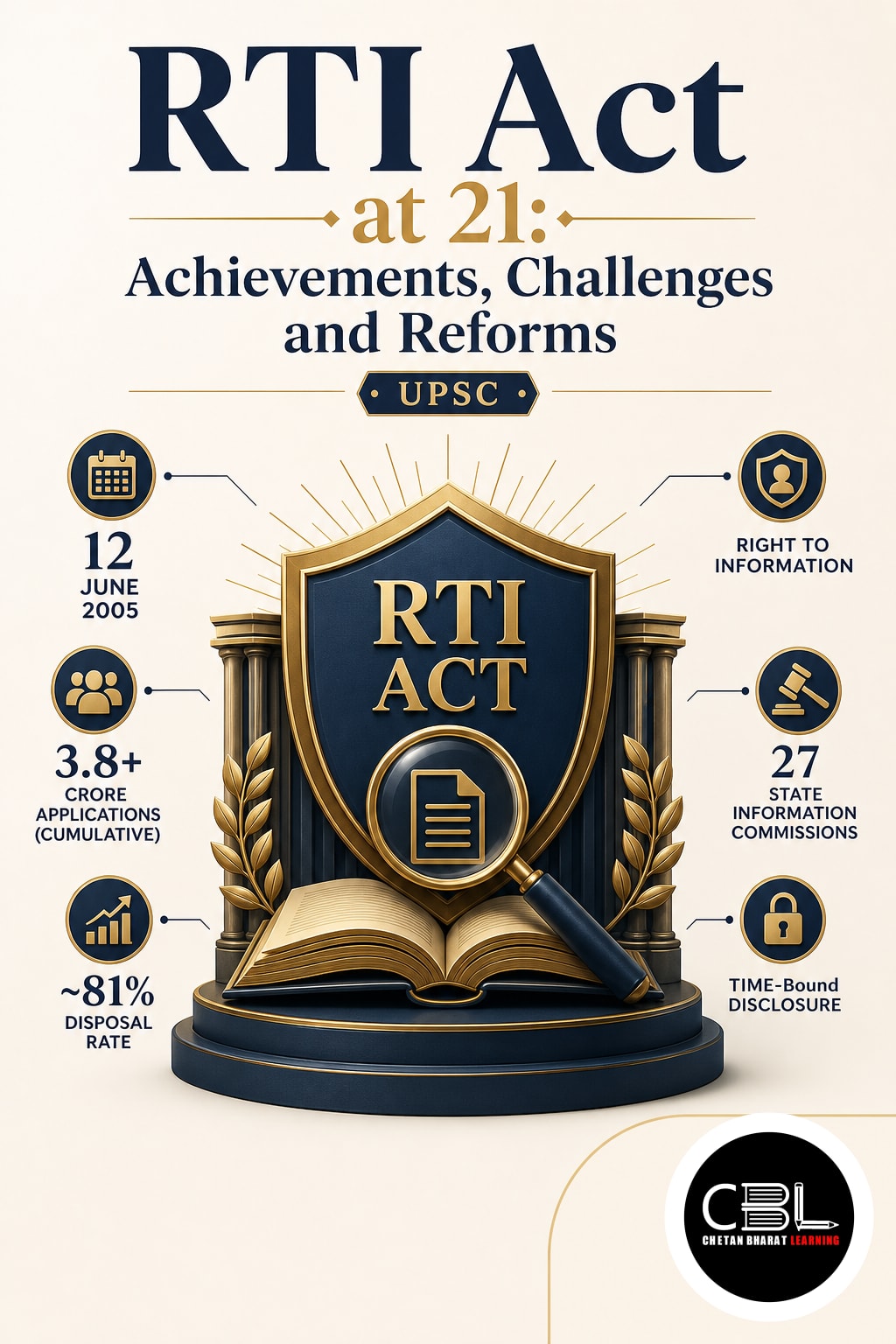
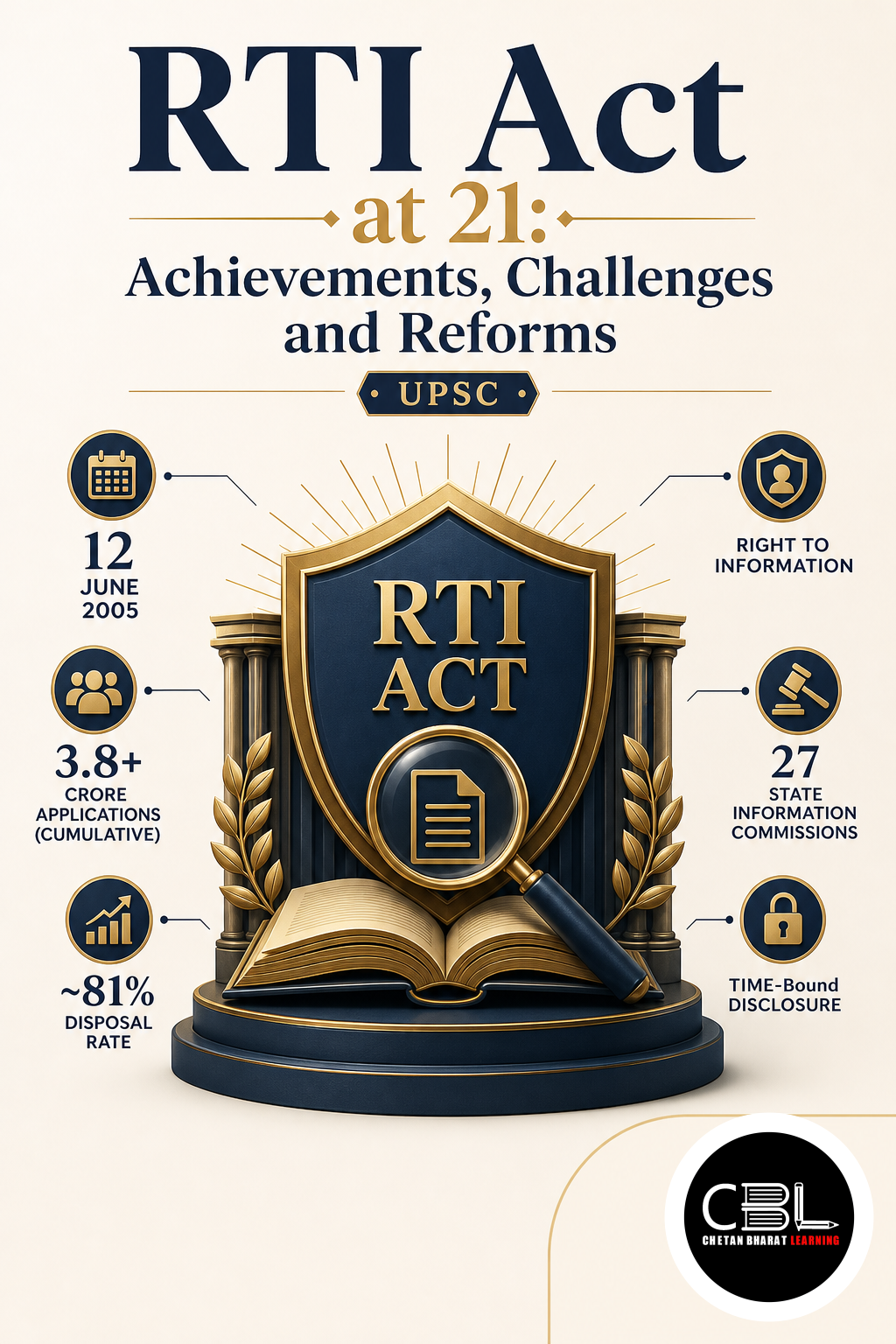
| Full Implementation | 12 October 2005 |
|---|---|
| Ordinary Response Period | 30 days |
| Life or Liberty | 48 hours |
| Institutional Status | Statutory commissions |
Article
What is the RTI Act?
The Right to Information Act, 2005 establishes a legal framework for citizens to access information held by public authorities. It seeks to improve transparency, accountability and informed participation in government. Its coverage includes specified government bodies and organisations that receive substantial government financing.
The constitutional foundation lies in the right to freedom of speech and expression under Article 19(1)(a). Access to public information enables citizens to assess decisions and participate meaningfully in democracy. Grassroots campaigns, including those associated with the Mazdoor Kisan Shakti Sangathan, helped build support for the legislation.
The law primarily provides access to existing records, documents and other covered information. It does not ordinarily require officials to create fresh explanations or resolve grievances. Citizens can use disclosed records to pursue remedies through the appropriate administrative or legal channels.
Why in News?
The anniversary coincides with the publication of Satark Nagrik Sangathan’s assessment of Information Commissions. Reporting on the study identifies over 3.85 lakh pending appeals and complaints across 28 commissions as of 30 June 2026. Fourteen commissions reportedly had estimated waiting periods of at least one year.
These estimates highlight the gap between a legal entitlement and timely enforcement. Waiting-period calculations project disposal times from observed performance; they are not fixed hearing dates. Delays can reduce the practical value of information concerning benefits, recruitment or public expenditure.
Key Features
- Citizen access: Citizens can request information under the control of public authorities, subject to statutory exemptions.
- Proactive disclosure: Section 4 requires authorities to publish organisational, financial and decision-making information without waiting for applications.
- Response deadlines: The ordinary response period is 30 days, while requests concerning life or liberty require a response within 48 hours.
- Appeal mechanism: Applicants can approach a departmental First Appellate Authority and subsequently the relevant Information Commission.
- Financial accountability: Section 20 permits penalties of ₹250 per day, up to ₹25,000, subject to the statutory conditions.
- Exemptions and safeguards: The framework protects specified interests while retaining provisions relevant to public-interest disclosure and partial access.
Achievements in Democratic Governance
The legislation enables citizens to examine welfare records, public spending and administrative decisions. Information about eligibility lists or payment records can help identify discrepancies affecting beneficiaries. Its importance extends beyond major corruption cases to everyday accountability.
Public scrutiny can encourage departments to maintain better records and explain decisions more carefully. Journalists, researchers and community organisations can compare official claims with documentary evidence. Citizens gain a means to question administrative action using verifiable information.
The framework also supports educational transparency, including access to evaluated answer scripts under applicable legal conditions. Transparency does not make every record automatically disclosable. Authorities must still apply relevant exemptions and safeguards to individual requests.
Challenges
- Appeal backlogs: Delayed decisions can make information irrelevant by the time applicants receive it.
- Institutional vacancies: Unfilled posts and inadequate support staff can weaken commissions’ ability to hear cases.
- Poor disclosure: Outdated websites and inaccessible records force citizens to request information that authorities should already publish.
- Procedural barriers: Technical objections and complicated filing requirements can disproportionately disadvantage vulnerable applicants.
- Privacy concerns: Broad interpretations of personal-information exemptions may restrict legitimate scrutiny of public administration.
- Applicant vulnerability: Threats and harassment can discourage people from seeking sensitive public records.
The 2019 amendment authorised the Central Government to prescribe commissioners’ tenure and service conditions. Critics argue that executive control over these matters can affect perceived institutional independence. The amendment’s legal effect should be distinguished from assessments of its practical consequences.
The Digital Personal Data Protection Act, 2023 changed the wording of the personal-information exemption in Section 8(1)(j). Critics fear weaker accountability, while the government maintains that privacy protection and transparency can coexist. Neither position establishes that every request involving personal information must receive the same outcome.
Importantly, the amendment did not remove Section 8(2), the broader public-interest override. Analysis should also consider severability under Section 10, allowing disclosure of accessible portions after exempt material is removed. The government’s position appears in its official explanation of privacy and transparency.
Way Forward
Governments should begin appointment processes before foreseeable vacancies arise. Commissions need adequate staff, accessible hearings and transparent reporting of pending cases. Institutional capacity should support timely, reasoned decisions rather than disposal numbers alone.
Departments should make proactive disclosure their default practice. Searchable records, updated budgets and accessible procurement information can reduce avoidable applications. Offline assistance and local-language access remain essential for citizens who cannot use digital services.
Digital systems should improve tracking without creating unnecessary identity-verification barriers. Applicants should receive clear opportunities to correct curable filing defects. Technology can assist record searches, but accountable officials must retain responsibility for disclosure decisions.
Authorities should apply privacy exemptions through reasoned orders that address the relevant statutory safeguards. Redaction can sometimes protect personal details while preserving scrutiny of public expenditure. Stronger applicant protection and public-interest disclosure practices can reinforce confidence in the system.
Effective implementation of the RTI Act requires cooperation among governments, commissions and citizens. Regular audits should measure disclosure quality, accessibility and compliance with decisions. Read related constitutional and governance analysis through our current affairs learning portal.
Prelims Practice Corner
-
Q1. The constitutional foundation of citizens’ right to know is primarily associated with:
(a) Article 19(1)(a)
(b) Article 23
(c) Article 29(2)
(d) Article 40Answer: (a). The right to know is associated with freedom of speech and expression under Article 19(1)(a).
-
Q2. Information concerning the life or liberty of a person must ordinarily be provided within:
(a) 24 hours
(b) 48 hours
(c) 15 days
(d) 30 daysAnswer: (b). Section 7(1) prescribes a 48-hour response period for information concerning life or liberty.
-
Q3. Consider the following statements: 1. Section 4 concerns proactive disclosure. 2. Section 20 permits a monetary penalty without any maximum limit. Which is correct?
(a) 1 only
(b) 2 only
(c) Both 1 and 2
(d) Neither 1 nor 2Answer: (a). Section 4 requires proactive disclosure; Section 20 caps the specified monetary penalty at ₹25,000.
-
Q4. Central and State Information Commissions are:
(a) Constitutional bodies
(b) Statutory bodies
(c) Parliamentary committees
(d) Private arbitration institutionsAnswer: (b). The legislation establishes Information Commissions as statutory institutions.
-
Q5. Which provision contains the broader public-interest override relevant to exemptions from disclosure?
(a) Section 4(1)(b)
(b) Section 6(2)
(c) Section 8(2)
(d) Section 20(2)Answer: (c). Section 8(2) permits access where the public interest in disclosure outweighs harm to protected interests.
Mains Practice Questions
-
Q1. Delayed access to public information can weaken democratic accountability. Examine the institutional reforms needed to strengthen India’s transparency framework. (150 words, 10 marks)
Answer Structure:
- Intro: Explain why timely information is essential for meaningful accountability.
- Body: Discuss vacancies, appeal backlogs, record management and proactive disclosure; suggest appointments, staffing and accessible procedures.
- Conclusion: Link institutional effectiveness with citizens’ ability to scrutinise government.
-
Q2. Privacy and transparency are complementary constitutional concerns that require careful reconciliation. Discuss with reference to access to government-held personal information. (250 words, 15 marks)
Answer Structure:
- Intro: Frame privacy and access to information as rights serving individual dignity and democratic governance.
- Body: Explain Section 8(1)(j), the public-interest override under Section 8(2), severability and risks of excessive disclosure or secrecy.
- Conclusion: Recommend reasoned decisions, appropriate redaction and effective independent review.
Frequently Asked Questions
Can an applicant seek information without explaining the reason?
Yes. Section 6(2) states that applicants need not provide reasons for requesting information or personal details beyond those necessary for contact.
What is proactive disclosure?
It means public authorities publish specified information without waiting for individual applications. Regularly updated disclosures can reduce unnecessary requests and improve public scrutiny.
Did changing the personal-information exemption remove every public-interest safeguard?
No. The broader public-interest override under Section 8(2) remains relevant. Authorities must examine the applicable law and circumstances rather than treating all requests involving personal information identically.
Related Current Affairs
Preparing for UPSC, PCS or HCS?
Talk to a mentor at Chetan Bharat Learning, Chandigarh. Free guidance on choosing the right exam and building a study plan.
Chat on WhatsAppCall 97793 53345UPSC / IAS / PCS coaching in Chandigarh · Trusted by aspirants across Punjab & Haryana
Leave a Reply
You must be logged in to post a comment.