
IAF commanders conference discussions on 12 November 2026 put emerging warfare and military preparedness at the centre of India’s national security agenda. Defence Minister Rajnath Singh called for stronger surveillance, technological adaptation and joint planning.
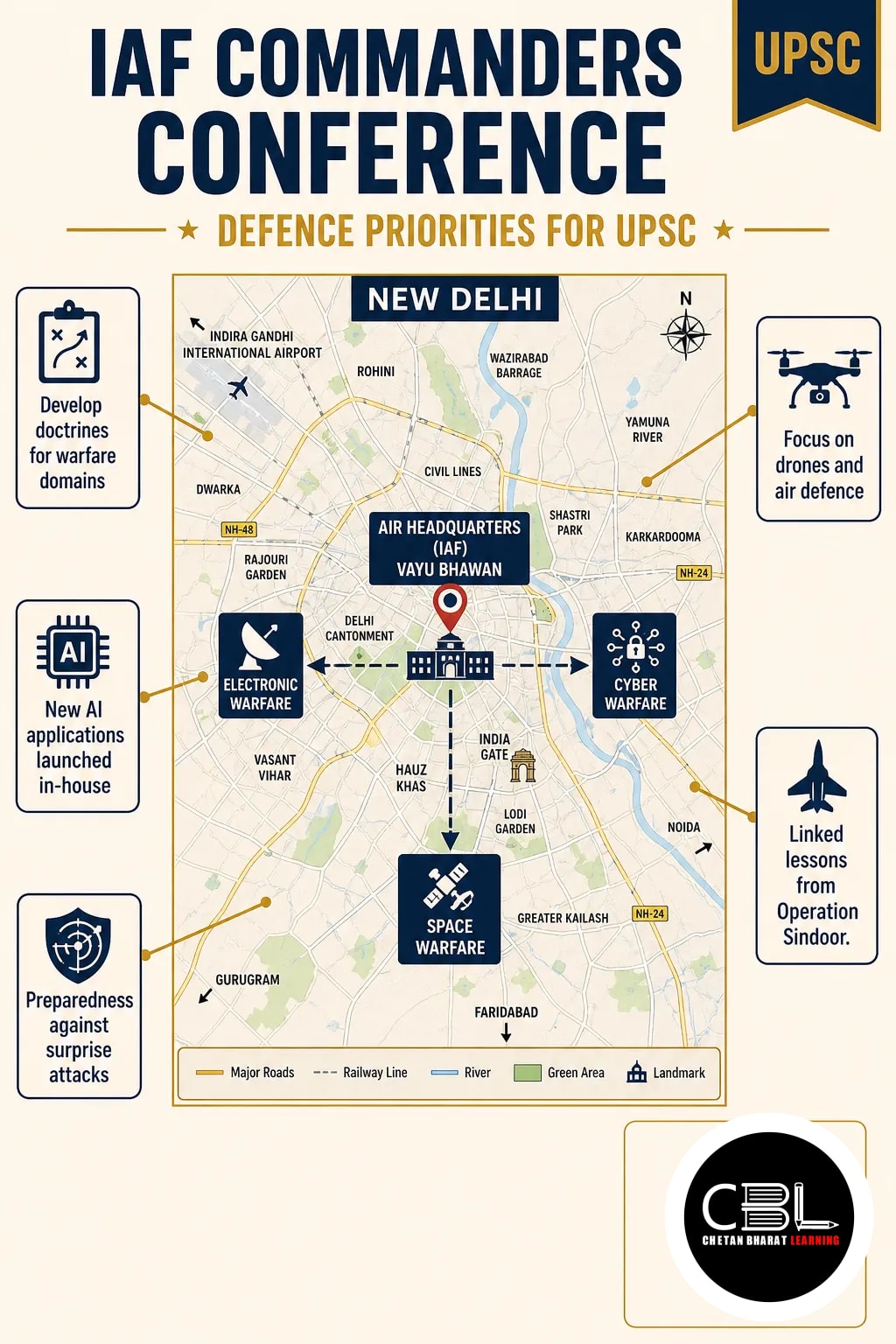
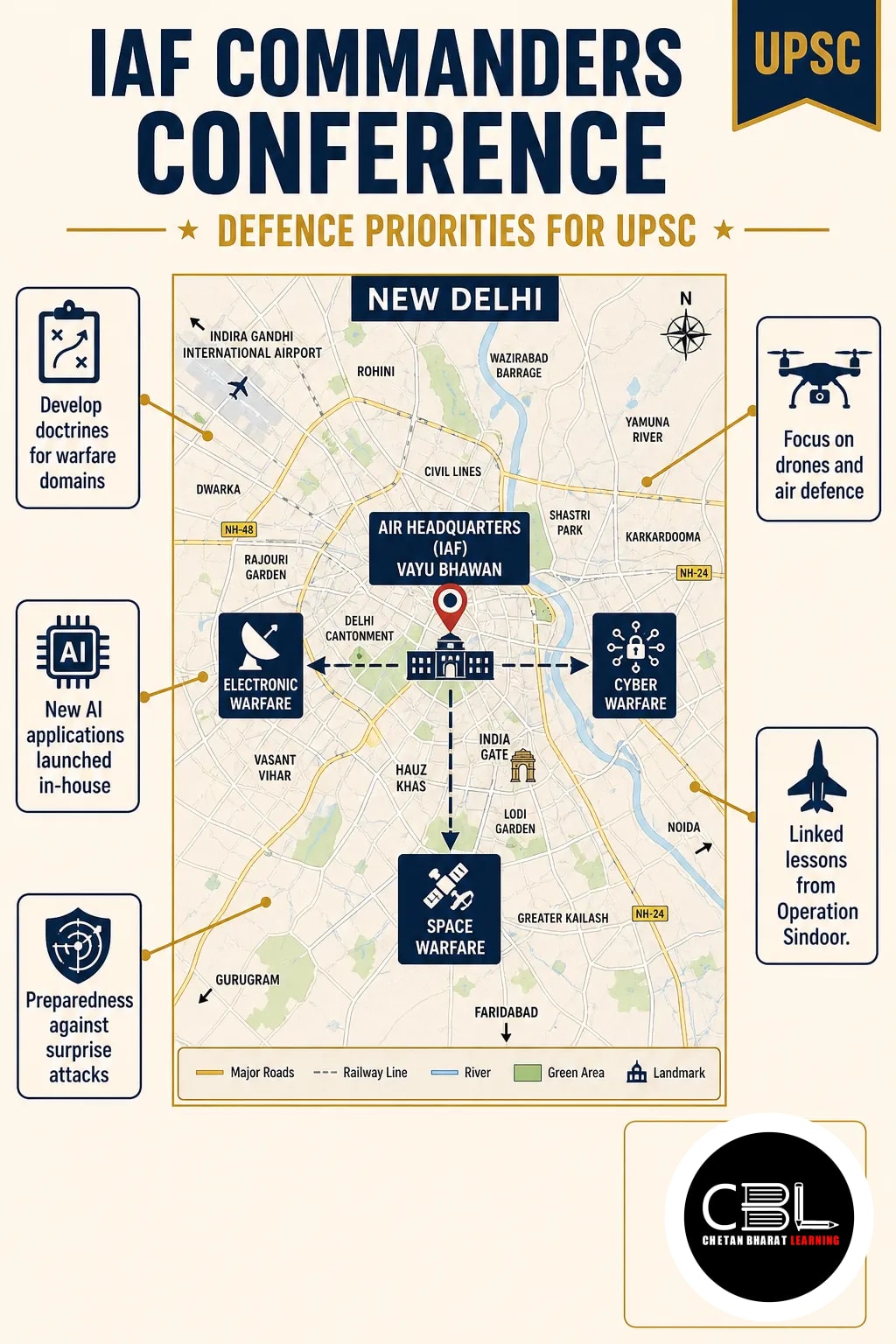
Quick answer: At the IAF commanders conference in New Delhi on 12 November 2026, Rajnath Singh urged the Indian Air Force to develop doctrines for electronic, cyber and space warfare. He also called for stronger surveillance and preparedness against surprise attacks. The minister launched in-house artificial intelligence applications for operations, administration and aerospace safety.
What happened at the IAF commanders conference?
Singh asked commanders to prepare for conventional threats and warfare beyond traditional battlefields. He emphasised intelligence, surveillance, drones, air defence and the ability to respond quickly.
The Chief of the Air Staff, Air Chief Marshal Ashutosh Dixit, attended the conference. Singh also launched applications developed by the Indian Air Force’s (IAF’s) Artificial Intelligence (AI) Centre of Excellence.
Singh referred to the Russia-Ukraine and Israel-Hamas conflicts when discussing drones and air defence. He also highlighted Operation Sindoor as a source of lessons for evolving operational procedures and cooperation among the three services.
Why do emerging warfare domains need dedicated doctrines?
Dedicated doctrines can translate broad security priorities into principles for training, planning and operations. An architecture, meanwhile, connects the systems, personnel and procedures needed to put those principles into practice.
Singh called for both doctrines and architectures in electronic, cyber and space warfare. The distinction matters because buying technology alone does not establish how forces should use it together.
| Domain | Operational issue |
|---|---|
| Electronic | Using and protecting the electromagnetic spectrum, including communications and sensors |
| Cyber | Protecting networks and information systems while addressing hostile digital activity |
| Space | Maintaining access to space-based services that can support communications and observation |
These domains interact with air operations. For example, disruption of communications can affect how quickly commanders assess a threat and coordinate a response. Therefore, planning must consider dependencies across domains rather than treating each system in isolation.
Why do surveillance and surprise matter?
Surveillance helps forces detect potential threats early, while surprise can reduce an adversary’s time to respond. Singh stressed both the offensive and defensive aspects of surprise.
On the offensive side, speed and unpredictability can create an operational advantage. On the defensive side, intelligence and alert personnel can reduce the risk of being caught unprepared. However, detection alone is insufficient: commanders must also assess information and communicate decisions quickly.
Singh identified kamikaze drones, surveillance and counter-drone operations as emerging challenges. Consequently, air defence planning must consider both the aircraft carrying out a mission and threats from smaller unmanned systems.
How do AI and jointness affect preparedness?
AI tools can support faster administrative and operational tasks, while jointness helps services coordinate their capabilities. Both require attention to secure systems and personnel training.
The IAF developed its new applications in-house and deployed them on its secure network. They will automate and expedite tasks in operations, administration and aerospace safety. The source does not specify individual applications or their performance.
Singh said Operation Sindoor demonstrated complementary contributions by all three services. He therefore called for jointness in military planning and execution. Separately, India’s naval exercise with Myanmar offers context on defence cooperation, though it is not evidence of jointness among India’s services.
The minister also linked personnel policy to feedback from the forces. He referred to a two-year extension for Agniveers and expressed confidence in their ‘Second Tour of Duty’. In addition, he urged commanders to use the technological expertise of young recruits and sustain training in emerging technologies.
What challenges should defence planning address?
Defence planning must connect new technologies with reliable decisions and coordinated action. The conference’s priorities point to several practical questions for policy analysis:
- Integration: Different sensors, networks and services need compatible procedures; otherwise, information may not reach decision-makers in time.
- Resilience: Cyber or electronic disruption could affect connected systems, so forces need ways to maintain essential functions.
- Human oversight: AI-assisted processes should support accountable decisions; moreover, secure deployment alone does not establish that outputs are reliable.
- Skills: New equipment needs trained personnel, while frequent technological change requires continuing instruction.
These are analytical challenges, not findings that the conference identified specific failures. Similarly, the source does not provide procurement costs or a timetable for the proposed doctrines.
What should be the way forward?
The way forward is to turn emerging-domain priorities into tested procedures, training and coordinated responses. First, doctrine development should clarify responsibilities across services and link surveillance to decision-making.
Second, exercises can test communications, counter-drone responses and continuity when systems are disrupted. Third, AI applications should undergo evaluation for reliability and security, with clear human responsibility for consequential decisions.
Finally, feedback from personnel should inform training and policy. As a result, technological adoption can be assessed alongside readiness, rather than merely by the number of systems acquired.
Source: The Hindu, 12 November 2026
State PCS General Studies can test the IAF’s emerging warfare domains, drone threats and defence technology. In addition, Mains answers can examine how surveillance and coordination contribute to national security.
Prelims Practice Corner
Mains Practice Questions
Frequently Asked Questions
What did Rajnath Singh ask the IAF to do?
He asked it to develop doctrines and architectures for electronic, cyber and space warfare. He also called for stronger surveillance and preparedness against surprise.
Who developed the AI applications launched at the conference?
The IAF’s AI Centre of Excellence developed them in-house. The applications will support operations, administration and aerospace safety on the IAF’s secure network.
Why did the minister refer to Operation Sindoor?
He cited it for operational lessons and cooperation among the three services. In addition, he linked those lessons to greater emphasis on drones and air defence.
What did Singh say about Agniveers?
He said the two-year extension followed feedback from the defence forces. He also expressed confidence that the ‘Second Tour of Duty’ would strengthen the services.
Related Current Affairs
Preparing for UPSC, PCS or HCS?
Talk to a mentor at Chetan Bharat Learning, Chandigarh. Free guidance on choosing the right exam and building a study plan.
Chat on WhatsAppCall 97793 53345UPSC / IAS / PCS coaching in Chandigarh · Trusted by aspirants across Punjab & Haryana









Leave a Reply
You must be logged in to post a comment.