
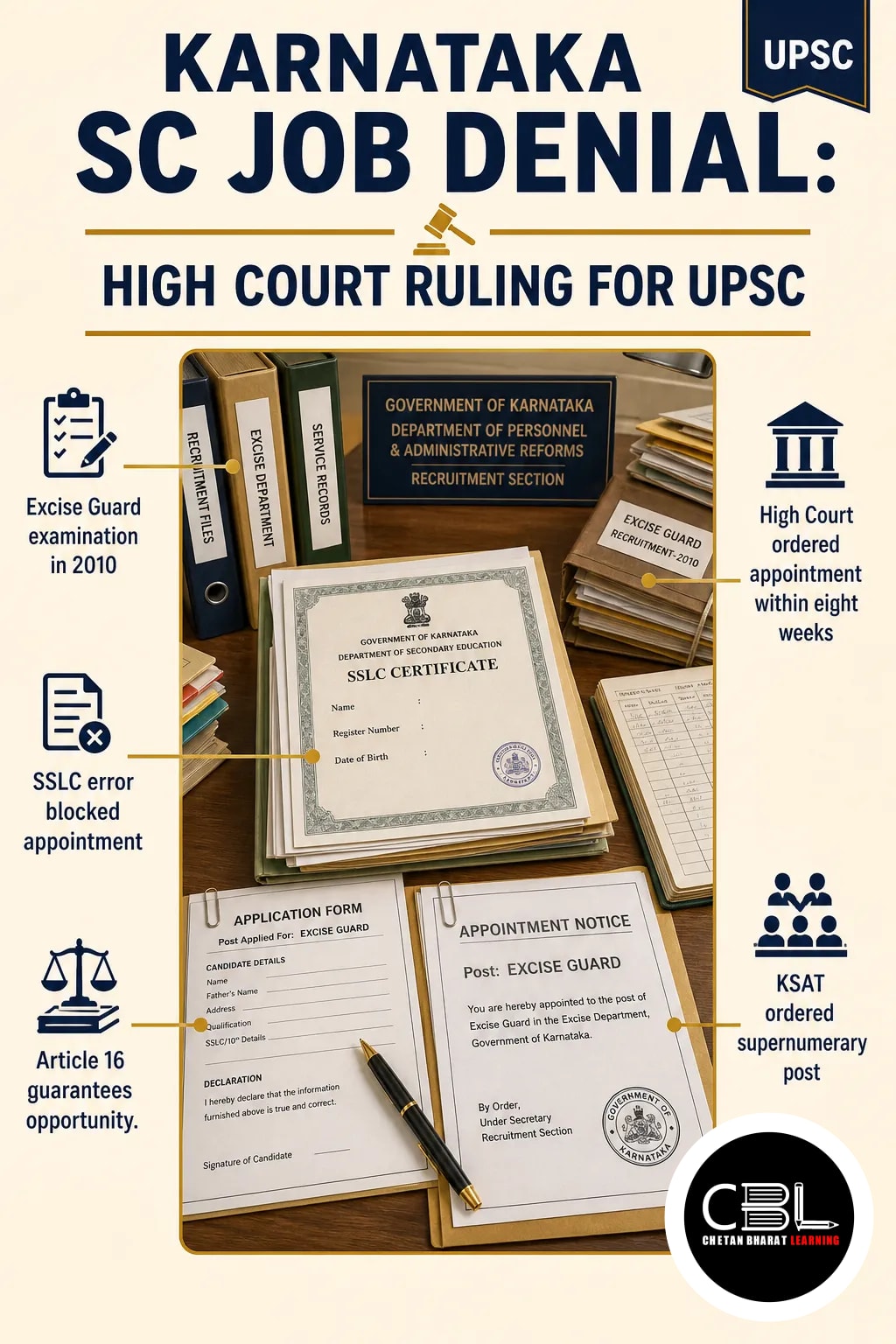
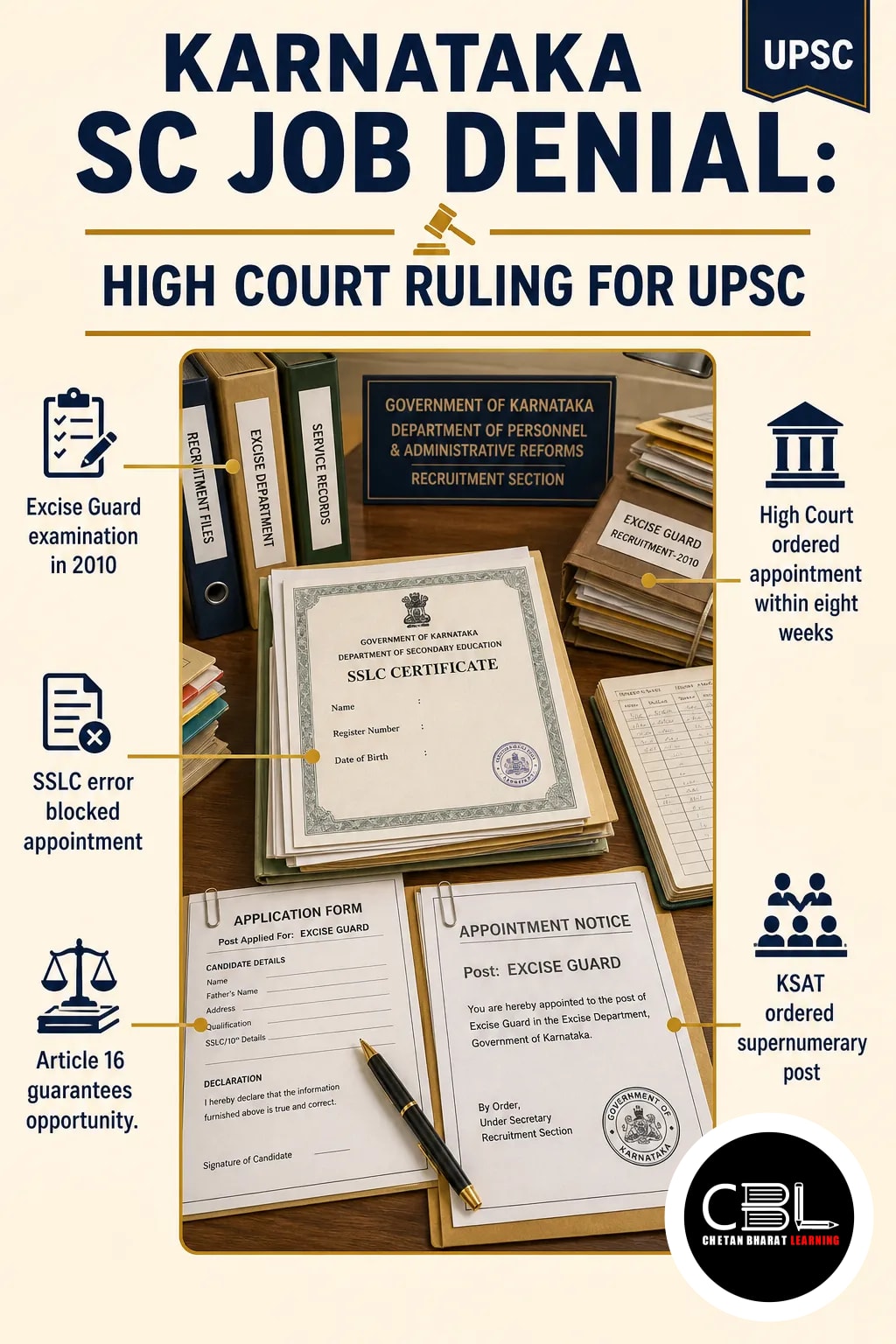
Karnataka SC job denial has drawn High Court criticism after a certificate error cost a candidate an Excise Guard appointment. The case raises questions about constitutional protections and administrative fairness in public recruitment.
Quick answer: In the Karnataka SC job denial case, the High Court directed the State to appoint Manjunath K. within eight weeks. He had cleared the 2010 Excise Guard examination, but a birth-date error in his school certificate blocked his appointment. The court rejected the State’s challenge to a 2018 tribunal order.
What did the High Court hold?
The High Court dismissed the State’s challenge and gave it eight weeks to appoint Manjunath under the tribunal’s order. The Division Bench comprised Justice S.G. Pandit and Justice Chillakur Sumalatha.
The Bench found that an eligible public employment aspirant should not lose an opportunity because officials made and then mishandled an error. Moreover, it questioned why State authorities rejected a correction made by their own functionaries.
The case concerns a Scheduled Caste (SC) candidate and an administrative error. However, the available report does not establish that the court decided a dispute over a reserved vacancy or laid down a new reservation rule.
How did the appointment dispute arise?
The dispute began when recruitment officials found conflicting birth details in Manjunath’s school records. His Secondary School Leaving Certificate (SSLC) marks card recorded 15 June 1980; his transfer certificate and cumulative records showed the correct birth year as 1982.
The Karnataka Public Service Commission (KPSC) gave him one week to correct the SSLC error. He approached the certificate authorities and filed a civil suit. Meanwhile, the KPSC published provisional and final lists without him and selected lower-scoring candidates.
The SSLC authorities later acknowledged the mistake and issued a corrected certificate; Manjunath then withdrew his suit. However, the KPSC declined to consider the revision because recruitment had ended.
| Year | Event |
|---|---|
| 2010 | Manjunath cleared the Excise Guard competitive examination. |
| 2011 | He approached the Karnataka State Administrative Tribunal (KSAT). |
| 2018 | In August, KSAT directed prospective appointment or a supernumerary post if no vacancy existed. |
| 2021 | The State challenged the tribunal’s order before the High Court. |
A supernumerary post is an additional post; here, the tribunal proposed it as an alternative if no vacancy existed. Thus, its remedy addressed the practical problem of an already completed recruitment process.
Why did the State’s objection fail?
The State disputed the method of correcting the certificate, rather than the correctness of Manjunath’s birth date. It cited a 2000 government circular requiring a civil court decree to alter an SSLC birth date.
However, the Bench noted that the government had issued notifications in 2009 and 2015 recalling the circular after recognising difficulties faced by students and parents. It also criticised the refusal to accept a correction made by government certificate authorities.
Manjunath learned of the mistake during KPSC verification, according to the material placed before the court. His father had died when he was young, and his mother, a coolie worker, raised him. Therefore, the case also illustrates how documentation disputes can impose substantial costs on applicants with limited resources.
Which constitutional provisions are relevant?
Equality in public employment and judicial review provide the constitutional context for the dispute. The following provisions are syllabus connections; the source does not say the Bench decided every issue under them.
| Provision | Relevance |
|---|---|
| Article 14 | Guarantees equality before the law and equal protection of the laws. |
| Article 16(1) | Guarantees equality of opportunity in public employment. |
| Article 16(4) | Permits reservation for inadequately represented backward classes, subject to its conditions. |
| Article 226 | Empowers High Courts to issue writs for fundamental rights and other purposes. |
| Article 335 | Requires SC and Scheduled Tribe claims in services to be considered consistently with administrative efficiency. |
Article 16(4) enables reservation; it does not itself establish the recruitment category used in this case. Similarly, Article 335 is relevant to the wider syllabus, not a finding attributed here to the Bench.
What are the governance implications?
The Karnataka SC job denial case shows how an official error can become a barrier when agencies treat correction and recruitment as separate processes.
- Fair opportunity: A short correction window can disadvantage candidates when another government office controls the records.
- Inter-agency accountability: When one authority acknowledges an error, another should assess the correction rather than rely only on procedural closure.
- Recruitment integrity: Verification still matters; however, safeguards should distinguish genuine official errors from unsupported changes.
- Effective remedies: A supernumerary post can provide relief where an eligible candidate has lost an opportunity and vacancies are unavailable.
What administrative reforms could help?
Recruitment bodies can reduce avoidable exclusion by making correction and review procedures accessible and time-bound.
- Early verification: Flag discrepancies before final selection and explain the documents needed for correction.
- Agency coordination: Enable direct confirmation with the issuing authority, while preserving a record of the decision.
- Reasonable review: Provide a route to consider authenticated corrections when candidates cannot control the issuing office’s timeline.
- Reasoned decisions: Record why a correction is accepted or rejected; consequently, candidates can challenge errors more effectively.
These are policy suggestions, not directions attributed to the court. Overall, fair recruitment requires both reliable records and a remedy when the State itself makes a mistake.
Source: The Hindu, 12 November 2026
Asked in UPSC: Previous Year Questions
- UPSC CSE Prelims 2023 (GS Paper I): Consider: Courts have limited Article 16(4) reservation policies by Article 335; Article 335 defines administrative efficiency. Which conclusion about these statements is correct?
UPSC links public employment reservation with administrative efficiency; therefore, revise both provisions alongside this case.
State PCS questions can use this case to test equality of opportunity, recruitment verification and administrative accountability. In addition, candidates should connect tribunal remedies with the role of High Courts in reviewing administrative disputes.
Prelims Practice Corner
Mains Practice Questions
Frequently Asked Questions
Why was Manjunath denied the Excise Guard appointment?
A birth-date discrepancy in his SSLC certificate blocked his appointment. Although the issuing authorities corrected it later, the KPSC refused to reconsider him after recruitment ended.
What did the Karnataka High Court direct?
The court directed the State to appoint him within eight weeks. It also dismissed the State’s challenge to the tribunal’s 2018 order.
Did the court announce a new SC reservation rule?
The source does not identify a new reservation rule. Instead, it describes relief for an SC candidate denied appointment because of a certificate error.
What is the role of a supernumerary post in this case?
It is an additional post proposed if no vacancy exists. Thus, the tribunal provided an alternative means to implement prospective appointment.
Related Current Affairs
Preparing for UPSC, PCS or HCS?
Talk to a mentor at Chetan Bharat Learning, Chandigarh. Free guidance on choosing the right exam and building a study plan.
Chat on WhatsAppCall 97793 53345UPSC / IAS / PCS coaching in Chandigarh · Trusted by aspirants across Punjab & Haryana









Leave a Reply
You must be logged in to post a comment.