
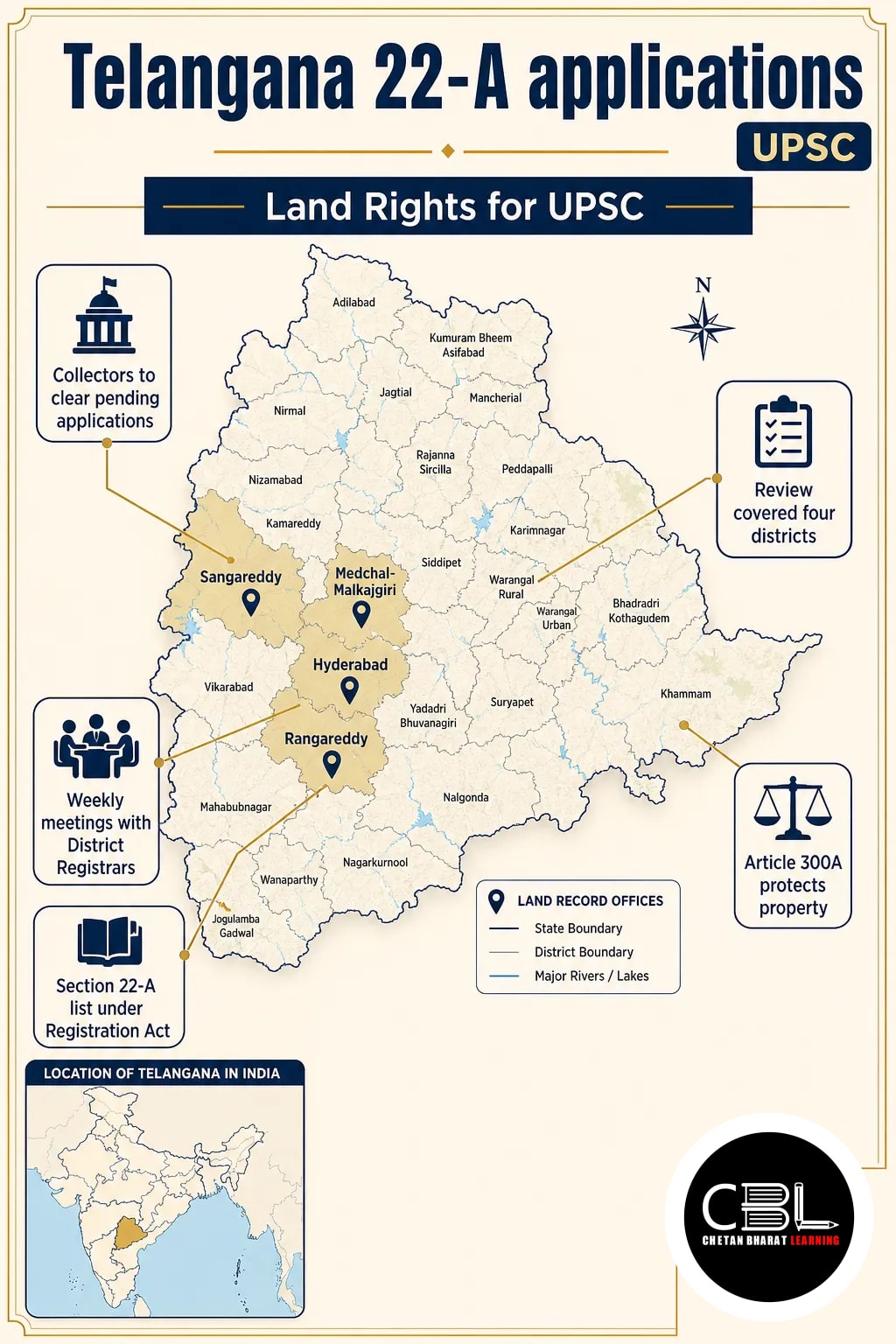
Telangana 22-A applications are under priority review after Revenue Minister Ponguleti Srinivas Reddy directed Collectors to clear pending land cases. The decision raises questions about property rights and state-level governance.
Quick answer: On 12 November 2026, Telangana Revenue Minister Ponguleti Srinivas Reddy directed Collectors to prioritise all pending Telangana 22-A applications. At a Hyderabad review covering four districts, he ordered weekly monitoring and document verification. He also sought a report on urban land ceiling cases within a week.
What are Telangana 22-A applications?
These applications concern land parcels included in the Section 22-A list under the Registration Act. The review addresses cases where applicants seek relief in connection with that listing. However, the source does not specify the precise legal grounds for every listing or removal.
Listing can create a registration-related obstacle, but a pending application does not by itself establish ownership. Therefore, officials must assess each parcel against the relevant records, orders and facts.
Why did Telangana order a review?
The government wants to resolve long-pending land issues and prevent eligible owners from repeatedly visiting offices. On 12 November, the Minister met Collectors and District Registrars at the State Secretariat in Hyderabad.
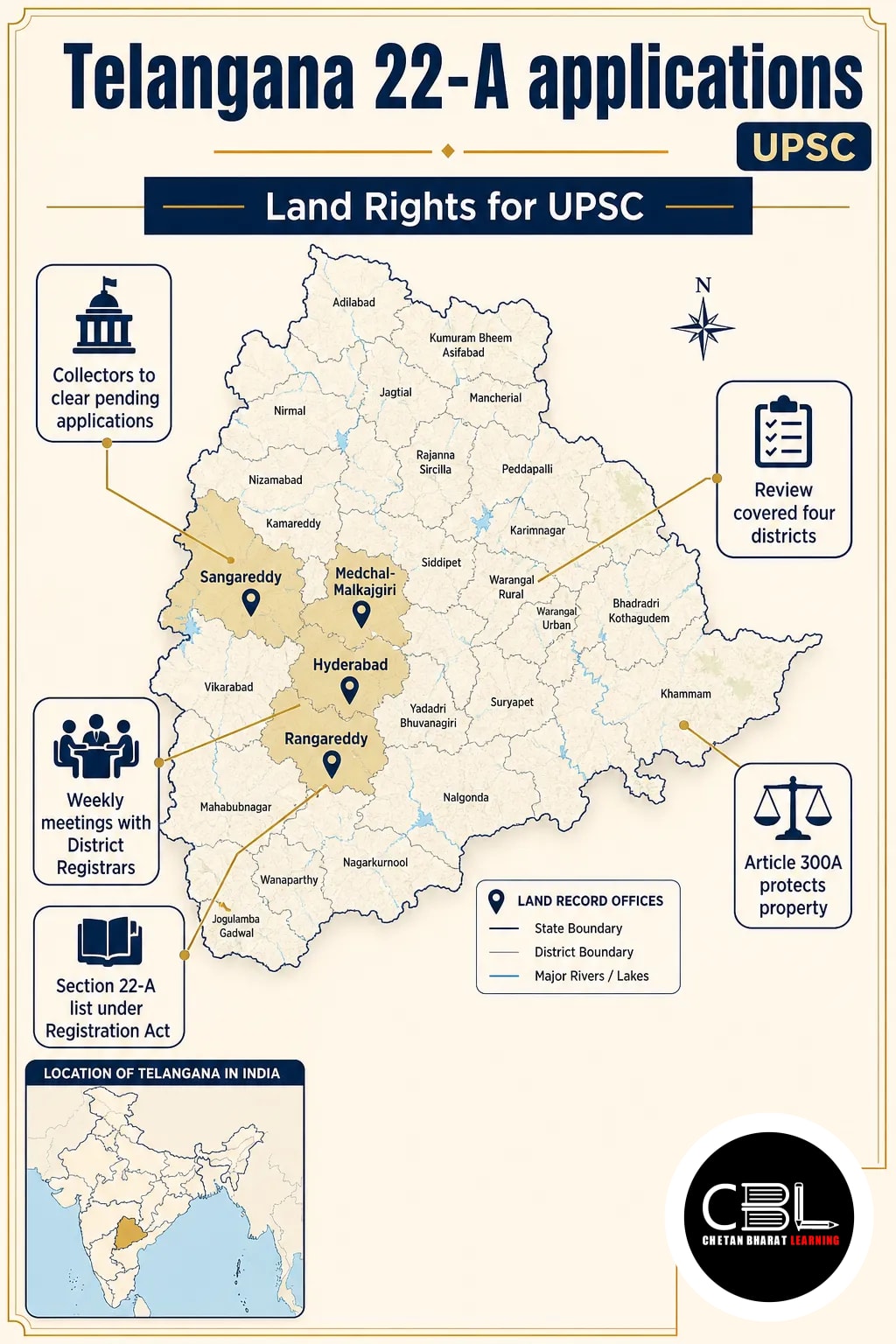
The meeting covered Hyderabad, Rangareddy, Sangareddy and Medchal-Malkajgiri. It followed government orders and memoranda linked to assurances Chief Minister A. Revanth Reddy gave in the Assembly.
The Minister asked officials to clear every pending application on priority. However, he set a one-week deadline specifically for the urban land ceiling report, not an explicit one-week deadline for every application.
Which cases and officials does the review cover?
The review covers several categories of land and property cases, with Collectors responsible for implementing the orders.
| Category | Issue identified in the review |
|---|---|
| Government orders | Issues relating to G.O.s 118 and 76, and implementation of G.O. 59 |
| Approved properties | Houses, plots and flats on the 22-A list despite approvals from specified authorities |
| Urban land ceiling | Disposal of applications and assessment of litigation options |
| Pattadar lands | Cases where the non-agricultural land assessment process remains incomplete |
The specified authorities include the Greater Hyderabad Municipal Corporation (GHMC), Hyderabad Metropolitan Development Authority (HMDA), Directorate of Town and Country Planning (DTCP) and municipal authorities. Their approvals are relevant to the cases identified; however, approval alone should not be treated as conclusive proof of title.
Collectors must hold weekly meetings with District Registrars and other officials. In addition, unresolved district-level issues must go to a high-level committee headed by Revenue Secretary D.S. Lokesh Kumar.
The committee must report on final court judgments and identify cases where the government can or cannot file special leave petitions (SLPs). Therefore, the report should distinguish concluded decisions from available litigation options.
What legal principles are relevant?
Constitutional property protection, equality and legislative powers provide the framework for examining land administration.
| Provision | Relevance |
|---|---|
| Article 300A | No person can be deprived of property except by authority of law. |
| Article 14 | Guarantees equality before the law and equal protection of laws. |
| Article 136 | Empowers the Supreme Court to grant special leave to appeal, subject to its terms. |
| Seventh Schedule | Land is principally a State List subject; registration of deeds and documents is in the Concurrent List. |
Article 300A is a constitutional right, not a fundamental right. Moreover, an SLP does not guarantee that the Supreme Court will grant leave or decide the underlying dispute in the applicant’s favour.
Why does the review matter for governance?
The review tests whether departments can reconcile records while protecting legitimate public and private interests.
- Access to services: Repeated office visits impose time and transaction costs; therefore, coordinated scrutiny can reduce the burden on eligible applicants.
- Record consistency: Revenue records, registration details and ground conditions may need reconciliation. For comparison, see the coverage of Chandigarh’s Lal Dora land-record notifications.
- Public interest: Speed alone cannot justify a change in a listing. Thus, officials must verify claims before granting relief.
- Accountability: Weekly reviews clarify responsibility, while escalation offers a route for cases districts cannot resolve.
What challenges remain and what can improve disposal?
The central challenge is to combine quick decisions with reliable evidence and lawful treatment of disputed parcels.
Different records may point to different positions, and court orders can constrain administrative action. Moreover, the source does not provide a pending-case count or the detailed contents of the cited orders, so the scale and case-specific eligibility cannot be inferred.
Officials should compare revenue and registration records with supporting documents and verify the actual ground position, as the Minister directed. In addition, a case-tracking process, written reasons for decisions and clear communication to applicants could make reviews more transparent.
Finally, the committee should separate cases needing legal assessment from those that district officials can decide. Such triage can support timely relief without treating every entry as erroneous.
Source: The Hindu, 12 November 2026
State PCS General Studies can test land records, registration and the role of district administration through this example. In addition, candidates should distinguish constitutional property protection from the procedures applicable in a particular state.
Prelims Practice Corner
Mains Practice Questions
Frequently Asked Questions
What are Telangana 22-A applications?
They concern land parcels included in the Section 22-A list under the Registration Act. The state has therefore directed Collectors to prioritise pending applications relating to those parcels.
Who will review unresolved district-level cases?
A high-level committee headed by Revenue Secretary D.S. Lokesh Kumar will receive them. Meanwhile, Collectors must hold weekly meetings with District Registrars and other officials.
Is the right to property a fundamental right in India?
No, it is a constitutional right under Article 300A, not a fundamental right. Therefore, deprivation of property must have the authority of law.
Related Current Affairs
Preparing for UPSC, PCS or HCS?
Talk to a mentor at Chetan Bharat Learning, Chandigarh. Free guidance on choosing the right exam and building a study plan.
Chat on WhatsAppCall 97793 53345UPSC / IAS / PCS coaching in Chandigarh · Trusted by aspirants across Punjab & Haryana









Leave a Reply
You must be logged in to post a comment.