
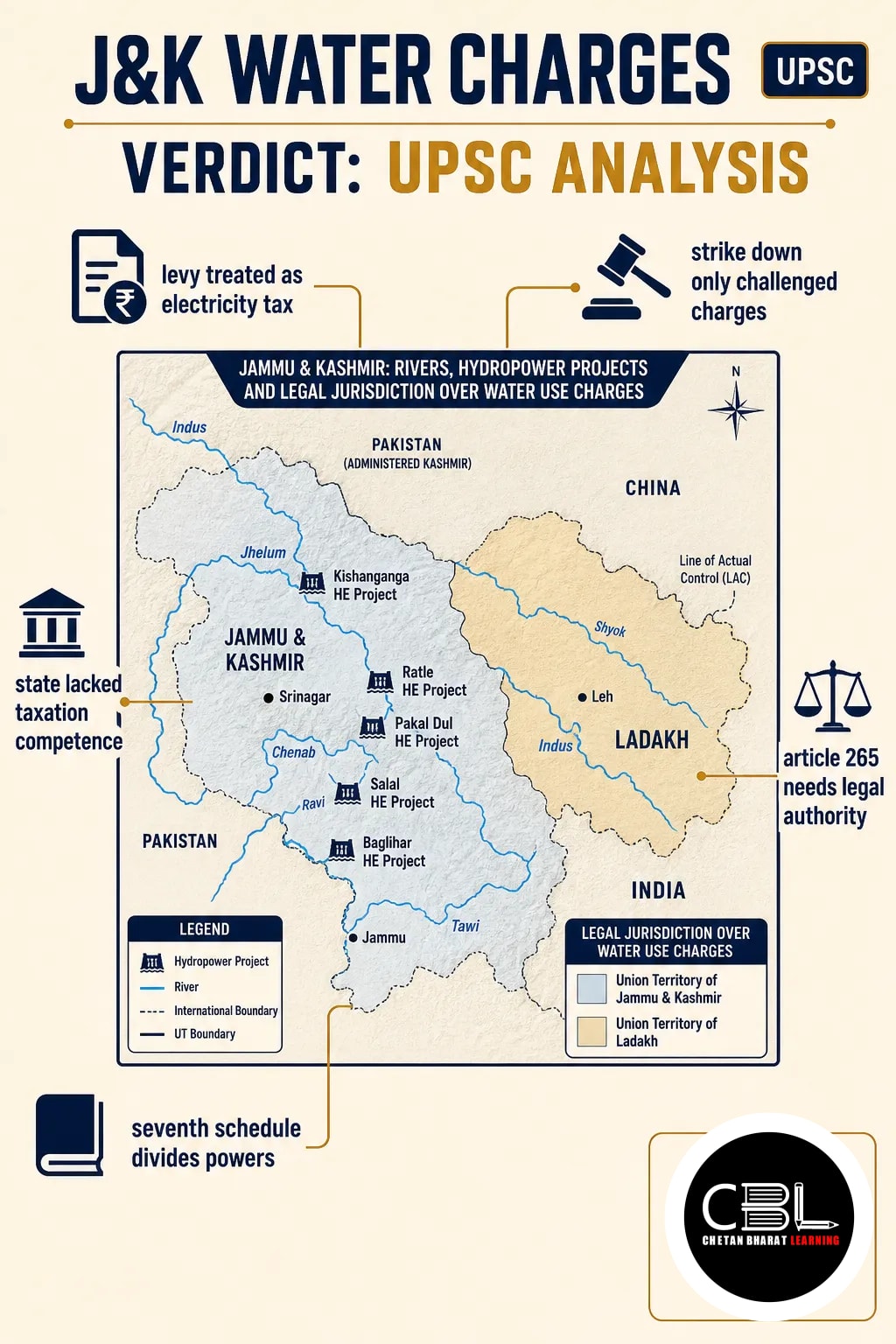

J&K water charges on hydropower projects have come under judicial scrutiny after the High Court struck down their imposition on the petitioners. The verdict raises questions about legislative competence and federal taxation.
Quick answer: On 29 October 2026, the J&K High Court held that J&K water charges imposed on the petitioning hydropower companies under the 2010 water law were unconstitutional. The court treated the levy as a tax on electricity generation, which the state legislature lacked competence to impose.
What did the High Court hold?
The court held that the challenged levy amounted to a tax on electricity generation, beyond the state legislature’s competence. Justices Sanjay Dhar and Rajnesh Oswal formed the Division Bench that delivered the ruling.
Accordingly, the Bench struck down the 2010 Act to the extent that it imposed the charges on the petitioners. It also quashed their demand notices and restrained the administration from taxing electricity generation under the guise of water charges or another tax.
The decision does not strike down the entire Act or establish that every charge for water use is unconstitutional. Instead, its stated scope concerns the challenged imposition and its character as a generation tax.
Why were J&K water charges challenged?
Eleven companies operating independent hydropower projects challenged the levy under the J&K Water Resources (Regulation and Management) Act, 2010. The former state government had enacted it to raise revenue from water use by public and private units, including electricity producers.
The government estimated annual revenue of around ₹850 crore from electricity-generating companies, including the National Hydro Power Corporation (NHPC). That figure was an estimate, not a reported collection.
The petitioners argued that hydropower uses water non-consumptively. They also said the Water Resources Regulatory Authority fixed charges on 2 April 2019 using the head height from which water drives turbines, rather than the quantity of water used.
Moreover, the companies referred to 12% free electricity supplied to the Union Territory government as royalty. They claimed an assurance against additional charges created a legitimate expectation for a 40-year project period. The source does not establish that the court accepted this separate claim.
Which constitutional provisions matter?
The dispute turns on the division of legislative and taxation powers under the Constitution’s Seventh Schedule. The following provisions provide the framework for analysing that division.
| Article or entry | What it says |
|---|---|
| Article 246 | Distributes legislative subjects between Parliament and state legislatures through the Seventh Schedule. |
| State List, Entry 17 | Covers water, including water power, subject to Union List Entry 56. |
| Union List, Entry 56 | Covers regulation and development of inter-state rivers and river valleys where Parliament declares Union control expedient in the public interest. |
| State List, Entry 53 | Covers taxes on the consumption or sale of electricity; it does not name generation. |
| Article 265 | Requires authority of law for the levy or collection of a tax. |
The administration relied on Entry 17 to defend its power over water storage and use. It also invoked State List Entries 49 and 50, concerning taxes on lands and buildings and on mineral rights, respectively.
Further, the administration argued that parliamentary adoption of the law during the J&K Reorganisation Act, 2019 supported its validity. The Bench nevertheless held that the challenged levy was a tax on generation outside the state legislature’s competence.
What are the implications for federalism and hydropower?
The verdict makes the substance of a levy central to assessing whether the legislature had power to impose it. Consequently, a law’s description of a payment as a water charge cannot by itself settle its constitutional character.
- Taxation and regulation: The ruling distinguishes authority over water as a subject from competence to impose the particular tax under challenge.
- Public revenue: The quashed notices affect the demands against the petitioners; however, the source does not quantify the final revenue impact.
- Project certainty: Clear statutory authority and predictable charges can help governments and developers assess project obligations.
- Resource governance: Non-consumptive use does not by itself resolve questions about a project’s wider ecological effects or water management.
Hydropower policy also involves choices beyond taxation. For a separate example of project-related governance concerns, see the discussion of opposition to the Siang project.
What issues remain for policymakers?
Policymakers must align any future revenue mechanism with the constitutional allocation of powers and the judgment’s scope. They should first identify the legal basis and actual incidence of a proposed levy rather than relying solely on its label.
In addition, transparent project agreements can clarify royalty, charges and other obligations. Consultation on water management and environmental impacts can complement that exercise, while keeping those questions distinct from the court’s finding on legislative competence.
The supplied report does not establish whether an appeal was filed or whether refunds were ordered. For background on one possible appellate route, see how special leave petitions reach the Supreme Court.
Source: The Hindu, 30 October 2026
Punjab PCS and Haryana HCS may test the Seventh Schedule entries on water and electricity alongside legislative competence. In addition, the case offers a state-governance example of judicial review of a revenue levy.
Prelims Practice Corner
Mains Practice Questions
Frequently Asked Questions
Why did the court strike down the hydropower water charges?
Because it held that the levy was effectively a tax on electricity generation. The state legislature therefore lacked competence to impose it, according to the Bench.
Did the court invalidate the entire 2010 J&K water law?
No, the court struck it down only to the extent it imposed the challenged charges on the petitioners. It also quashed their demand notices.
Which Seventh Schedule entry covers water power?
State List Entry 17 covers water, including water power. However, it is subject to Union List Entry 56 on specified inter-state rivers and river valleys.
Related Current Affairs
Preparing for UPSC, PCS or HCS?
Talk to a mentor at Chetan Bharat Learning, Chandigarh. Free guidance on choosing the right exam and building a study plan.
Chat on WhatsAppCall 97793 53345UPSC / IAS / PCS coaching in Chandigarh · Trusted by aspirants across Punjab & Haryana
Leave a Reply
You must be logged in to post a comment.