
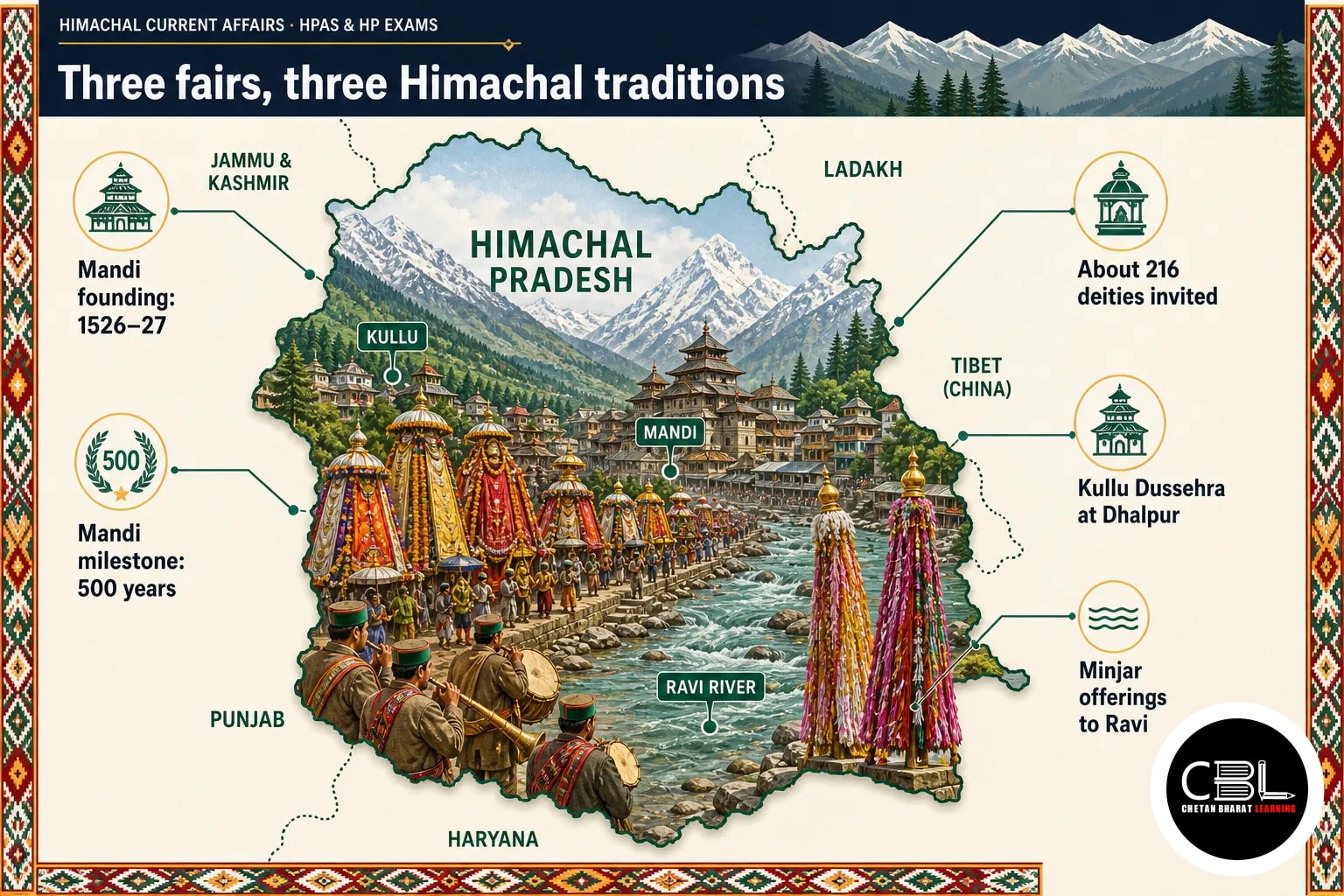
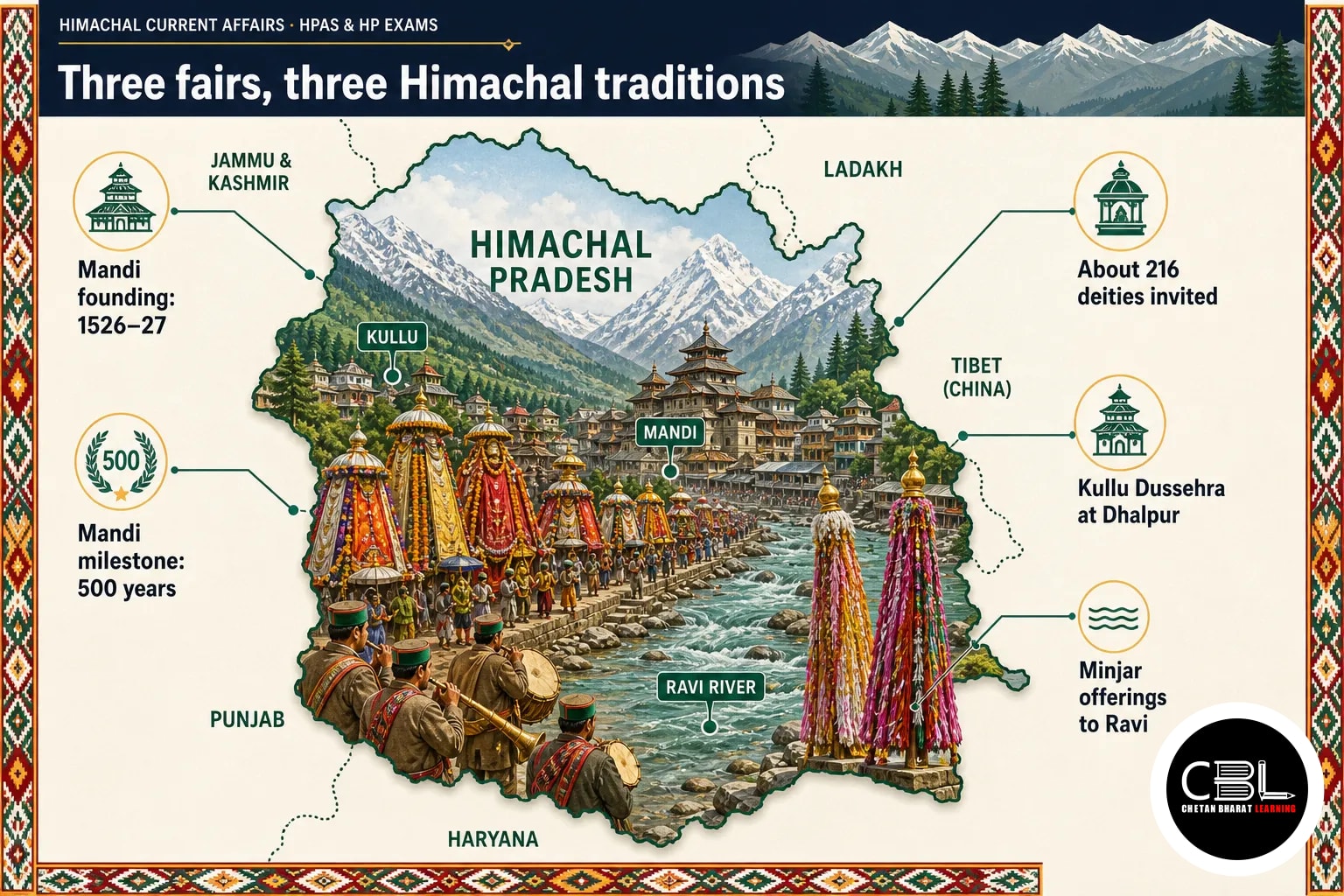
Himachal Pradesh’s fair calendar brings together deity processions, local traditions and cultural performances. The International Mandi Shivratri fair, held on 16–22 February 2026, marked 500 years since Mandi’s founding. About 216 deities were invited. Kullu Dussehra followed in October at Dhalpur ground, while Chamba’s Minjar is held in July–August. Together, the fairs offer a way to study Himachal’s living heritage and the administration of large public gatherings.
Timeline: three fairs across centuries
- 1526–27reported foundingMandi founded
Raja Ajbar Sen founded Mandi; Bhutnath temple is linked to the town’s founding.
- 17th centuryKullu traditionDussehra link
Kullu Dussehra is linked to Raja Jagat Singh and Raghunath ji.
- 16–22 Feb2026Mandi milestone
Mandi Shivratri marked 500 years of the town’s founding; about 216 deities were invited.
- July–Augannual seasonMinjar offering
Chamba’s Minjar fair is held in this season; silk tassels are offered to the Ravi.
- 21–27 Oct2026, reportedKullu gathering
International Kullu Dussehra was held in October at Dhalpur ground.
- Ajbar Sen founded Mandi, whose founding is reported as 1526–27.
- The Mandi Shivratri 2026 Jaleb procession was led by Raj Madhav.
- Raghunath ji leads the deity procession at Kullu Dussehra.
- At Minjar, silk tassels are offered to the Ravi.
- The International Lavi fair is held at Rampur in Shimla district.
What connects these Himachal fairs?
These fairs bring together local communities around distinct traditions. Mandi Shivratri is linked to Madho Rai, and its Jaleb procession was led by Raj Madhav in 2026. Mandi is also known as Chhoti Kashi.
Kullu Dussehra begins on Vijayadashami, when Dussehra ends elsewhere, and lasts seven days. Chamba’s Minjar is named for the silk tassels offered to the Ravi; a traditional account links it to Raja Sahil Varman’s victory.
Why it matters
Deity processions and offerings connect participants with traditions associated with their towns and districts.
Large gatherings create opportunities for local trade and services. Fair arrangements also shape the experience of visitors and vendors.
Processions and large gatherings require coordinated crowd, traffic, sanitation and emergency arrangements. River protection matters during Minjar offerings.
- River: The Ravi flows through Chamba district.
- Fair: The International Lavi fair is held at Rampur in Shimla district in November.
- District: Renuka ji fair is associated with Sirmaur district.
- Temple: Bhutnath temple is linked to Mandi town’s founding.
Key data
| Point | Details |
|---|---|
| Mandi Shivratri 2026 | 16–22 February; marked 500 years since Mandi’s founding |
| Mandi founding | 1526–27, reported variously; attributed to Raja Ajbar Sen |
| Mandi participation | About 216 deities invited; 11 international troupes in the cultural parade |
| Kullu Dussehra 2026 | October, reported as 21–27 October; Dhalpur ground |
| Kullu tradition | Begins on Vijayadashami and lasts seven days |
| Minjar | Chamba; July–August; silk tassels offered to the Ravi |
Way forward
- Protect traditions: Consult local communities and customary participants while planning fair arrangements.
- Manage crowds: Prepare procession routes, entry controls and emergency access in advance.
- Keep rivers clean: Work with communities on environmentally responsible offerings and waste collection.
- Support livelihoods: Provide accessible, fairly allocated vending spaces and visitor facilities.
- Coordinate services: Link police, health, transport and local bodies through a common fair plan.
HPAS Mains practice questions
Explain the distinctive traditions of Mandi Shivratri, Kullu Dussehra and Chamba Minjar. (150 words)
Answer pointers:
- Introduce fairs as expressions of local cultural heritage.
- Describe Mandi’s Jaleb and Kullu’s Raghunath ji procession.
- Explain Minjar tassels and the Ravi offering.
- Conclude with community participation in preserving traditions.
Critically examine the opportunities and challenges of organising major fairs in Himachal Pradesh. (250 words)
Answer pointers:
- Introduce fairs as cultural gatherings with local economic relevance.
- Discuss cultural continuity, trade and visitor services as opportunities.
- Examine crowd safety, traffic, waste and river protection concerns.
- Conclude with community-led planning and coordinated public services.
As Sub-Divisional Magistrate (SDM) of Kullu, how would you plan a safe and inclusive Dussehra? (150 words)
Answer pointers:
- Begin with a joint assessment of the venue and procession routes.
- Consult customary participants, vendors and local communities.
- Arrange crowd controls, medical aid, sanitation and accessible facilities.
- Conclude with interdepartmental coordination and a contingency plan.
Discuss how Himachal’s fair traditions can be linked with environmental protection, using Minjar as an example. (150 words)
Answer pointers:
- Introduce Minjar’s silk-tassel offering to the Ravi.
- Explain the importance of cultural participation and river health.
- Suggest community consultation and waste-management arrangements.
- Conclude with culturally sensitive protection of Himalayan rivers.
For Himachal Pradesh Administrative Service (HPAS) prelims and Himachal Pradesh Rajya Chayan Aayog (HPRCA) papers, memorise the fair, district, deity or river pairings. For mains, connect cultural preservation with crowd management and environmental care.
MCQ Practice Corner
Q1. Consider the following statements:
1. Kullu Dussehra begins on Vijayadashami.
2. Minjar tassels are offered to the Ravi.
3. The Lavi fair is held in Sirmaur district.
Which statements are correct?
(a) 1 and 2 only (b) 2 and 3 only (c) 1 and 3 only (d) 1, 2 and 3
Show answer
Answer: (a) because Lavi is held at Rampur in Shimla district, while statements 1 and 2 are correct.
Q2. Which combination correctly describes Mandi Shivratri in 2026?
(a) 500-year founding milestone; about 216 deities invited (b) 216-year founding milestone; 500 deities invited (c) Held at Dhalpur ground in October (d) Silk tassels offered to the Ravi
Show answer
Answer: (a) because the fair marked 500 years since Mandi’s founding and invited about 216 deities.
Q3. Which deity leads the Kullu Dussehra procession?
(a) Raghunath ji (b) Bhutnath (c) Sahil Varman (d) Ajbar Sen
Show answer
Answer: (a) because the Kullu deity procession is led by Raghunath ji.
Q4. Minjar fair is associated with which district?
(a) Kullu (b) Chamba (c) Sirmaur (d) Shimla
Show answer
Answer: (b) because Minjar is a fair of Chamba.
Frequently Asked Questions
Why was Mandi Shivratri 2026 significant?
It marked 500 years since Mandi town’s founding. The fair was held from 16 to 22 February 2026.
Where is Kullu Dussehra celebrated?
It is celebrated at Dhalpur ground in Kullu. The fair begins on Vijayadashami and lasts seven days.
What is offered during Chamba’s Minjar fair?
Silk tassels called minjar are offered to the Ravi. The fair is held in July–August.
Sources: The Hans India (IANS), The Print, ETV Bharat, Hill Post, Incredible India
Related Current Affairs
More Himachal topics for HPAS & HP exams
Preparing for UPSC, PCS or HCS?
Talk to a mentor at Chetan Bharat Learning, Chandigarh. Free guidance on choosing the right exam and building a study plan.
Chat on WhatsAppCall 97793 53345UPSC / IAS / PCS coaching in Chandigarh · Trusted by aspirants across Punjab & Haryana



Leave a Reply
You must be logged in to post a comment.