
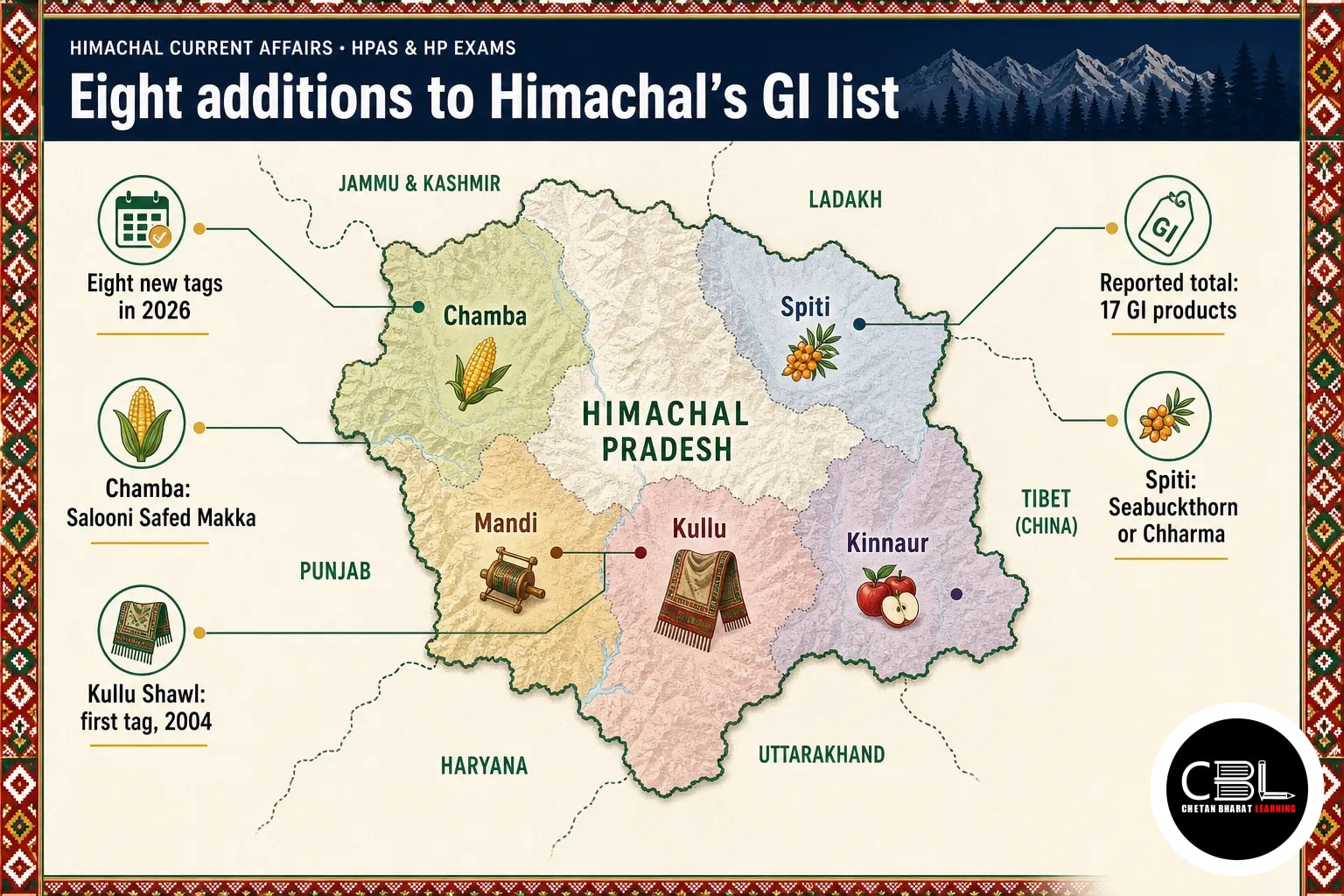
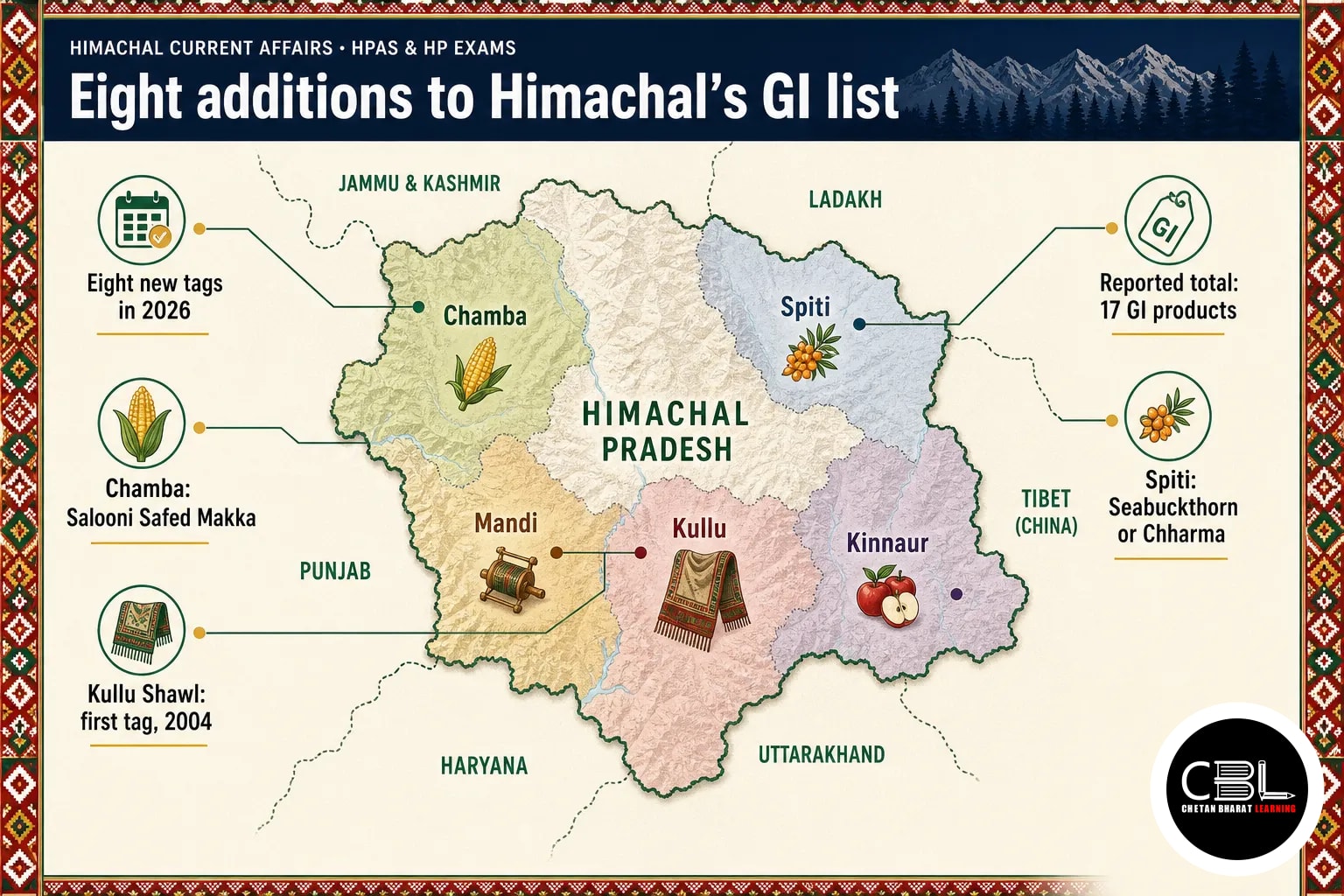
On 1 July 2026, eight Himachal products received geographical indication (GI) tags, taking the state’s reported total to 17. The additions range from Spiti seabuckthorn and Chamba maize to Kinnauri apple and jewellery. The Himachal Pradesh Council for Science, Technology and Environment (HIMCOSTE) facilitated the process. Four more applications are pending. The GI Registry in Chennai is the registration authority; a tag links a product’s qualities or reputation to its geographical origin.
Timeline: from law to 17 tags
- 1999GI lawLaw
The Geographical Indications of Goods Act was enacted in 1999.
- 2003law in forceCommencement
The Act came into force in 2003.
- 2004Himachal firstFirst tag
Kullu Shawl became Himachal’s first GI product.
- 1 July2026New additions
Eight additions took Himachal’s reported total to 17.
- Kullu Shawl was Himachal’s first GI product, registered in 2004.
- Eight Himachal products received GI tags on 1 July 2026.
- Salooni Safed Makka is associated with Chamba.
- Seabuckthorn (Chharma) in the new list is associated with Spiti.
- The GI Registry is located in Chennai.
Which products are on Himachal’s GI list?
The eight additions are Seabuckthorn (Chharma) of Spiti, Salooni Safed Makka, Chamba Metal Art, Sirmauri Loiya, Kinnauri Topi, Sepu Vadi of Mandi, Kinnauri Apple and Kinnauri Jewellery.
The earlier nine are Kullu Shawl, Kangra Tea, Chamba Rumal, Kinnauri Shawl, Kangra Paintings, Himachali Kala Zeera, Himachali Chulli (apricot) Oil, Chamba Chappal and Lahauli Knitted Socks and Gloves. A GI identifies goods whose qualities or reputation are linked to their place of origin.
Why it matters
A GI can help craftspeople and growers distinguish products associated with their region. Benefits depend on producers’ ability to use and market the indication.
Recognition can support product visibility and market opportunities. A tag alone does not guarantee higher incomes.
Registration connects product identity with legal protection. Producer awareness and action against misuse matter alongside registration.
- District: Chamba is a district of Himachal Pradesh; Chamba town is its headquarters.
- Valley: Spiti lies in Lahaul and Spiti district.
- River: The Ravi flows through Chamba district.
Key data
| Point | Details |
|---|---|
| New tags | Eight, on 1 July 2026 |
| Reported total | 17 Himachal products: nine earlier and eight additions |
| First Himachal GI | Kullu Shawl, 2004 |
| Law | Geographical Indications of Goods (Registration and Protection) Act, 1999; in force from 2003 |
| Registry | GI Registry, Chennai |
| Facilitating agency | HIMCOSTE |
| Pending applications | Bhot Jau (Pangi barley), Chamba Chukh, Plectranthus honey of Bharmour and Sirmaur ginger |
Way forward
- Producer awareness: Help eligible producers understand registration, authorised use and protection.
- Market access: Support collective marketing and product information without promising automatic price gains.
- Authenticity: Encourage traceability and action against misuse of registered names.
- Ecological care: Promote sustainable sourcing and production suited to the fragile Himalayan environment.
- Application support: Assist communities in documenting the geographical links of pending products.
HPAS Mains practice questions
Explain the significance of geographical indications for Himachal’s traditional products. (150 words)
Answer pointers:
- Define a GI through its link with geographical origin.
- Use the 2026 additions as examples.
- Discuss identity and potential market visibility.
- Conclude with producer awareness and sustainable use.
Critically examine whether GI registration can strengthen Himachal’s rural economy. (250 words)
Answer pointers:
- Introduce the reported 17-product list.
- Discuss recognition and potential collective marketing.
- Consider market access, misuse and the absence of guaranteed income gains.
- Recommend producer support and ecological safeguards.
As Sub-Divisional Magistrate (SDM) of Chamba, how would you help local producers benefit from GI recognition? (150 words)
Answer pointers:
- Identify relevant producer groups and their needs.
- Coordinate awareness on authorised use with responsible agencies.
- Support traceability and collective market access.
- Monitor outcomes and protect local resources.
Discuss how GI protection can connect Himachal’s cultural heritage with sustainable livelihoods. (150 words)
Answer pointers:
- Link place-based knowledge with product identity.
- Use Chamba Rumal and Kullu Shawl as examples.
- Consider market access and ecological pressures.
- Conclude with community-led, sustainable production.
For Himachal Pradesh Administrative Service (HPAS) prelims and Himachal Pradesh Rajya Chayan Aayog (HPRCA) papers, memorise the first tag, the 2026 additions and their place links. For mains, connect GI protection with livelihoods and ecological sustainability.
MCQ Practice Corner
Q1. Consider the following statements:
1. Kullu Shawl was Himachal’s first GI product.
2. Eight Himachal products received GI tags on 1 July 2026.
3. The GI Registry is located in Shimla.
Which of the statements given above are correct?
(a) 1 and 2 only (b) 2 and 3 only (c) 1 and 3 only (d) 1, 2 and 3
Show answer
Answer: (a) because statements 1 and 2 are correct; the GI Registry is in Chennai.
Q2. The law governing registration and protection of geographical indications in India was enacted in which year?
(a) 1948 (b) 1971 (c) 1999 (d) 2004
Show answer
Answer: (c) because the Geographical Indications of Goods Act was enacted in 1999.
Q3. Salooni Safed Makka is associated with which Himachal district?
(a) Chamba (b) Kullu (c) Kangra (d) Mandi
Show answer
Answer: (a) because Salooni Safed Makka is a Chamba product.
Q4. Which was Himachal Pradesh’s first GI product?
(a) Kangra Tea (b) Kullu Shawl (c) Chamba Chappal (d) Kinnauri Apple
Show answer
Answer: (b) because Kullu Shawl became Himachal’s first GI product in 2004.
Frequently Asked Questions
How many GI-tagged products did Himachal have in July 2026?
Himachal’s reported total was 17 after eight additions on 1 July 2026. The GI Registry is the authority for registration.
Which was Himachal Pradesh’s first GI tag?
Kullu Shawl was Himachal’s first GI product. It was registered in 2004.
Which Himachal GI applications are pending?
Applications are pending for Bhot Jau, Chamba Chukh, Plectranthus honey of Bharmour and Sirmaur ginger. Bhot Jau is Pangi barley.
Sources: The News Himachal, The News Mill, Himachal Headlines
Related Current Affairs
More Himachal topics for HPAS & HP exams
Preparing for UPSC, PCS or HCS?
Talk to a mentor at Chetan Bharat Learning, Chandigarh. Free guidance on choosing the right exam and building a study plan.
Chat on WhatsAppCall 97793 53345UPSC / IAS / PCS coaching in Chandigarh · Trusted by aspirants across Punjab & Haryana



Leave a Reply
You must be logged in to post a comment.