

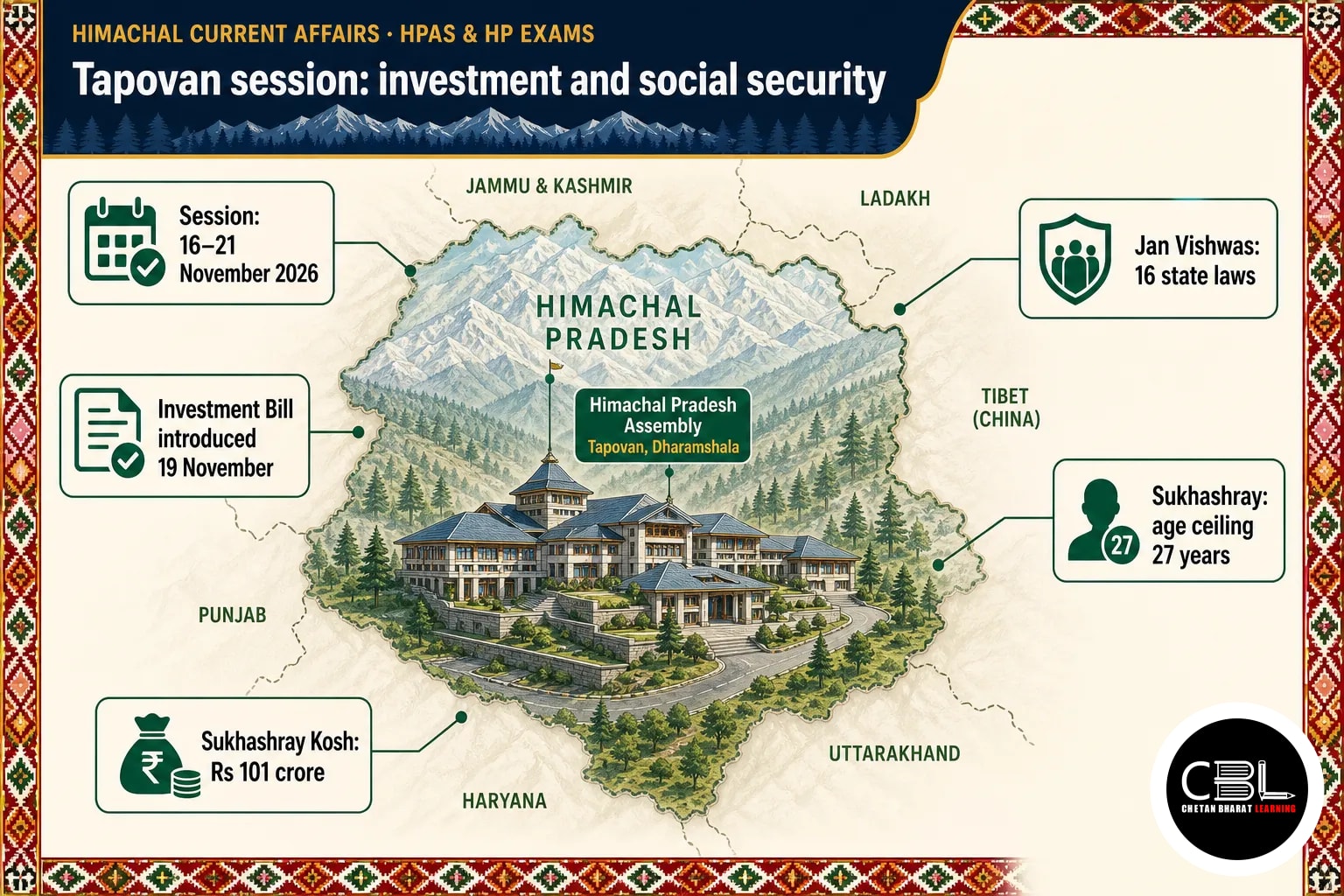
The Himachal Pradesh Assembly met at Tapovan, Dharamshala, from 16–21 November 2026. The Investment Promotion and Facilitation Bill proposed time-bound clearances and a land bank. The Jan Vishwas Bill decriminalises minor offences under 16 state laws. The Assembly passed the Sukhashray Bill, giving statutory status to two welfare schemes and creating a fund with an initial corpus of Rs 101 crore. The investment Bill was introduced on 19 November.
Timeline: the Tapovan session in four stops
- 2017Winter capitalLocation
Dharamshala was declared Himachal Pradesh’s second, winter capital.
- 2023National precedentJan Vishwas
The central Jan Vishwas Act decriminalised minor offences under 42 central laws.
- 16–21 Nov2026 sessionSukhashray passed
At Tapovan, the Assembly passed the Sukhashray Bill, providing an initial fund corpus of Rs 101 crore.
- 19 Nov2026Investment tabled
Industries Minister Harshwardhan Chauhan introduced the Investment Promotion and Facilitation Bill.
- The winter session met at Tapovan, near Dharamshala.
- The investment Bill was introduced by Harshwardhan Chauhan.
- The proposed single-window authority is headed by the Chief Minister.
- The Jan Vishwas Bill covers minor offences under 16 state laws.
- The Sukhashray Kosh has an initial corpus of Rs 101 crore.
What do the three Bills address?
The Investment Promotion and Facilitation Bill proposes time-bound clearances, digital approvals, a land bank and reduced compliance. It also proposes a single-window authority and stricter penalties for investors violating norms.
The Jan Vishwas Bill addresses minor offences under state laws. The passed Sukhashray Bill gives statutory status to the Sukh-Ashray and Indira Gandhi Sukh Shiksha schemes. It covers Children of the State up to 27 years and creates the Sukhashray Kosh.
Why it matters
Statutory status provides a legal basis for the two social security schemes. The Bill recognises Children of the State up to 27 years.
Time-bound clearances and digital approvals can reduce procedural delays for investors. A land bank must be managed with regard to local communities and Himalayan ecology.
Decriminalising minor offences changes how compliance is enforced under 16 state laws. The proposed single-window authority would be headed by the Chief Minister.
- Location: Tapovan, near Dharamshala, hosts the Assembly’s winter session.
- District: Dharamshala is the headquarters of Kangra district.
- Capital: Dharamshala was declared the state’s second, winter capital in 2017.
Key data
| Point | Details |
|---|---|
| Winter session | 16–21 November 2026, Tapovan |
| Investment Bill | Introduced on 19 November 2026; proposes a single-window authority |
| State Jan Vishwas Bill | Minor offences under 16 state laws |
| Central Jan Vishwas Act | 2023 Act covering minor offences under 42 central laws |
| Sukhashray coverage | Children of the State up to 27 years |
| Sukhashray Kosh | Initial corpus of Rs 101 crore; estimated cost about Rs 80–90 crore annually |
| Constitutional link | Article 39(f): opportunities for children to develop in a healthy manner |
Way forward
- Clear timelines: Publish clearance stages and provide a channel for tracking applications.
- Protect ecology: Assess land-bank sites for environmental risks and community impacts before allocation.
- Fair enforcement: Apply proportionate penalties while retaining safeguards against serious violations.
- Support beneficiaries: Make scheme information accessible and establish a grievance-redress mechanism.
- Track expenditure: Monitor the Sukhashray fund and publish periodic spending and outcome reports.
HPAS Mains practice questions
Explain the principal provisions of the Investment Promotion and Facilitation Bill introduced at Tapovan. (150 words)
Answer pointers:
- Introduce the Bill and its November 2026 tabling.
- Outline time-bound clearances, digital approvals and the land bank.
- Explain the proposed authority and penalties for violations.
- Conclude with transparent implementation and ecological safeguards.
Critically examine the governance implications of decriminalising minor offences and simplifying investment approvals. (250 words)
Answer pointers:
- Introduce the Jan Vishwas and investment proposals.
- Discuss lower compliance burdens and potentially faster decisions.
- Examine enforcement, accountability and environmental concerns.
- Conclude with proportionate penalties, scrutiny and public reporting.
As the Sub-Divisional Magistrate (SDM) of Kangra, how would you improve access to Sukhashray benefits? (150 words)
Answer pointers:
- Identify eligible people through coordination with relevant departments.
- Share accessible information through local institutions.
- Facilitate applications and address grievances sensitively.
- Review delivery and protect beneficiaries’ personal information.
Discuss how statutory social security for children relates to Article 39(f) of the Constitution. (150 words)
Answer pointers:
- Introduce Article 39(f) as a Directive Principle.
- Explain its emphasis on healthy development and protection of children.
- Connect this objective with statutory support under Sukhashray.
- Conclude with inclusive access and monitoring of outcomes.
For Himachal Pradesh Administrative Service (HPAS) prelims and Himachal Pradesh Rajya Chayan Aayog (HPRCA) papers, memorise 16 laws, 27 years and Rs 101 crore. For mains, distinguish an introduced Bill from one passed by the Assembly.
MCQ Practice Corner
Q1. Consider the following statements about the Tapovan session:
1. The investment Bill was introduced on 19 November 2026.
2. The state Jan Vishwas Bill covers minor offences under 16 state laws.
3. The Sukhashray Kosh has an initial corpus of Rs 101 crore.
Which statements are correct?
(a) 1 and 2 only (b) 2 and 3 only (c) 1 and 3 only (d) 1, 2 and 3
Show answer
Answer: (d) because all three statements match the session’s Bills and their provisions.
Q2. Who heads the single-window authority proposed in the Investment Promotion and Facilitation Bill?
(a) Governor (b) Chief Minister (c) Speaker (d) Chief Justice
Show answer
Answer: (b) because the Bill proposes an authority headed by the Chief Minister.
Q3. Where was the November 2026 Himachal Assembly winter session held?
(a) Tapovan (b) Chamba (c) Bilaspur (d) Una
Show answer
Answer: (a) because the Assembly met at Tapovan near Dharamshala.
Q4. The Sukhashray Bill covers Children of the State up to what age?
(a) 18 years (b) 21 years (c) 27 years (d) 35 years
Show answer
Answer: (c) because the Bill covers Children of the State up to 27 years.
Frequently Asked Questions
When was the Himachal winter session held in 2026?
It was held from 16 to 21 November 2026 at Tapovan, near Dharamshala. Dharamshala is Himachal Pradesh’s second, winter capital.
What is the initial corpus of Sukhashray Kosh?
The initial corpus is Rs 101 crore. The estimated cost of the Sukhashray measures is about Rs 80–90 crore a year.
What does the Himachal Jan Vishwas Bill do?
It decriminalises minor offences under 16 state laws. The central Jan Vishwas Act of 2023 addressed minor offences under 42 central laws.
Sources: The Tribune: investment Bill, The Tribune: Sukhashray Bill, The Tribune: Assembly session, ANI: winter session
Related Current Affairs
More Himachal topics for HPAS & HP exams
Preparing for UPSC, PCS or HCS?
Talk to a mentor at Chetan Bharat Learning, Chandigarh. Free guidance on choosing the right exam and building a study plan.
Chat on WhatsAppCall 97793 53345UPSC / IAS / PCS coaching in Chandigarh · Trusted by aspirants across Punjab & Haryana



Leave a Reply
You must be logged in to post a comment.