
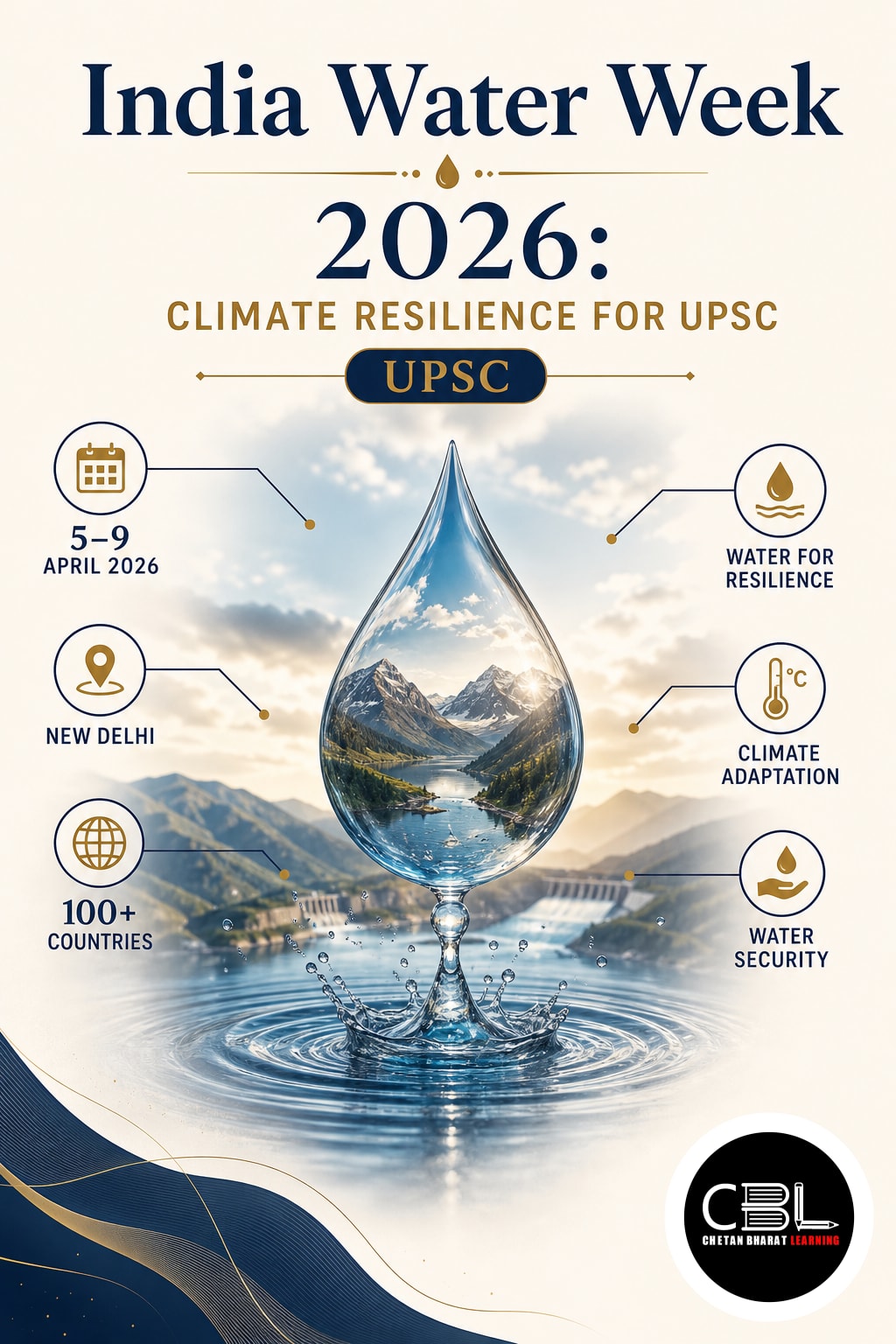
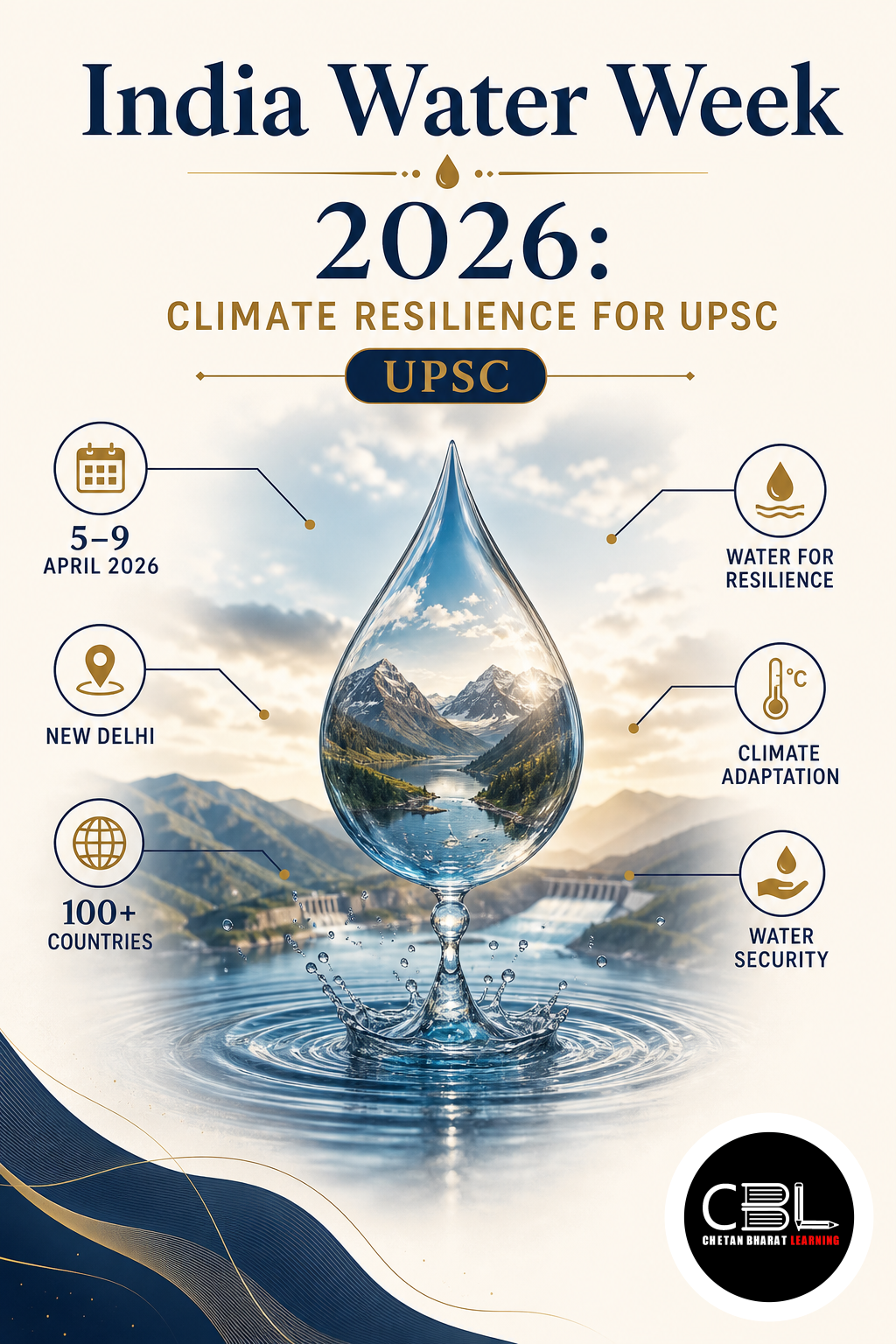
UPSC Mapping
Prelims
- Ministry of Jal Shakti, SDG 6 and Water Governance
Mains
- GS Paper II and III – Water Resources and Climate Adaptation
Quick Facts
| Edition | 9th Edition |
|---|---|
| Dates | 22–26 September 2026 |
| Theme | Climate Resilient Water Management |
| Venue | Bharat Mandapam, New Delhi |
| Organiser | Ministry of Jal Shakti |
What is India Water Week?
India Water Week is a flagship government event designed to encourage dialogue on water-resource management and sustainable development. The initiative began in 2012 and has developed into a major meeting point for national and international stakeholders. Eight editions were organised between 2012 and 2024 before the event received an expanded international identity in 2026.
The platform brings together government representatives, researchers, water professionals, private enterprises, civil-society organisations and local communities. Participants discuss policy reforms, scientific research, technological solutions and successful field practices. This multidisciplinary approach recognises that water security affects agriculture, cities, public health, energy, ecosystems and economic growth.
Why is India Water Week in News?
The Ministry of Jal Shakti is organising the ninth India Water Week from 22 to 26 September 2026. The event is officially presented as the India International Water Week, reflecting its wider global participation. Its theme, Climate Resilient Water Management, highlights the need to prepare water systems for uncertain rainfall, floods, droughts and rising demand.
The programme includes a four-day conference and exhibition from 22 to 25 September. Study tours scheduled for 26 September will expose participants to practical water-management initiatives. The official event portal presents the programme as a global forum for decision-makers, experts, innovators, students and water-sector stakeholders.
Key Features
The ninth edition combines policy dialogue, technical exchange and practical learning within a common international platform.
- Climate-centred theme: Discussions examine how institutions, infrastructure and communities can withstand droughts, floods, rainfall variability and other climate-related water risks.
- Global participation: India Water Week connects policymakers, researchers, industry leaders and development partners for collaborative responses to shared water challenges.
- Conference sessions: Technical and policy discussions cover water-use efficiency, river health, groundwater management, urban demand, irrigation and technology-driven governance.
- Technology exhibition: Organisations can demonstrate innovations concerning treatment, monitoring, conservation, efficient irrigation, forecasting and water-resource data management.
- Field exposure: Study tours help participants examine operational projects and connect conference recommendations with implementation experiences on the ground.
Challenges
India needs to convert conference deliberations into measurable improvements in water efficiency, ecological security and local resilience.
- Climate uncertainty: Changing monsoon patterns can intensify droughts and floods, making conventional infrastructure planning and reservoir operations increasingly difficult.
- Groundwater stress: Agricultural, domestic and industrial withdrawals can exceed local recharge, particularly where users face weak measurement and limited regulation.
- Water pollution: Untreated sewage, industrial discharge and agricultural runoff reduce usable supplies while imposing serious public-health and ecological costs.
- Fragmented governance: Multiple departments manage irrigation, drinking water, sanitation, groundwater and urban drainage without always sharing data or coordinating decisions.
- Implementation gaps: Financial constraints, limited local capacity and weak maintenance can prevent promising technologies from producing lasting results.
Way Forward
India Water Week should produce implementable partnerships supported by timelines, financing mechanisms and transparent progress indicators. Authorities need integrated river-basin planning that considers surface water, groundwater, ecosystems and changing climate conditions together. Shared and reliable water data can improve allocation, forecasting, infrastructure operations and public accountability.
India must combine supply augmentation with demand management in agriculture, industries and growing cities. Priorities include efficient irrigation, wastewater reuse, aquifer recharge, wetland protection, leakage reduction and community participation. The Department of Water Resources can strengthen coordination among Union institutions, states, research bodies and local governments.
Prelims Practice Corner
Q1. Which Union Ministry organises the India International Water Week?
(a) Ministry of Environment, Forest and Climate Change (b) Ministry of Jal Shakti (c) Ministry of Rural Development (d) Ministry of Housing and Urban Affairs
Answer: (b) The Ministry of Jal Shakti organises the flagship international water event.
Q2. What is the theme of the ninth edition held in 2026?
(a) Water for Digital Economies (b) River Navigation and Trade (c) Climate Resilient Water Management (d) Universal Ocean Governance
Answer: (c) The 2026 edition focuses on Climate Resilient Water Management.
Q3. The ninth edition of the event was organised at which venue?
(a) Vigyan Bhawan (b) Hyderabad International Convention Centre (c) Bharat Mandapam (d) Mahatma Mandir
Answer: (c) The event was organised at Bharat Mandapam in New Delhi.
Q4. Sustainable Development Goal 6 primarily concerns which objective?
(a) Affordable and clean energy (b) Clean water and sanitation (c) Sustainable cities (d) Life below water
Answer: (b) SDG 6 seeks access to water and sanitation alongside sustainable management.
Q5. Consider the following statements: 1. The flagship event was first conceptualised in 2012. 2. The 2026 programme included conference sessions, an exhibition and study tours. Which statement is correct?
(a) 1 only (b) 2 only (c) Both 1 and 2 (d) Neither 1 nor 2
Answer: (c) Both statements correctly describe the development and programme of the event.
Mains Practice Questions
Q1. Climate-resilient water management requires integration across sectors, institutions and levels of government. Discuss. (250 words, 15 marks)
Answer Structure:
- Intro: Define climate resilience in water-resource management.
- Body: Cover basin planning, groundwater, agriculture, cities, ecosystems, institutional coordination, data and community participation.
- Conclusion: Emphasise integrated governance supported by science, federal cooperation and local implementation.
Q2. How can international water forums contribute to India’s domestic water-security objectives? (150 words, 10 marks)
Answer Structure:
- Intro: Present water forums as platforms for cooperation, innovation and policy exchange.
- Body: Discuss technology transfer, research partnerships, climate finance, capacity building and sharing of successful practices.
- Conclusion: Link international learning with accountable, locally appropriate and measurable domestic action.
FAQs on India Water Week
What was the central theme of the 2026 event?
The ninth edition adopted Climate Resilient Water Management as its theme. It focused on making water systems more capable of handling droughts, floods and changing rainfall patterns.
Why was an international identity added to the event?
The expanded identity reflects the event’s growing engagement with international policymakers, researchers and development partners. It also supports wider cooperation on technologies and sustainable water-management practices.
Why is the event important for civil services preparation?
The event connects water security with climate change, agriculture, urbanisation, federalism and sustainable development. These themes are relevant to environment, geography, governance and economy portions of the examination.
Related Current Affairs
Preparing for UPSC, PCS or HCS?
Talk to a mentor at Chetan Bharat Learning, Chandigarh. Free guidance on choosing the right exam and building a study plan.
Chat on WhatsAppCall 97793 53345UPSC / IAS / PCS coaching in Chandigarh · Trusted by aspirants across Punjab & Haryana
Leave a Reply
You must be logged in to post a comment.