

Article
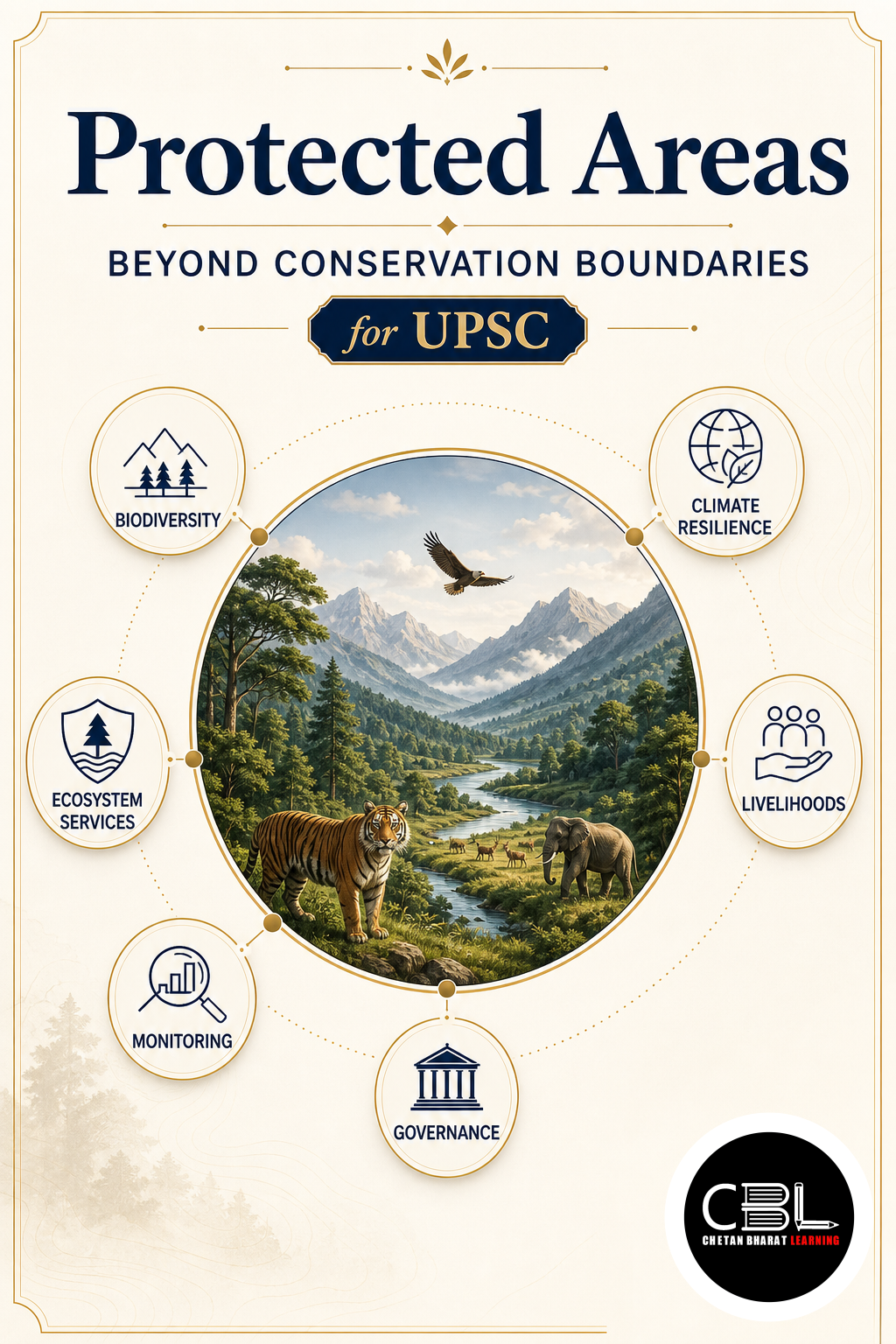
Protected Areas are in focus after the passage argued that India’s next conservation challenge extends beyond legally protected forests and requires landscape-level conservation. The article highlights that while Protected Areas have delivered remarkable conservation success, they alone cannot ensure long-term biodiversity protection in an increasingly fragmented landscape.
Why in News
According to the passage, India’s conservation strategy must move beyond isolated Protected Areas and focus on connected landscapes. Wildlife does not recognise administrative boundaries, while infrastructure development and climate change continue to fragment natural habitats.
What are Protected Areas?
The passage describes Protected Areas (PAs) as legally designated regions for biodiversity conservation under the Wildlife (Protection) Act, 1972. These include National Parks, Wildlife Sanctuaries, Conservation Reserves and Community Reserves.
The primary objective is to conserve ecosystems, wildlife and natural habitats through legal protection and scientific management.
Success of Protected Areas
The passage credits Protected Areas with the recovery of several flagship species in India. Examples mentioned include the Tiger, Asiatic Lion, One-horned Rhinoceros, Elephant and Gharial.
The article also notes that Protected Areas have safeguarded key ecosystems and created valuable sites for scientific research and conservation planning.
Why Protected Areas Alone Are Not Enough
Protected Areas function like isolated islands within wider landscapes. Wildlife frequently moves across forests, rivers, grasslands, agricultural fields and reserve forests, making connectivity essential.
- Restricted movement: Animals require connected habitats for migration.
- Reduced gene flow: Isolation weakens long-term population health.
- Inbreeding: Small isolated populations become genetically vulnerable.
- Local extinction: Species become more vulnerable to local disturbances.
- Poor ecosystem resilience: Fragmented landscapes reduce ecological stability.
Habitat Fragmentation
The passage identifies habitat fragmentation as one of the biggest threats to biodiversity. Large continuous habitats become divided into smaller patches due to human activities.
Major causes listed include highways, railways, dams, mining, urbanisation, industrial development and agriculture.
Consequences of Habitat Fragmentation
- Restricted wildlife movement between habitats.
- Greater human-wildlife conflict.
- Smaller populations becoming genetically isolated.
- Disruption of ecological processes essential for ecosystem health.
Ecological Corridors
The passage describes ecological corridors as natural or restored strips of habitat connecting two or more ecosystems. These corridors enable seasonal migration, dispersal of young animals, gene flow, pollination, seed dispersal and climate adaptation.
Examples of Ecological Corridors in India
- Elephant Corridors in the Nilgiris.
- Kanha–Pench Tiger Corridor.
- Terai Arc Landscape connecting habitats across northern India and Nepal.
Importance of Genetic Exchange
Ecological connectivity enables new genes to enter populations, increases genetic diversity, strengthens disease resistance and reduces the risks associated with inbreeding. Isolated wildlife populations gradually lose genetic diversity over time.
OECMs – The Missing Piece
The article introduces Other Effective Area-based Conservation Measures (OECMs) as conservation areas outside formally designated Protected Areas that still deliver significant biodiversity outcomes.
Examples mentioned include sacred groves, wetlands, mangroves, private conservation areas, biodiversity-friendly agricultural lands, army lands and tea or coffee estates.
Way Forward
According to the passage, future conservation should move beyond isolated Protected Areas by recognising and promoting OECMs, strengthening ecological corridors, integrating ecology into infrastructure planning, encouraging community participation and adopting landscape-level conservation approaches.
The central message is that future conservation depends on connected landscapes rather than isolated Protected Areas.
UPSC Relevance
GS Paper III: Environment, Biodiversity, Wildlife Conservation.
Prelims: Protected Areas, Wildlife (Protection) Act, Ecological Corridors, OECMs.
Prelims Practice
- Protected Areas in India are primarily notified under which legislation? Answer: Wildlife (Protection) Act, 1972.
- Which of the following is an example of an ecological corridor mentioned in the passage? Answer: Kanha–Pench Tiger Corridor.
- Habitat fragmentation mainly results in: Answer: Reduced wildlife connectivity and gene flow.
- What does OECM stand for? Answer: Other Effective Area-based Conservation Measures.
- Which flagship species are highlighted as conservation success stories? Answer: Tiger, Asiatic Lion, One-horned Rhinoceros, Elephant and Gharial.
Mains Practice
Q1. Why are Protected Areas alone insufficient for long-term biodiversity conservation? Discuss. (10 Marks)
Q2. Explain the role of ecological corridors and landscape-level conservation in ensuring India’s biodiversity security. (15 Marks)
FAQs
What are Protected Areas? They are legally designated regions created for biodiversity conservation under the Wildlife (Protection) Act, 1972.
Why are ecological corridors important? They connect fragmented habitats, allowing wildlife movement, genetic exchange and ecosystem resilience.
Why is this topic important for UPSC? It integrates biodiversity conservation, wildlife management, habitat fragmentation and environmental governance, making it highly relevant for Prelims and GS Paper III.
Related Current Affairs
Preparing for UPSC, PCS or HCS?
Talk to a mentor at Chetan Bharat Learning, Chandigarh. Free guidance on choosing the right exam and building a study plan.
Chat on WhatsAppCall 97793 53345UPSC / IAS / PCS coaching in Chandigarh · Trusted by aspirants across Punjab & Haryana
Leave a Reply
You must be logged in to post a comment.