

UPSC Mapping
| Prelims | Environment & Disaster Management |
|---|---|
| Mains | GS Paper 3 (Environment & Disaster Management) |
Article
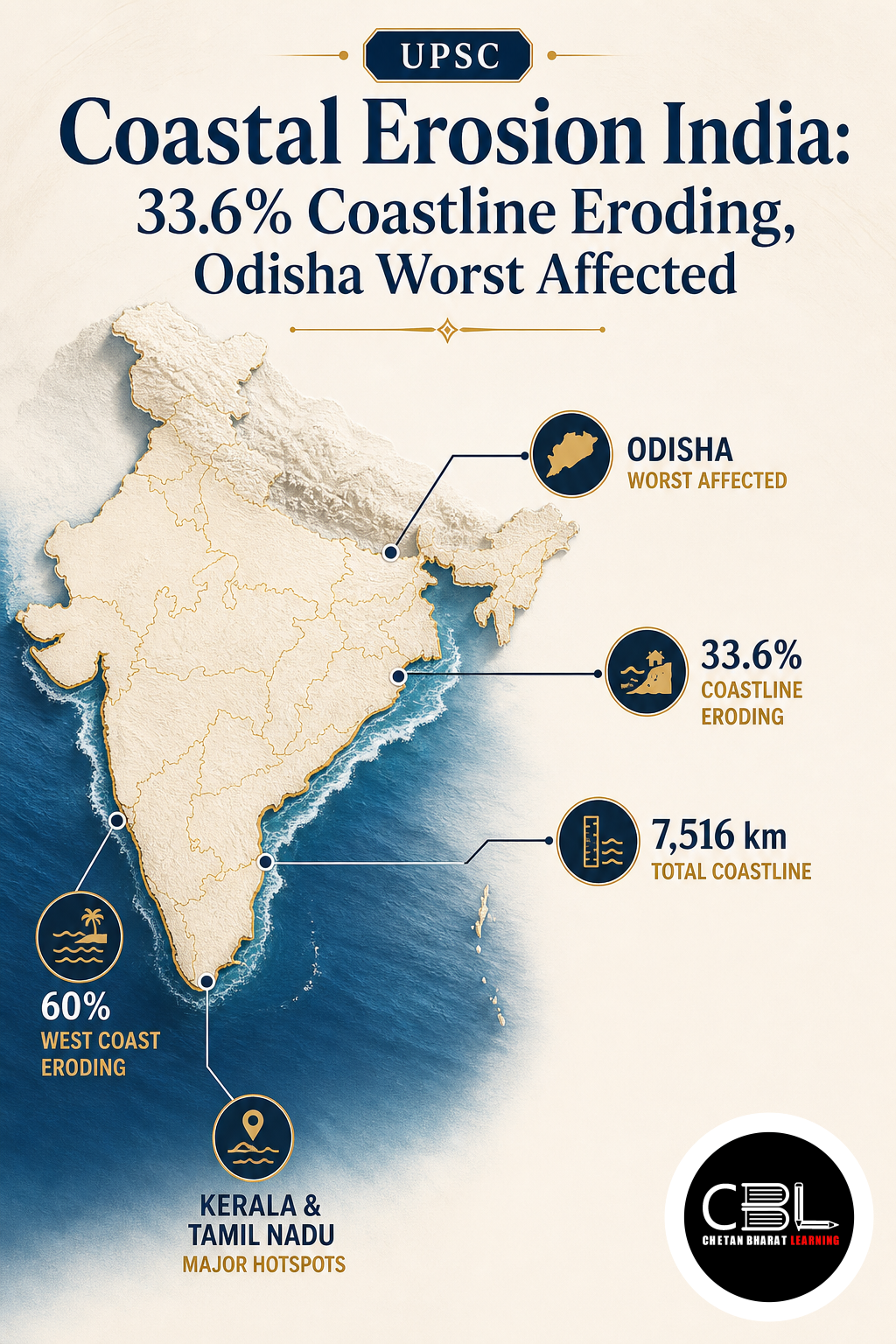
Coastal Erosion India is a growing concern, with a National Center for Coastal Research (NCCR) study finding that 33.6% of India’s coastline eroded between 1990 and 2018, while 26.9% accreted. The eastern coast exhibits greater vulnerability, with 38% of its shoreline facing erosion compared to 30% of the western coastline.
Quick Facts
| Erosion (India) | 33.6% |
|---|---|
| West Bengal Erosion | 60%+ |
| Odisha Erosion | 28.3% |
What is Coastal Erosion India?
Coastal Erosion India refers to the gradual loss of coastal land due to natural and human-induced factors. The NCCR study found that 33.6% of India’s coastline is eroding, with West Bengal (60%+ erosion) being the most affected, followed by Puducherry (56.2%), and Kerala and Tamil Nadu (over 40%). Odisha’s 564-km coastline has 28.3% erosion, with Jagatsinghpur district the most affected.
Sea-level rise and wave attacks have submerged 16 coastal villages in Odisha, prompting the state to establish India’s first climate-resettlement colony in Bagapatia. The eastern coast is more vulnerable, with 38% erosion compared to 30% on the western coast.
Why is Coastal Erosion India in News?
Coastal Erosion India is in the news following the NCCR study revealing the extent of shoreline change across the country. The study was cited by the Union Minister in Parliament, highlighting the vulnerability of Odisha’s coast and the need for urgent action.
Odisha has developed a climate-resettlement policy—touted as India’s first—to accommodate people displaced by coastal erosion. Measures being taken include geotextile tube embankments and sea wall-cum-serving roads.
Key Features of Coastal Erosion India
- Regional Disparity: Eastern coast (38%) more vulnerable than western coast (30%).
- Vulnerable States: West Bengal (60%+), Puducherry (56.2%), Kerala (40%+), Tamil Nadu (40%+).
- Natural Causes: Cyclonic activity, sea-level rise, and littoral drift.
- Anthropogenic Causes: Coastal infrastructure (breakwaters, ports), upstream sediment deficit from dams, mangrove loss, and sand mining.
- Impacts: Community displacement, aquifer salinization, ecological degradation, and demographic exposure.
Challenges in Coastal Erosion India
- Sea-Level Rise: Accelerates erosion and saltwater intrusion.
- Hard Structures: Sea walls/jetties can shift erosion downstream.
- Sand Mining: Unregulated extraction depletes sediment.
- Development Pressure: Unplanned coastal infrastructure increases vulnerability.
- Livelihood Loss: Fishing communities and farmers lose land and income.
Way Forward
A hybrid approach combining hard engineering (geotextile tubes, sea walls) with nature-based solutions (mangrove restoration, beach nourishment) is essential. Managed retreat—relocating communities from extremely vulnerable areas—should be a last-resort strategy. Enforcing Coastal Regulation Zone (CRZ) norms and regulating sand mining can reduce human-induced erosion. Early warning systems and climate-resilient planning are critical.
Prelims Practice Corner
- Q1. What percentage of India’s coastline is eroding?
Answer: 33.6% of the coastline is eroding. - Q2. Which state has the highest coastal erosion in India?
Answer: West Bengal has over 60% of its shoreline eroded. - Q3. Which organisation monitors shoreline change in India?
Answer: The National Center for Coastal Research (NCCR). - Q4. What is the erosion percentage of Odisha’s coastline?
Answer: 28.3% of Odisha’s coastline is eroding. - Q5. What is managed retreat as a coastal adaptation strategy?
Answer: Managed retreat is planned relocation from high-risk coastal zones.
Mains Practice Questions
- Q1. Discuss the causes and impacts of coastal erosion in India, with reference to the NCCR study. What measures are needed for sustainable coastal management? (250 words, 15 marks)
Answer Structure:
- Intro: Introduce the NCCR study and extent of erosion.
- Body: Natural causes (cyclones, sea-level rise); anthropogenic causes (infrastructure, dams, sand mining). Impacts: displacement, salinization, ecological loss. Suggest measures: hybrid solutions, CRZ enforcement, managed retreat.
- Conclusion: Emphasise the need for climate-resilient coastal planning.
- Q2. What is the Coastal Regulation Zone (CRZ) framework, and how does it help in managing coastal erosion? (150 words, 10 marks)
Answer Structure:
- Intro: Define CRZ as a regulatory framework for coastal development.
- Body: Explain CRZ zones and restrictions on construction, sand mining, and industrial activities. How CRZ protects sensitive ecosystems and reduces erosion.
- Conclusion: Effective enforcement of CRZ is crucial for coastal resilience.
FAQs on Coastal Erosion India
- What is the extent of coastal erosion in India?
- 33.6% of India’s coastline is eroding, with West Bengal (60%+) and Odisha (28.3%) most affected.
- What are the major causes of coastal erosion?
- Natural causes: cyclones, sea-level rise, littoral drift. Anthropogenic: coastal infrastructure, dams, sand mining, mangrove loss.
- What is Odisha’s climate-resettlement policy?
- India’s first climate-oriented policy to accommodate people displaced by coastal erosion, establishing a resettlement colony in Bagapatia.
Related Current Affairs
Preparing for UPSC, PCS or HCS?
Talk to a mentor at Chetan Bharat Learning, Chandigarh. Free guidance on choosing the right exam and building a study plan.
Chat on WhatsAppCall 97793 53345UPSC / IAS / PCS coaching in Chandigarh · Trusted by aspirants across Punjab & Haryana
Leave a Reply
You must be logged in to post a comment.