
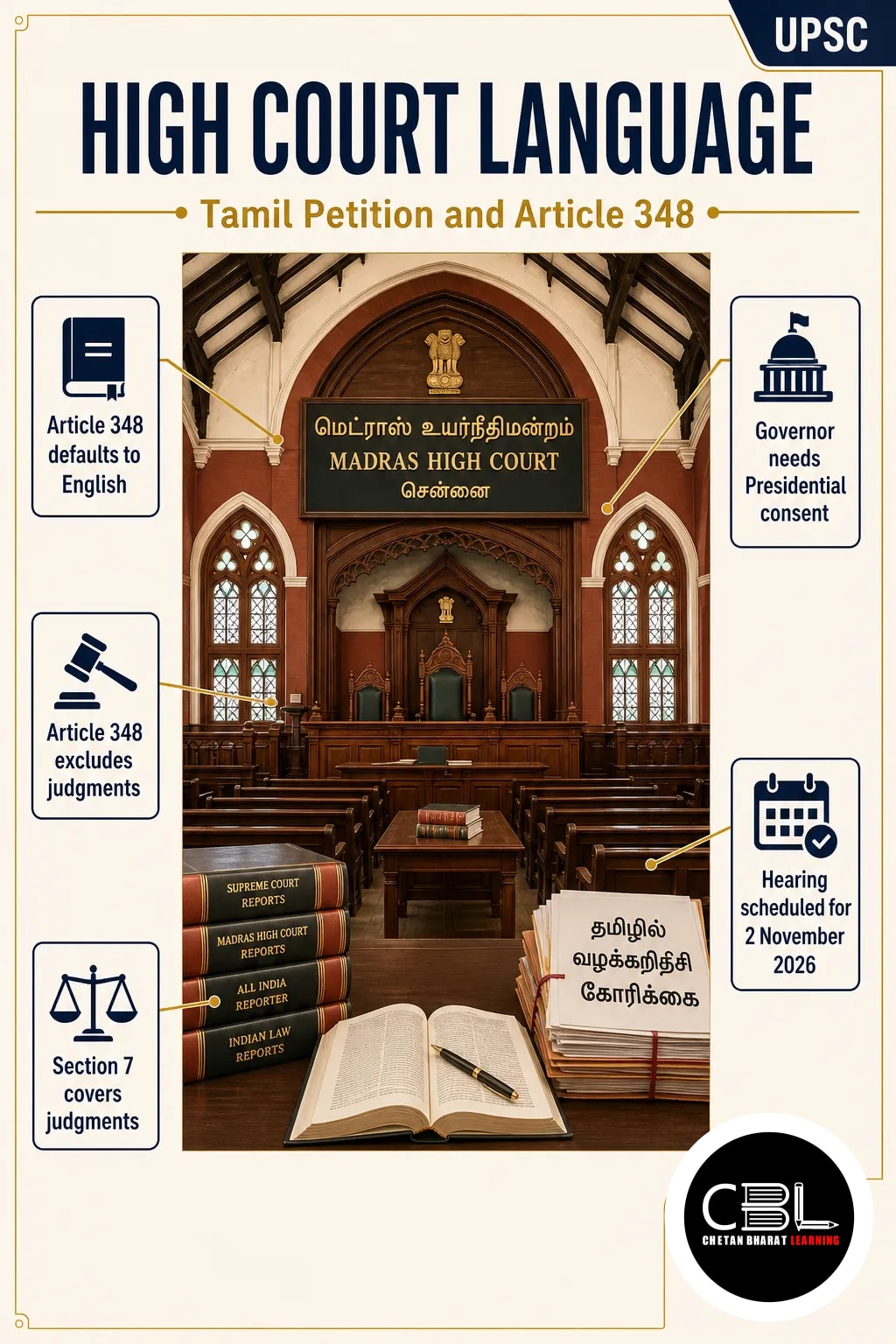

High Court language rules face a constitutional challenge from the Madras High Court Advocates Association. The petition adds a judicial dimension to India’s constitutional and governance debates.
Quick answer: The Madras High Court Advocates Association has challenged a 1965 Cabinet Committee decision on High Court language. It says the decision obstructs Tamil’s use in court proceedings. The association learned of it through Right to Information material in 2025. The petition is scheduled for hearing on 2 November 2026.
What is the court being asked to decide?
The court must consider a challenge to the constitutional validity of the 1965 Cabinet Committee decision. The Madras High Court Advocates Association (MHAA) argues that restrictions on regional languages in High Courts violate Articles 14, 19 and 21.
The association seeks to prevent the decision from obstructing the demand to use Tamil in the Madras High Court. It also contests treating consultation with the Chief Justice of India (CJI) as a requirement for the CJI’s mandatory consent.
The case is scheduled before Chief Justice Sushrut Arvind Dharmadhikari and Justice G. Arul Murugan on 2 November 2026. No ruling is indicated in the source; the association’s claims remain to be adjudicated.
How did the 1965 decision arise?
A conference of High Court Chief Justices recommended retaining English as a common judicial language. The conference met in the first week of March 1965 under then CJI P.B. Gajendragadkar.
Its recommendations reached Prime Minister Lal Bahadur Shastri, Union Home Minister Gulzarilal Nanda and Chief Ministers on 26 March. They proposed continuing English until Hindi could take its place and opposed introducing regional languages in High Courts.
On 17 May 1965, the Ministry of Home Affairs (MHA) placed a note before the Cabinet Committee. It argued that a common language supported judicial transfers, lawyers’ appearances across courts and a unified judiciary. The committee approved the note on 21 May 1965.
MHAA secretary S. Arivazhagan said an advocate obtained the details under the Right to Information (RTI) Act, 2005. The association learned of the decision in 2025 and subsequently challenged it.
What does the Constitution say about court languages?
Article 348 establishes English as the default language for Supreme Court and High Court proceedings, subject to constitutional and statutory provisions. However, the framework distinguishes court proceedings from judgments, decrees and orders.
| Provision | What it says |
|---|---|
| Article 348(1) | Until Parliament provides otherwise by law, proceedings in the Supreme Court and every High Court are in English. |
| Article 348(2) | A Governor may, with the President’s previous consent, authorise Hindi or another language used for state official purposes in High Court proceedings. This does not cover judgments, decrees or orders. |
| Section 7, Official Languages Act, 1963 | A Governor may, with the President’s previous consent, authorise Hindi or the state’s official language in addition to English for High Court judgments, decrees or orders. An English translation issued under the court’s authority must accompany them. |
| Articles 14, 19 and 21 | These protect equality, specified freedoms including speech, and life and personal liberty, respectively. MHAA invokes them in its challenge. |
Article 348(2) expressly requires previous Presidential consent, not CJI consent. The MHA’s 1965 note suggested a convention of consulting the CJI; MHAA disputes treating that consultation as mandatory consent. For the wider framework, see CBL’s analysis of India’s official-language provisions.
How have state proposals differed?
MHAA argues that the Centre has not applied a uniform approach to state proposals. It contrasts rejected requests for several languages with authorisations for Hindi.
| State and language | Position cited in the petition |
|---|---|
| Tamil Nadu: Tamil | The Centre rejected proposals from December 2006 and June 2014. The source says the outcome of the Assembly’s 3 September 2026 resolution was not known. |
| West Bengal, Gujarat and Karnataka | The Centre rejected proposals for Bengali in 1997, Gujarati in 2012 and Kannada in 2014, respectively, according to MHAA. |
| Rajasthan: Hindi | MHAA cites permission for Hindi in the High Court from 1950. |
| Uttar Pradesh, Madhya Pradesh and Bihar: Hindi | MHAA cites authorisations from 1969, 1971 and 1972, respectively, through Governor’s orders and Presidential consent. |
Separately, the Madurai Bar Association seeks a declaration covering pleadings, oral arguments and judgments in a language litigants understand. It also seeks steps under Article 348(2) and Section 7 to make Tamil the primary language of the Madras High Court and its Madurai Bench.
Why does the language choice matter?
The dispute tests how judicial accessibility can coexist with an integrated court system. It also raises questions about the respective roles of states, the Union and the judiciary.
- Access to justice: Proceedings in a familiar language could help litigants understand their cases; however, linguistic needs differ within a state.
- Judicial integration: A common language can assist lawyers and judges working across states. Conversely, exclusive reliance on it may create barriers for some court users.
- Federal choice: Article 348(2) gives the Governor a role, but requires Presidential consent. Therefore, the basis for accepting or rejecting proposals matters.
- Legal certainty: Judgments and proceedings follow different rules. In addition, accurate translations matter for appeals and consistent interpretation.
The debate also fits within India’s broader constitutional language compromise, although court-language rules have their own specific provisions.
What could a balanced approach involve?
A balanced approach would combine accessible proceedings with reliable communication across courts. Any change must operate within Article 348 and applicable law.
- Transparent decisions: The Union could publish reasons for decisions on state proposals, enabling comparison against consistent criteria.
- Translation capacity: Courts could strengthen trained legal translation and terminology, while retaining authoritative English translations where the law requires them.
- Consultation: States, the Union, judges, lawyers and court users could identify practical needs without conflating consultation with a consent requirement.
- Implementation safeguards: Phased arrangements could address records, appeals and training before expanding language use.
Ultimately, the pending petition concerns whether the challenged executive approach is constitutionally valid. It does not itself change the language rules.
Source: The Hindu, 1 November 2026
- Official Language Debate: India’s Constitutional Balance (17 Sep 2026)
- Hindi Diwas: The Constitutional Language Compromise (16 Sep 2026)
State PCS General Studies can test Article 348, the Governor’s role and Presidential consent. Candidates should also distinguish language authorisation for proceedings from the separate statutory provision for judgments.
Prelims Practice Corner
Mains Practice Questions
Frequently Asked Questions
What is the Madras High Court language petition about?
It challenges the 1965 Cabinet Committee decision to continue English as a common court language. MHAA argues that the decision obstructs the use of Tamil in High Court proceedings.
Can a Governor authorise a regional language in High Court proceedings?
Yes, with the President’s previous consent, for a language used for the state’s official purposes or Hindi. However, Article 348(2) does not cover judgments, decrees or orders.
Does Article 348(2) expressly require the Chief Justice of India’s consent?
No, it expressly requires the President’s previous consent. MHAA challenges treating consultation with the Chief Justice of India as mandatory consent.
Has the court decided the petition?
No decision is indicated in the source. The hearing is scheduled for 2 November 2026.
Related Current Affairs
Preparing for UPSC, PCS or HCS?
Talk to a mentor at Chetan Bharat Learning, Chandigarh. Free guidance on choosing the right exam and building a study plan.
Chat on WhatsAppCall 97793 53345UPSC / IAS / PCS coaching in Chandigarh · Trusted by aspirants across Punjab & Haryana

 Ananya RanaIAS · AIR 60
 Aditya SharmaIAS · AIR 70
 Ria Kaur SethiIPS · AIR 89
 Aman AloonIRS · AIR 295
 Sumer Singh VirkIRS · AIR 335
 Shivani PanchalIAS

Leave a Reply
You must be logged in to post a comment.