

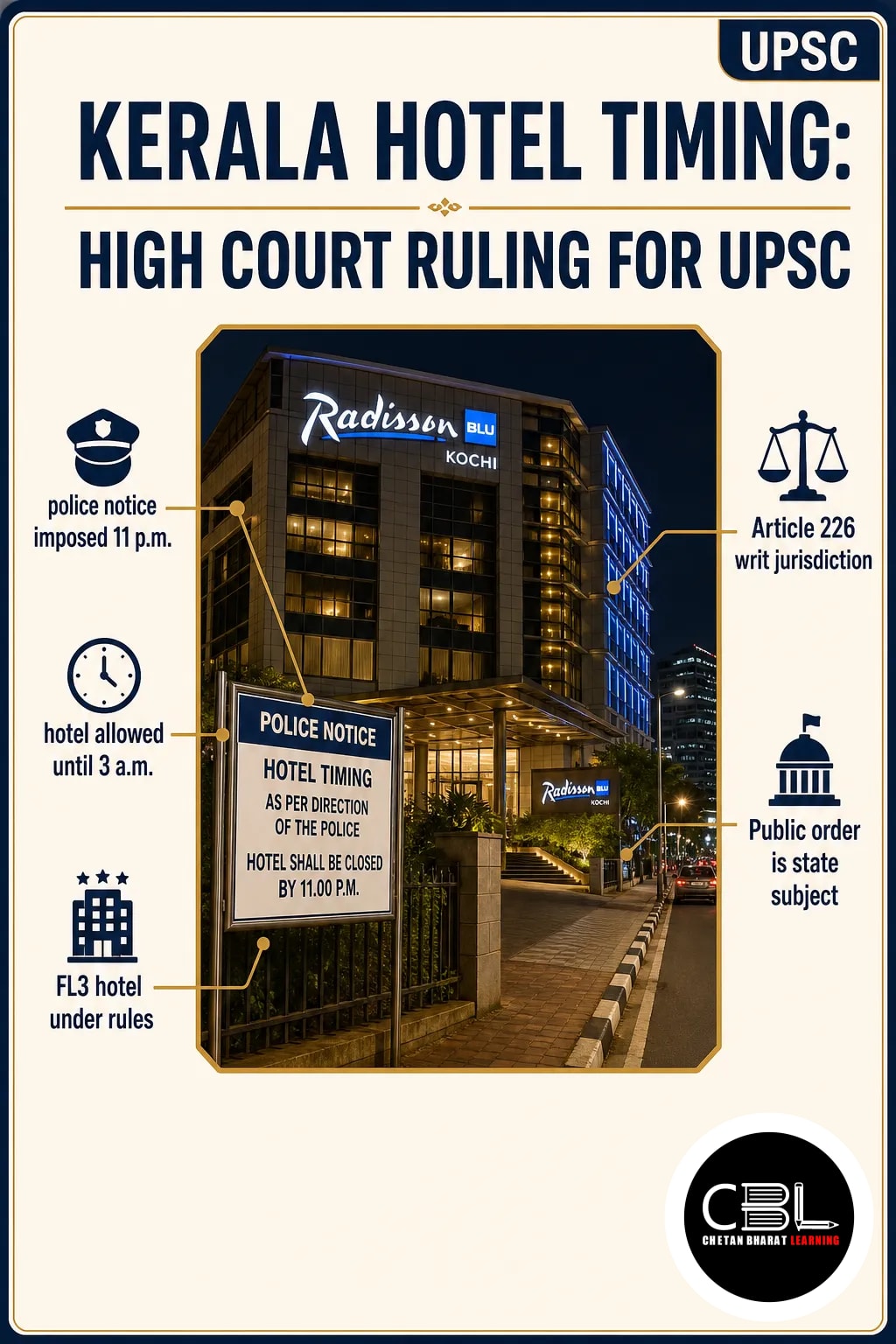
Kerala hotel timing rules came under scrutiny after the High Court set aside a police notice against a Kochi hotel. The decision raises questions about licensing and police powers for polity and governance preparation.
Quick answer: In the Kerala hotel timing case, Justice Murali Purushothaman allowed Radisson Blu, Kochi, to operate until 3 a.m. The court set aside a police notice imposing an 11 p.m. limit, holding that a mere possibility of criminal activity could not justify restricting permitted hours without state regulations curtailing them.
What did the Kerala High Court hold?
The court held that police could not cut the hotel’s operating hours unless the state government issued regulations curtailing them. Justice Murali Purushothaman therefore set aside the notice and allowed the hotel to operate until 3 a.m.
The notice had prohibited hotel operations and disc jockey (DJ) parties after 11 p.m. However, the court held that the mere possibility of criminal activity could not justify restricting the extended hours permitted for an FL3 hotel under the Foreign Liquor Amendment Rules.
The ruling concerns the notice and permission before the court. It should not be read as a blanket exemption from every licensing condition or other applicable law.
What led to the dispute?
Hotel licensee K. Mahadevan challenged the police notice after asserting that the hotel had qualified for extended operation. He said the hotel had met the required criteria, including payment of additional licence fees.
The state, meanwhile, argued that operations and DJ parties until 3 a.m. could disrupt public order. It also contended that the hotel could become a venue for drug-related transactions. The court considered those concerns insufficient to sustain the restriction on the basis presented.
| Issue | Case fact |
|---|---|
| Petitioner | K. Mahadevan, the hotel’s licensee |
| Police notice | No hotel operations or DJ parties after 11 p.m. |
| State’s concern | Public order disruption and potential drug transactions |
| Court’s decision | Notice set aside; hotel allowed to operate until 3 a.m. |
Which legal and constitutional provisions matter?
The case turns on the relationship between state licensing rules and the legal basis for police restrictions. The following constitutional provisions provide a wider syllabus framework; the source does not say that the court decided the case under each of them.
| Provision | Relevance |
|---|---|
| Foreign Liquor Amendment Rules | The court referred to extended operating hours permitted for an FL3 hotel under these rules. |
| Kerala Police Act | The court rejected a restriction under the Act based merely on possible criminal activity. |
| Article 226 | High Courts can issue writs for fundamental rights and other purposes. |
| Article 14 | It guarantees equality before law and equal protection of laws. |
| Seventh Schedule, State List | Public order, police and regulation of intoxicating liquors fall within listed state subjects. |
Article 226 provides a route for judicial review of administrative action. For a related governance theme, see CBL’s discussion of court rulings on security clearance and rights.
What are the governance implications?
The Kerala hotel timing decision illustrates why administrative restrictions need an identifiable legal basis. It also separates a general concern about possible misconduct from justification for curtailing a particular permission.
- Regulatory certainty: Licensees need clarity about permitted hours and the authority empowered to change them.
- Public safety: Police must still address public order and alleged offences through legally authorised measures.
- Accountability: Courts can examine whether an administrative notice exceeds the authority available to its issuer.
- State coordination: Licensing authorities and police need consistent guidance so that operational decisions reflect the applicable rules.
Liquor regulation also involves state policy choices beyond this dispute. For another aspect of state regulation, see the discussion of Tamil Nadu’s bottle-return initiative.
What concerns remain, and what is the way forward?
The central challenge is to protect public order without imposing restrictions unsupported by the applicable legal framework. Longer operating hours can require attention to safety, while businesses and residents need predictable rules.
First, state authorities should clearly specify licence conditions and any permitted changes to operating hours. Second, police should document relevant facts and identify their legal authority before issuing restrictions. Finally, agencies should coordinate enforcement and provide accessible channels for complaints and review.
These are governance recommendations, not additional directions attributed to the court. Thus, the Kerala hotel timing ruling is best understood as a case about lawful administrative action rather than an absence of regulation.
Source: The Hindu, 10 November 2026
- Kerala NHM Contracts: Health Services and UPSC (3 Nov 2026)
Punjab PCS and Haryana HCS may test the division of powers over police, public order and intoxicating liquors. In addition, candidates should connect licensing decisions with judicial review and state-level administrative accountability.
Prelims Practice Corner
Mains Practice Questions
Frequently Asked Questions
What did the Kerala High Court decide about the Kochi hotel?
The court allowed Radisson Blu to operate until 3 a.m. It therefore set aside the police notice imposing an 11 p.m. limit.
Why did the court reject the police restriction?
A mere possibility of criminal activity was insufficient. Moreover, the court said police could not curtail the hours unless the state issued regulations doing so.
Does the ruling remove all restrictions on hotels?
No, the decision concerned the challenged notice and the hotel’s permitted hours. It therefore should not be treated as a blanket exemption from applicable laws or licence conditions.
Who challenged the police notice?
K. Mahadevan, the hotel’s licensee, challenged it. He said the hotel had met the criteria for extended operation, including payment of additional licence fees.
Related Current Affairs
Preparing for UPSC, PCS or HCS?
Talk to a mentor at Chetan Bharat Learning, Chandigarh. Free guidance on choosing the right exam and building a study plan.
Chat on WhatsAppCall 97793 53345UPSC / IAS / PCS coaching in Chandigarh · Trusted by aspirants across Punjab & Haryana









Leave a Reply
You must be logged in to post a comment.