
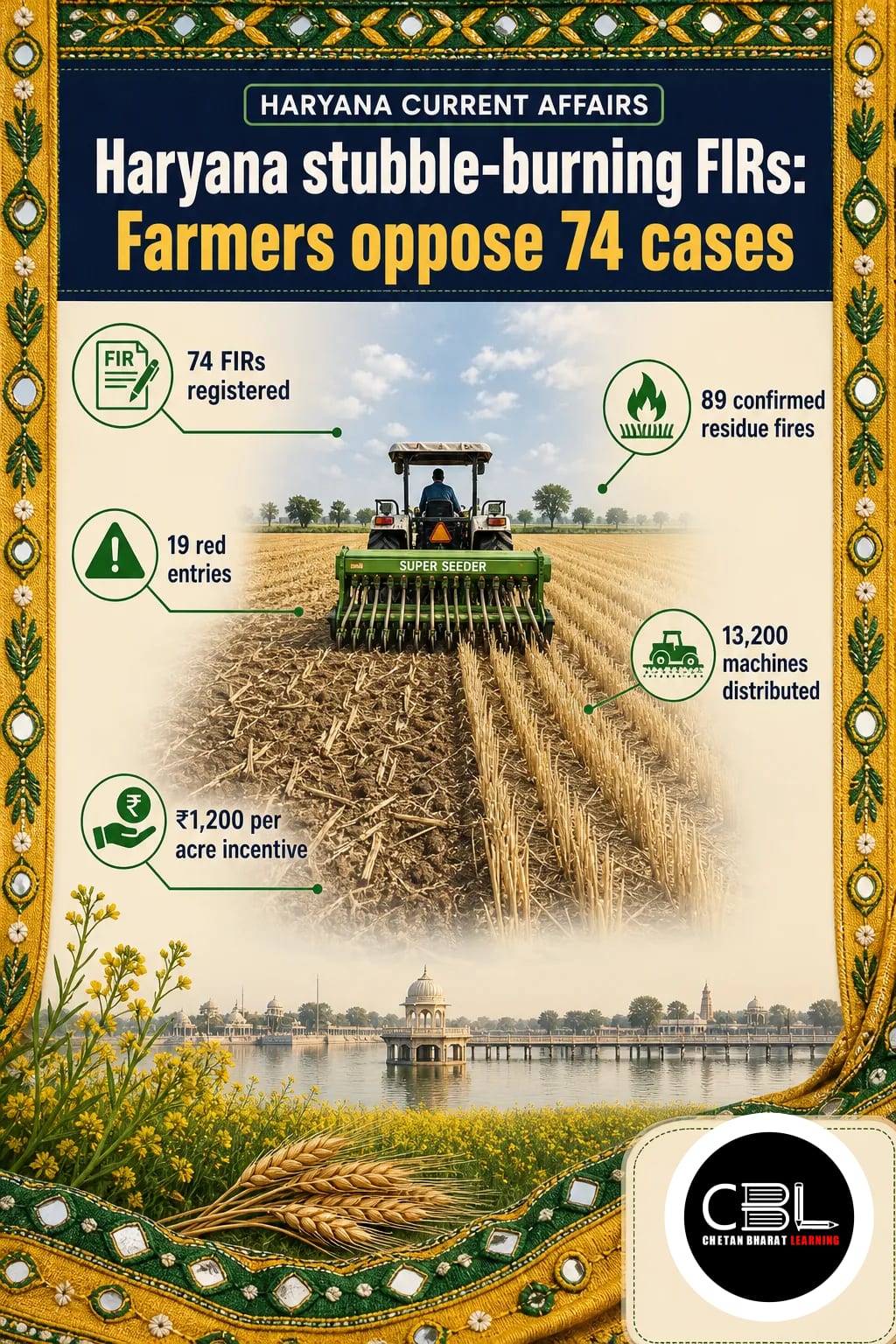
Haryana stubble-burning FIRs (first information reports) have drawn criticism from farmer unions after police registered 74 cases. For Haryana current affairs aspirants, the issue connects crop-residue management with air pollution and revenue records.
Quick answer: Haryana stubble-burning FIRs triggered farmer union opposition in November 2026. Police registered 74 FIRs, while red entries were made in revenue records in 19 cases. An official reported 206 fire incidents across Haryana’s 23 districts, with crop-residue burning confirmed at 89 locations after inspections.
| Point | Details |
|---|---|
| Police action | 74 FIRs registered |
| Revenue records | 19 red entries |
| Inspected locations | 89 confirmed residue fires |
| Machinery | 13,200 machines distributed |
| Government support | ₹1,200 per acre incentive |
Why are farmer unions opposing the FIRs?
Farmer unions want the FIRs and other punitive measures withdrawn. They argue that cultivators should not bear sole responsibility without adequate government support. Instead, they seek machinery, financial assistance and practical alternatives to burning residue.
Bharatiya Kisan Union (Chaduni) president Gurnam Singh Chaduni said small farmers may burn residue when machines are unavailable. Meanwhile, red entries in field revenue records could restrict access to agricultural procurement facilities and government benefits.
What action has Haryana taken?
Police registered the Haryana stubble-burning FIRs against farmers and others allegedly involved in residue burning. Several people were booked under Section 223(b) of the Bharatiya Nyaya Sanhita, 2023, and Section 39 of the Air (Prevention and Control of Pollution) Act, 1981.
Officials also reported ₹3.55 lakh in fines through 62 challans; ₹2.30 lakh had been recovered. In addition, 109 nodal officers received show-cause notices for alleged negligence. The figures on reported fires and confirmed residue burning are separate and should not be treated as identical.
What crop-residue support has the government reported?
The government reported distributing 13,200 agricultural machines, including Super Seeders and Balers. It also said purchase subsidies of up to 50 per cent were available. Farmers adopting crop-residue management practices receive an incentive of ₹1,200 per acre, according to the official.
For monitoring, 79 sensors have been installed in hotspot villages, while 36 drones are being deployed across districts. The government says scientific residue management supports soil fertility and cleaner air.
- State formation: Haryana became a separate state on 1 November 1966.
- Constitution: Article 48A directs the state to protect and improve the environment.
Source: Indian Express Chandigarh, 12 November 2026
Prelims Practice Corner
Frequently Asked Questions
How many stubble-burning FIRs were registered in Haryana?
Haryana Police registered 74 FIRs. Farmer unions have sought their withdrawal.
What do red entries mean for affected farmers?
Red entries could restrict access to agricultural procurement facilities and government benefits. They were made in the revenue records of concerned fields in 19 cases.
What support did Haryana report for crop-residue management?
The government reported machinery subsidies of up to 50 per cent and an incentive of ₹1,200 per acre. It also said 13,200 agricultural machines had been distributed.
Related Current Affairs
Preparing for UPSC, PCS or HCS?
Talk to a mentor at Chetan Bharat Learning, Chandigarh. Free guidance on choosing the right exam and building a study plan.
Chat on WhatsAppCall 97793 53345UPSC / IAS / PCS coaching in Chandigarh · Trusted by aspirants across Punjab & Haryana









Leave a Reply
You must be logged in to post a comment.